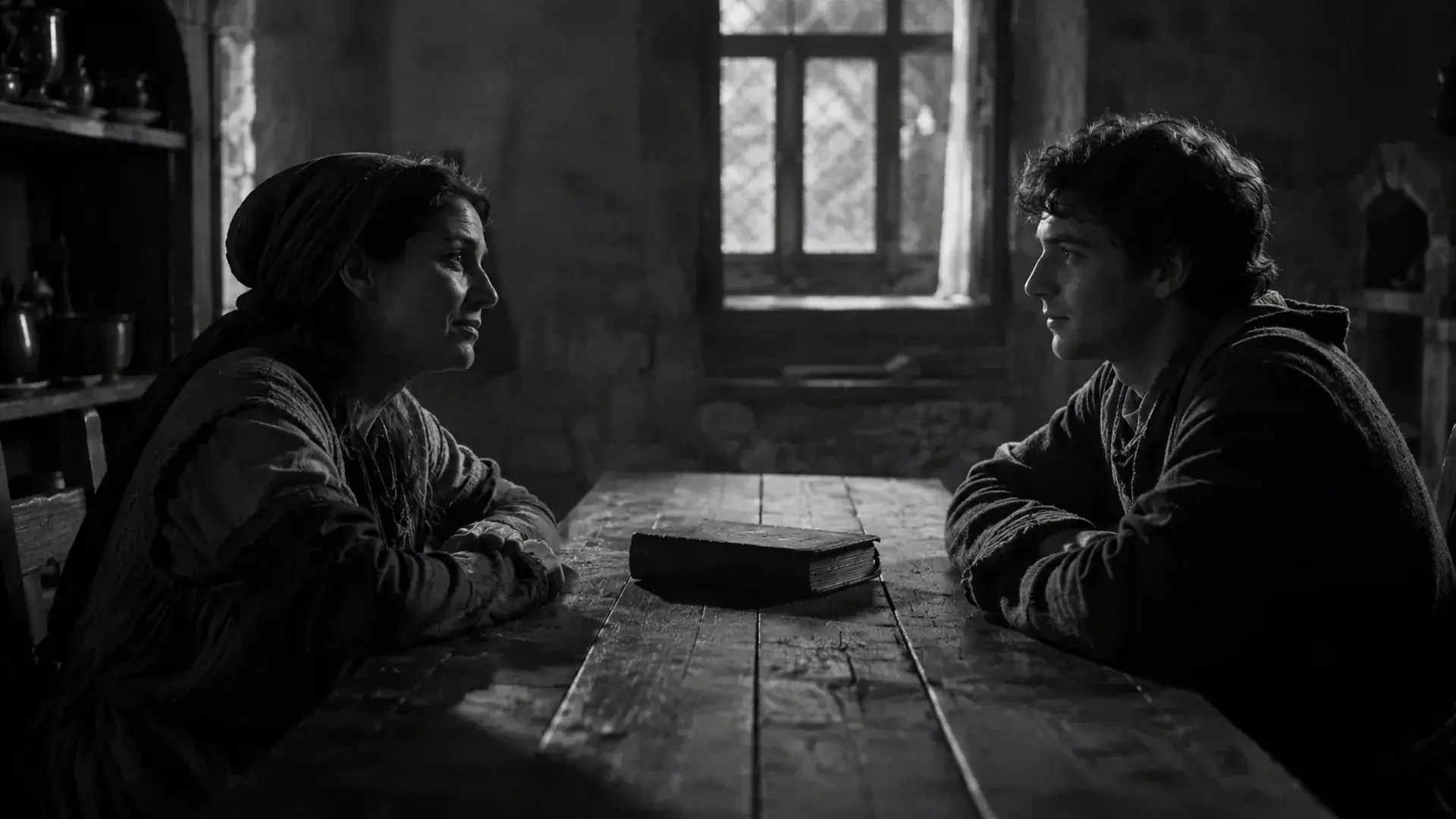
The Wife of Bath’s Philosophy of Power
Analysis by Jimmy — Part 2 of 4
If you read Part 1 of this analysis, you already know the central question: why is she telling us this?
Now we go deeper. Because the Wife of Bath isn’t just telling a story about her marriages. From the very first line of her Prologue, she is making an argument. And the argument is philosophical, even if she would probably laugh at that word.
She opens like this:
“Experience, though all authority
Was lacking in the world, confers on me
The right to speak of marriage, and unfold its woes.”
That’s her opening move. Not “I have read the scriptures.” Not “I have consulted the scholars.” Experience. That’s her credential. That’s her authority. Five husbands, each one a lesson. And no book, no monk, no bishop is going to tell her she’s wrong about what she lived.
A Philosophy Break
Let’s pause here, because what the Wife of Bath is doing in those opening lines has a name — two names, actually — and understanding them deepens everything that follows.
Empiricism is the idea that knowledge comes from sensory experience. Eyes, ears, nose, taste, touch. Everything we truly know about the world arrives through these five senses and stays with us as impressions. David Hume, among others, formalized this thinking centuries after Chaucer. The argument is simple: you can’t reason your way to truth in a vacuum. Truth has to be tested against what you observe, what you live, what you feel.
Jimmy went to the Grand Canyon once with his wife. He had seen photographs for years. And then he saw it. And his first response — the only honest one — was Holy #@!! You know the rest. You cannot get that from a picture.
That is what the Wife of Bath is. She is an empiricist. She has had five husbands. She has felt the weight of marriage, the pleasure of it, the violence of it, the negotiation of it, the grief of it. No scholar can tell her something truer about marriage than what she has already lived. Her belief: “I don’t care what the books say. I know.”
Rationalism — what philosophers like Kant called a priori reasoning, from the Latin meaning “from the earlier” — is the opposite approach. It’s the idea that some knowledge exists before experience, built into the structure of the mind. Logic. Mathematics. Deduction. All men are mortal; Socrates is a man; therefore Socrates is mortal. You don’t need to watch Socrates die to reach that conclusion. You reason your way to it.
The Church’s moral teachings, its positions on marriage, virginity, and womanhood, were largely a priori in this sense. They told people what was supposed to be true — often regardless of real life.
The Wife of Bath rejects this. She is not interested in what should be, could be, would be. She is focused on what is — and what has been. Her marriages trump whatever the Bible says, whatever the scholars argue, whatever the monks preach from behind their walls. She lived it. That’s the end of the discussion.
The Rubber Band
Jimmy uses a rubber band to help you understand power, and there is no better story in classical literature to apply it to than this Prologue.
Take a rubber band. Hold one end. Give someone else the other end. Now start pulling.
If I pull and you let me pull you — who is in control? The answer is not as obvious as it seems. The person being pulled may look like they’re losing. But if they’re choosing to be pulled — if they’re letting it happen, watching, waiting — they are the one in control. The person pulling thinks they’re pulling. They’re not. They are being managed.
Now pull in both directions at once, both sides refusing to give. What happens? The rubber band snaps.
Power in a relationship is not about who wins. It’s about how power is shared, shifted, and ultimately stabilized.
This is exactly what the Wife of Bath demonstrates across five marriages. She lets them pull when it serves her. She pulls when she needs to. She plays the game until the rules no longer work — and then she changes the rules.
The Five Husbands: A Study in Power
She is direct about this — almost shockingly so:
“Now, sirs, I will get onward with my tale.
If ever I hope to drink good wine or ale,
I’m speaking truth: the husbands I have had,
Three of them have been good, and two were bad.
The three were kindly men, and rich, and old.
But they were hardly able to uphold
The statute which had made them fast to me.”
The three good husbands were kind, wealthy, and old. She obtained their wealth and their land. She controlled them through guilt, denial, and relentless verbal skill — and she says so openly. A woman who is wise is never done busily winning love when she has none.
The fourth husband found pleasure elsewhere. She paid him back not with infidelity, she says, but with jealousy so calculated it drove him mad with rage — made him fry in his own grease for spite. And then he died, and while the mourners were carrying his coffin, she noticed the legs and feet of the student Jenkin walking behind the bier.
She was 40. He was 20. And she put her heart completely in his hold.
What She Does with Scripture
Here is where the Wife of Bath becomes genuinely astonishing, and where Chaucer’s audience would have been sitting bolt upright.
She doesn’t just ignore scripture. She uses it. She bends it to her will, turning the Church’s own authority against itself.
Take the story of the Samaritan woman at the well, from the Gospel of John. Jesus speaks with a woman who has had five husbands. He doesn’t condemn her. The Wife of Bath knows this story — and here is what she does with it:
“Beside a well, Jesus, both God and man,
Spoke in reproving the Samaritan —
“Five husbands thou hast had” — this certainly
He said to her — but what he meant, I say,
I’d ask why the fifth was not a husband too.”
She is talking back to Jesus. She is telling the other pilgrims what she would have said to Christ himself — what she thinks the correct interpretation of that passage is, and why it supports her having had five husbands. She is not submitting to scripture. She is cross-examining it.
She does the same with Saint Paul’s words — better to marry than to burn — seizing on his concession about marriage not as a reluctant compromise but as a license to marry as often as she likes. If Paul says marriage is better than lust, then bring on the husbands.
The Rubber Band Snaps
With the fifth husband, Jenkin, everything comes to a head.
Jenkin had a book — a long, miserable collection of stories about wicked women through the ages. Night after night he would read from it, cataloguing the failures and treacheries of women, and she would sit there and listen. He was pulling at the rubber band. She was pulling back.
And then one night she tore three pages from his book and hit him on the cheek.
He hit her back so hard she fell to the floor. She lay still. He thought he had killed her.
“At length I came to, and I gave a cry:
‘You’d kill me for my lands before I die,
False thief!’ I said. ‘I’ll give you a last kiss.'”
He came to her. He knelt down. He begged her forgiveness. And she hit him again.
And then — this is the crucial moment — they reconciled. Truly reconciled. She gave him sovereignty over the household, and he burned the book. They never quarreled again. Each in the power of the other.
That is not a truce. That is an ending to the power game. The rubber band stopped being pulled. What remained was the relationship itself — no longer a battle of wills, but a shared space. Aristotle’s golden mean: not too far in either direction, but a balance that could hold.
The Poster Child for Experience
The Wife of Bath is the medieval poster child for knowledge gained through experience. From the beginning of her Prologue, she refuses to let anyone else’s authority — not the Church’s, not Saint Paul’s, not Christ’s own words — override what she has lived.
Dostoevsky wrote that writers present social types more real than real life itself. Ezra Pound said that art gives us our data for determining what sort of creature man is. The Wife of Bath is exactly that: a character so fully alive on the page that she teaches us something we could never learn from a lecture.
She teaches us that power is not a possession. It is a dynamic. It shifts. It moves. And the person who understands that — who knows when to pull and when to be pulled — is the one who ends up in a relationship worth having.
Continue with Part 3 of the analysis: the language of a woman who will not be quiet — the diction of the Wife of Bath, the Morrison translation, and what the specific passages reveal about Alison’s character.