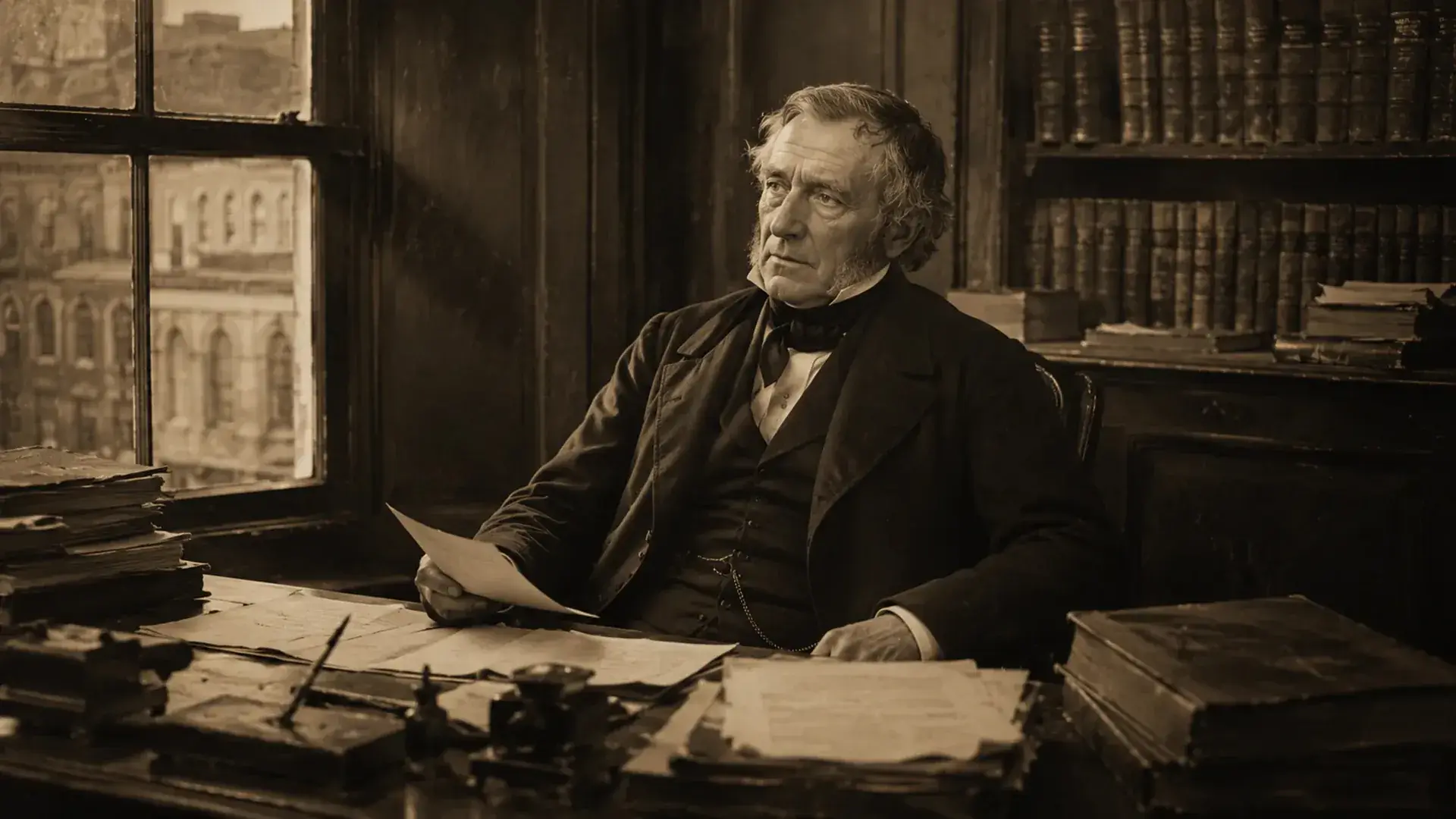
What a strange story, wasn’t it?
Herman Melville’s Bartleby, the Scrivener was first published in two parts in November and December of 1853 in Putnam’s Magazine. It barely registered. It wasn’t rediscovered until the 1920s, and since then it has been read as existentialism, as social protest, as a portrait of alienated labor, as a window into despair. All of those readings find something real in the story. But before we get to what it actually means, there’s a question that most readers skip right past.
Why is this narrator telling us this story at all?
That question is the key to everything in Bartleby – and in any story you read with Jimmy. And to answer it, you have to start with the most important decision: the position of the narrator in the story.
The “I” in the First Sentence
The story opens with a declaration: “I am a rather elderly man.” That single word — I — tells us everything about how we are going to receive this narrative. The lawyer who tells us this story is inside it. He is not an observer standing outside the events. He is a participant, a decision-maker, and — this is the key — a shaper of everything we are allowed to know.
First-person narrators shape what they tell us. They choose what to include, what to omit, what to emphasize, and how to frame it. They can lie to us, consciously or not. They can be self-deceived. They can be telling us one story while revealing another without knowing it. That’s just like anyone you meet in the real world, isn’t it?
We never learn this narrator’s name. He is anonymous. That is not an accident in a story with 14,000 carefully chosen words.
The Narrator Addresses the Reader Directly
What makes this first-person narrator unusual — unusual even among the first-person narrators we encountered in the classical literature we covered — is that he addresses us directly. He uses the word reader.
Early in the story, after a minor commotion involving his staff, he writes: “The reader of nice perceptions will here perceive that…” He is speaking to us. He knows we are here. He is, in some sense, performing for us — selecting what to show us, curating his own account. And that’s why you have to always ask why the narrator is narrating what he narrates: he is trying to shape our perceptions of events, and of himself. It’s only through careful reading that you’ll be able to figure out the truth of things. And that’s no different than real life narrations…and why we read classical literature: to see how other people lead their lives and then how to lead our own!
For example, at the very end of the story, after Bartleby has died, after the space that appears in the physical text of the story (a white silence that’s placed there deliberately), the narrator addresses us again: “But ere parting with the reader, let me say…”
He is parting with us. He brought us in, and now he is letting us go. This is a man who has composed a narrative — not simply remembered one. Don’t forget: he is a lawyer.
The Question That Drives the Analysis
So why is he telling us this? To share an experience? To show us what he learned? To prove something to himself?
These are not rhetorical questions. They are the engine of the entire story. When you read Bartleby with that question in the front of your mind — why is this man telling me this? — the story transforms. The lawyer is not just a passive witness to a strange employee’s decline. He is a man who has been changed by what happened, and who is now, years later, still trying to make sense of it. He realizes, perhaps hesitantly, that he himself is the root cause of what happens to Bartleby.
Jimmy believes the narrator is telling this story because Bartleby changed him. Before Bartleby, he went through scriveners the way you go through office supplies — they were there, they were useful, they had nicknames. Turkey. Nippers. Ginger Nut. But no nickname for Bartleby. No nickname. Think about that.
Bartleby was different. He crept into the narrator’s existence and would not leave — not the office, not the new office after the narrator moved, not the narrator’s conscience. He didn’t bend to the narrator’s will.
That is why the narrator is telling us this story. Not to explain Bartleby. He admits, right in the opening paragraph, that no satisfactory biography of Bartleby is possible. “I believe that no materials exist for a full and satisfactory biography of this man. It is an irreparable loss to literature.”
He cannot explain Bartleby. So he is explaining himself through Bartleby. And in doing so, he reveals far more than he intended.
Stay with us. There are four more posts in this series, and each one goes deeper into this remarkable story.