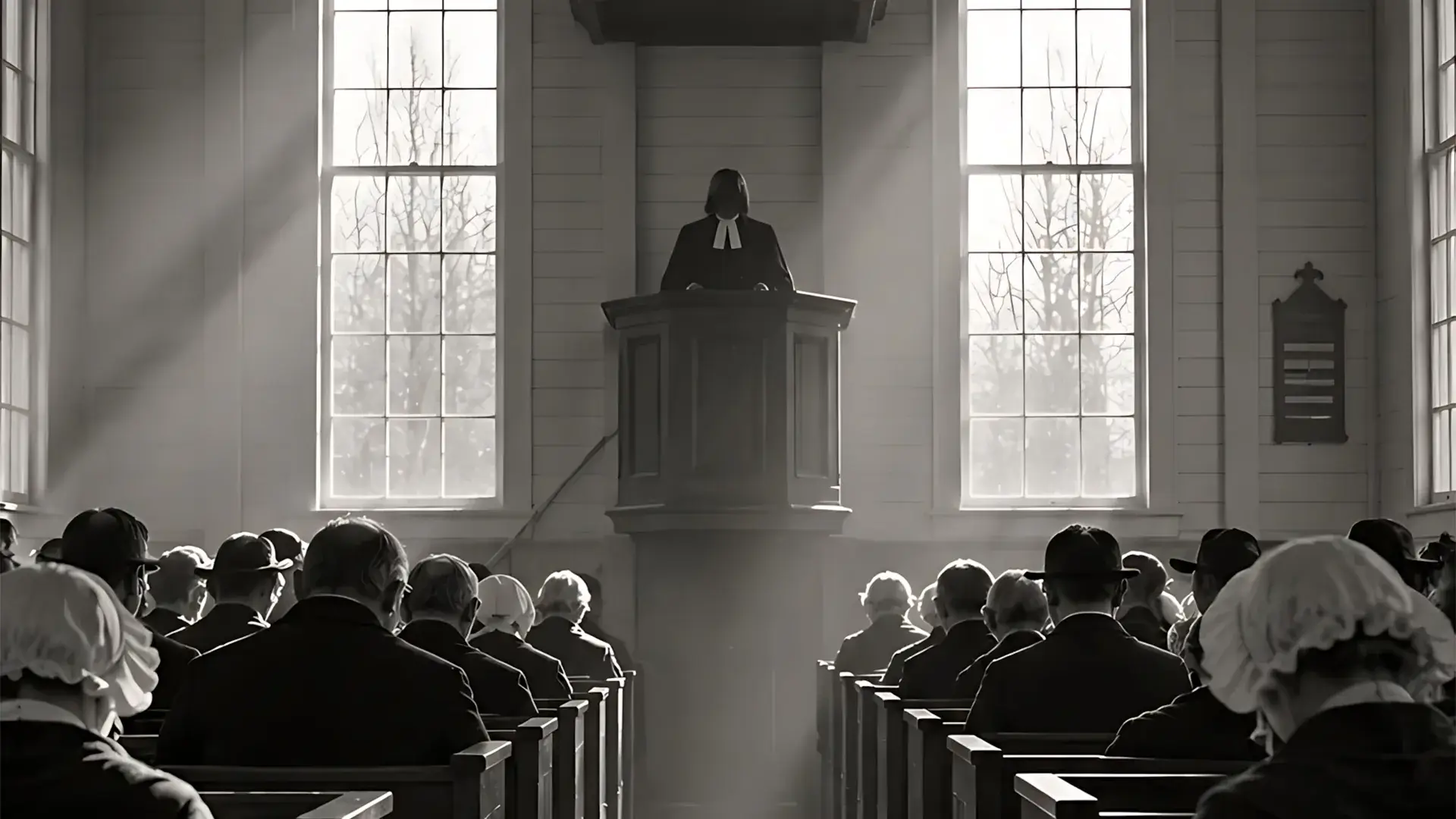
Here’s the strangest fact in The Minister’s Black Veil: nobody asks Hooper why he is wearing that veil. Think about that. From the moment he emerges on that fine morning with the veil covering his face, throughout his life, no one ever asked him: “Why are you doing that?”
Why are people afraid to ask questions? In school we learn, “there is no such things as a dumb question.” But that doesn’t always carry through to when we grow up, does it? If you think about it, people worry that a question will make them look uninformed, or stupid. Do questions do that? Is there such a thing as a dumb question?
Lawyers are taught: “you shouldn’t ask a question you don’t know the answer to.” Unlike real life, where we ask questions to learn new things, a courtroom trial is a highly controlled performance. If a lawyer asks an open-ended question without knowing the answer, they completely lose control of the courtroom narrative. And therein lies the clue: controlling the narrative.
Maybe the people in Hooper’s parish don’t want to know why he has put on that black veil. Because if you ask the question, you might very well get the answer you don’t want.
- Do you love me?
- How much did this cost?
- Are you seeing someone else?
- Did I do something wrong?
- Why are you wearing a black veil?
You can see the obvious can’t you? Asking Hooper would see like an easy question, an obvious question. But no one asks it. What are they afraid of?
Instead, the whole village gets into an uproar. Gossiping women lean from open windows. The tavern keeper tells his guests first thing. Children babble about it on the way to school. Yet the narrator tells us that not one of these busybodies and impertinent people ventured to put the plain question to Hooper. Why are you doing this? What does it mean? Not one of them would say it.
Why?
This is a man who, we’re told, never lacked for advisers when he needed one. People were always telling him what to do and how to do it. Now that he’s done something truly strange, silence. Where’s the courage?
Eventually the village decides it has to do something, so it sends a deputation. Never did an embassy, says the narrator, so ill discharge its duties. Hooper welcomes them with friendly courtesy, then falls silent and lets them introduce the business. They don’t. They just sit there. They shuffle. The topic is obvious enough: it’s the elephant in the room, the issue everyone knows is present and no one wants to discuss, because avoiding it is more comfortable. Everyone in that room is looking at the veil.
I want to call your attention to silence. Used properly, silence is a devastating weapon. The best salespeople know how to wait for a response when an offer is made. Most of the time, we want to fill silence with something. “You know,” is a favorite crutch.
Hooper, however, is prepared to sit there as long as it takes, and the deputation realizes who’s controlling the situation. They finally leave, shrinking from his eye, even though they can’t see his eyes, and report that the matter is too weighty for them. It may require a Council of Churches, maybe a General Synod. In other words, let’s escalate it.
Think about that. All they had to do is ask the simple question: why are you wearing that?
If you’ve seen the movie High Noon, you know this feeling. The town won’t help Gary Cooper face the men who are coming. Nobody wants to be the one. It’s easier to talk about the veil than to talk to the man wearing it.
So what filled the silence? Imagination.
These people had no social media, no television, no radio. They had their imaginations, and those imaginations were powerful. Even now, with all technology around us, our imaginations undercut reality all the time (just think about AI).
At a young woman’s funeral, one person swears the corpse shuddered when Hooper’s veil slipped. Two people swear that the minister and the dead girl’s spirit walked away together, hand in hand. A fable goes around that the stare of the dead drove him from the burial ground. When people don’t understand something, they make things up. It’s what we do. All of us, don’t we?
And then something I always find more unsettling than the fear: they get used to it. The years go by, he never takes the veil off, and the village adjusts. Dostoevsky wrote that man gets used to everything, “the beast.” I know something about that. I once developed fourth nerve palsy in my right eye and started seeing double. Driving down a highway and seeing two white lines instead of one, with no idea which is real, was not fun. But after a few days I got used to it. You get used to everything. It healed on its own. I had a good eye doctor.
So the village got used to Hooper’s veil, and he became a very good, powerful preacher, with strangers coming from miles away to hear him. Do you see what happened?
They never asked the question. They never got the answer. They just adjusted. Maybe like we all do. Some questions are hard to ask. Some are even harder to answer. Read The Minister’s Black Veil with Jimmy, and ask yourself what questions you’ve stopped asking.