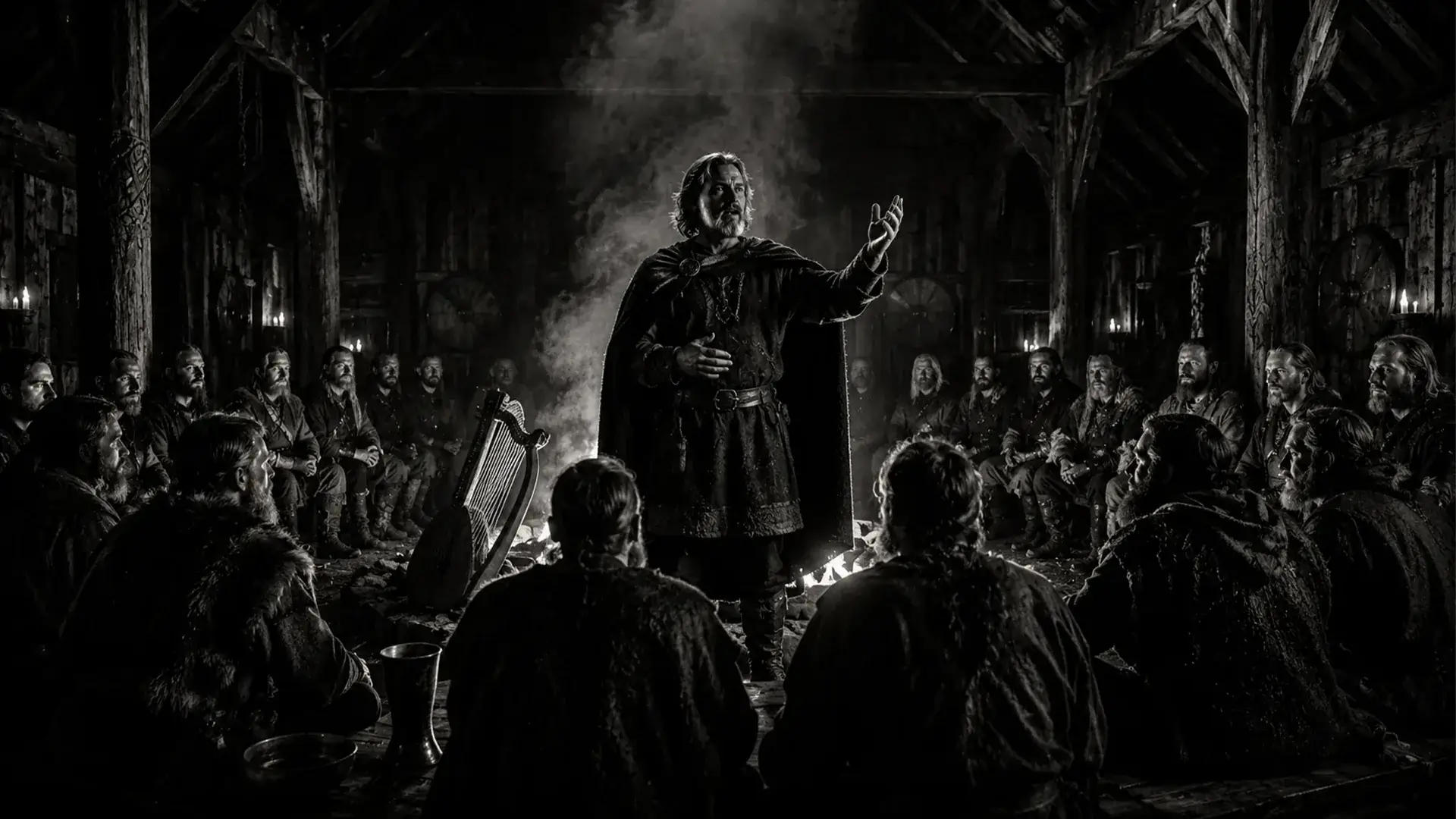
The first words of Beowulf are not a title page or a dedication. They’re a command:
Hear me!
Two words. And they tell you everything about what this poem is and where it came from.
Beowulf was not composed to be read quietly in a chair. It was performed — recited aloud in communal halls by storytellers who were calling the room to attention. “Hear me.” Not “read this.” The poem was born in oral tradition, so the structure, the repetition, the narrator who seems to be everywhere at once — all of it makes sense.
A Narrator Who Is Inside and Outside at Once
Beowulf is a third-person narrated story. The narrator is outside the action, describing characters and events rather than being part of them. But the opening lines confuse this immediately:
Hear me! We’ve heard of Danish heroes, Ancient kings and the glory they cut For themselves, swinging mighty swords!
“Hear me.” That’s first person. “We’ve heard.” First person plural. So you’re wondering, how is this third person? The narrator is using “I” and “we” — doesn’t that put him inside the story?
No. Here’s the distinction: the narrator uses the first person because he is the performer. He’s reciting the poem to an audience — and he is part of that audience, he and all the listeners together are the “we” who have heard these stories. But he is not a character in the events. He never appears in the Mead Hall, he never fights Grendel, he’s never in Geatland. He’s outside the story, calling everyone to listen.
You could begin ANY third-person narrator story with these words, “Hear me!” Any. For example, The Most Dangerous Game begins: “’Off there to the right—somewhere—is a large island,’ said Whitney. This is third-person narration. Insert “Hear Me!” in front of it and nothing changes.
Or try To Build a Fire which begins: “Day had broken cold and gray, exceedingly cold and gray, when the man turned aside from the main Yukon trail and climbed the high earth-bank, where a dim and little-travelled trail led eastward through the fat spruce timberland.” Insert “Hear me!” in front of that and nothing changes.
Beowulf is one of the rare occasions in literature where a third-person narrator sounds like a first-person narrator — and the reason is oral tradition.
What Is Oral Tradition?
Oral tradition describes a time and culture in which stories, histories, laws, and customs were preserved and passed down through the spoken word rather than the written one. Most people in Beowulf’s era couldn’t read. Writing was a rare skill belonging mostly to monks and the wealthy. So the primary way a community remembered who it was — its heritage, its heroes, its moral code — was through storytelling.
The basic tools of oral tradition are storytelling, poetry, songs, and chants. And all of them depend entirely on the memory and skill of the person performing them. Imagine trying to recite all of Beowulf from memory. It’s over three thousand lines. No notes. No teleprompter. Just your memory, the firelight, and the room.
To make that possible, oral tradition developed specific techniques:
Repetition and Formula Language. Phrases and images recur throughout the poem — “ring-giver” appears again and again as a way of describing a king who rewards his warriors. This repetition isn’t laziness; it’s the architecture of language. It anchors memory, creates rhythm, and gives the recitation a musical quality.
Variation. Every retelling was slightly different. In Beowulf, the story of how Beowulf killed Grendel is told at least three times — and each time it’s told, it shifts slightly. The killing is the anchor, but the details move. That’s oral tradition at work: fluid, adaptive, alive.
Think about Genesis, the story of God creating humans. How God actually made man is told twice in the beginning chapters, once as an overview, and the second time in more detail. It actually happens more than you might think in these stories.
Community. Oral tradition is a communal event, not a private one. The Mead Hall was the original streaming service — warriors gathered around fire, the harp playing, the court poet singing stories that everyone knew. Raffel captures one of these scenes beautifully:
Hrothgar’s hall resounded with the harp’s High call, with songs and laughter and the telling Of tales, stories sung by the court Poet as the joyful Danes drank And listened, seated along their mead-benches.
Use your imagination when you read that. Put yourself in the hall. Feel the warmth, hear the harp. That’s what this poem was.
How the Poem Became a Text
At some point, probably between the 8th and 11th centuries, a monk sat down and wrote Beowulf out. Monks were among the few people in that era who could read and write. Jimmy’s theory — and it’s a well-supported one — is that a monk heard this story being passed through oral tradition, perhaps from a traveling storyteller, and decided to transcribe it.
But here’s the critical thing: by the time that monk picked up his pen, Beowulf had already been evolving for generations through the oral tradition. Every retelling added something, shifted something, dropped something. And when a Christian monk was the one writing it down — a man who believed in one God, not the Norse gods like Odin and Thor — the Christianity he lived and breathed seeped into the text.
That’s not a scandal. That’s how oral tradition works. The story evolved. And we’ll examine exactly what the monk added — and what it means — in a later post.
Why Your Imagination Matters More Than Any Movie
There have been Beowulf movies. Jimmy watched five minutes of one and turned it off. They changed the story in ways that were, to put it diplomatically, unfortunate. Grendel wasn’t a monster — he was “just a hairy guy.” The whole thing had been reinterpreted into something else entirely.
This is what oral tradition was protecting against. When the words are doing the work, the listener’s imagination fills in everything: what Grendel looks like, how Heorot smells at night, what Beowulf’s face looks like when he grabs the monster’s arm. Netflix gives you someone else’s interpretation and calls it the story. The poem gives you the materials and trusts you to build the vision yourself.
If you’ve been watching more than you’ve been reading lately, Beowulf is the cure. Use your imagination. Jimmy promises it’s still working.
Next post: The Language That Paints Without Brushes — Raffel’s translation choices, the burden of a single word, and why the hyphenated compounds of Beowulf are doing more work than they appear to be.