When something goes wrong — in a factory, in a business, in a life — the first instinct is to identify what happened. The second, harder instinct is to ask what caused it. Root cause analysis. You keep asking why until you get to the thing that set everything else in motion. The thing that, if it had been different, would have made all the subsequent damage impossible.
In Hamlet, that thing is the ghost.
Remove the ghost and there is no play. Not a different play. No play. Hamlet is sad about his father’s death and his mother’s remarriage — that’s Act One Scene Two and it goes nowhere without the ghost. Claudius sits on the throne and rules Denmark. Hamlet goes back to Wittenberg. Ophelia and Laertes live their lives. Everyone is unhappy in ordinary ways.
The ghost appears and every one of them is dead within five acts.
Fear is the element of Hamlet that most readers underestimate because the play is so densely intellectual. All that word fencing. All that philosophy. To be or not to be. The readiness is all. It’s easy to get lost in the language and forget that the play begins with armed soldiers standing in the dark, terrified of something they cannot explain.
That’s where Shakespeare starts. Not with Hamlet’s grief. Not with Claudius’s guilt. With fear.
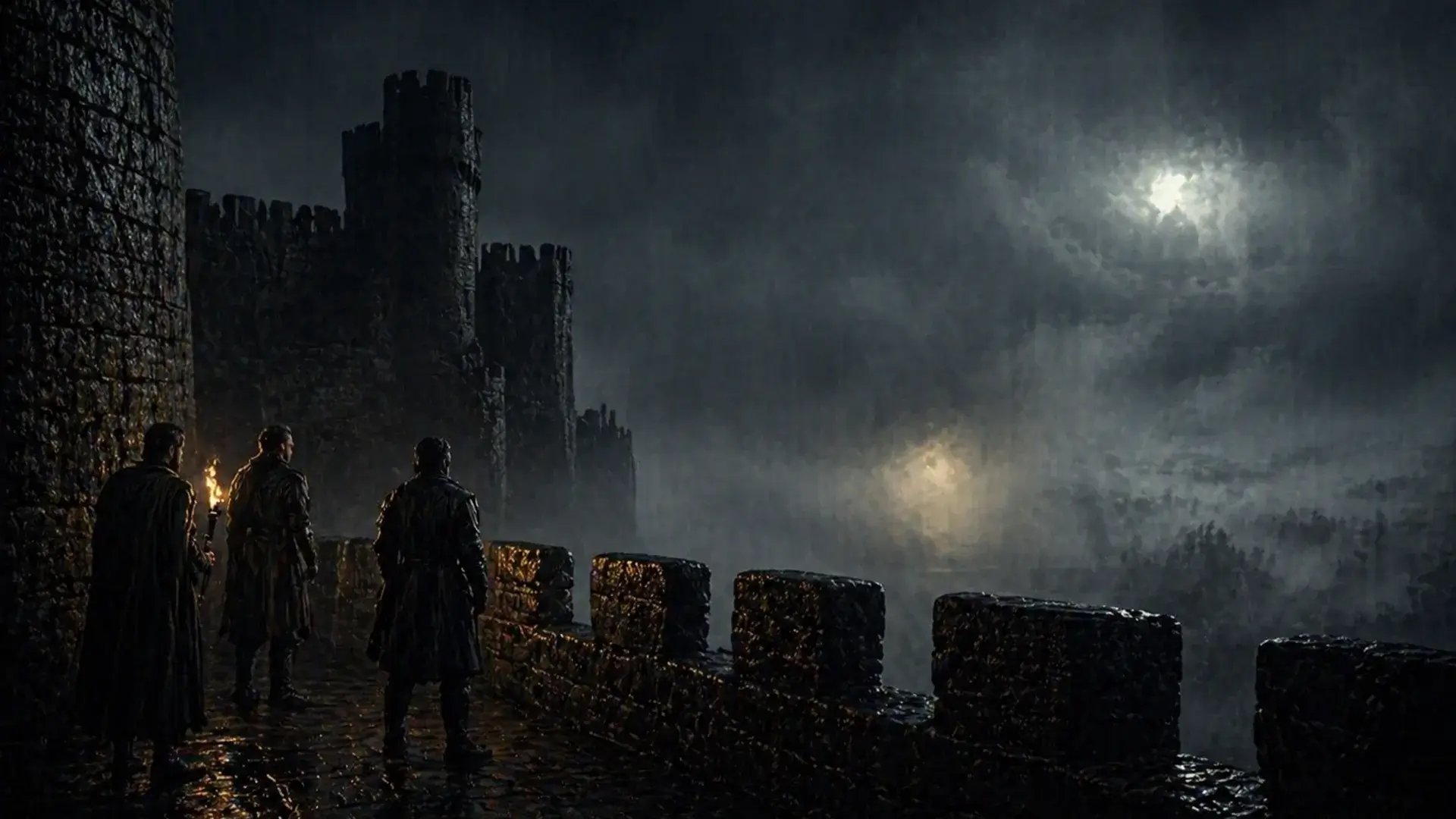
Three soldiers and a scholar on a battlements. Something appears that should not exist. Horatio — who came specifically because he didn’t believe the soldiers’ report, who is by his own description a skeptic — sees it and loses his certainty in an instant. It harrows me with fear and wonder.
A man who came to disprove something is the first one to confirm it. That’s not an accident. Shakespeare is establishing something before the ghost says a single word to Hamlet. He is establishing that what is coming cannot be dismissed. It has already broken through the defenses of the most rational mind in the room.
Jimmy has thought about fear in classical literature for a long time. Not the fear of ghosts specifically — the fear of what cannot be explained by the tools you have.
Horatio is a scholar. His tools are reason, evidence, the framework of the known world. The ghost doesn’t fit any of those categories. It’s real — he can see it, hear it, the soldiers can see it and hear it — and it is simultaneously impossible within the framework he has spent his education building. That’s a specific kind of fear that has nothing to do with cowardice. It’s the fear of having your understanding of reality revised without your consent.
Hamlet feels it too. But where Horatio’s fear produces wonder, Hamlet’s produces obligation. The ghost doesn’t just appear to him. It speaks to him. It gives him a task. And from that moment forward Hamlet is afraid not of the ghost but of what knowing the truth requires him to do with it.
That’s the fear that runs through the rest of the play. Not the fear of death — Hamlet addresses that directly in the To Be or Not To Be speech and concludes that death itself isn’t the problem. The problem is what comes after. The undiscovered country. The dream in the sleep of death. He’s afraid not of dying but of the unknown that dying opens onto.
Conscience makes cowards of us all. That’s not a statement about weakness. It’s a statement about what happens when a person with genuine moral awareness confronts an action that cannot be undone. The fear isn’t irrational. It’s the only rational response to the weight of what he’s been asked to carry.
Now trace every death in the play back to its root cause.
Polonius. He’s in the Queen’s chamber because he believes Hamlet is mad from unrequited love and wants to prove his theory to the King. He believes this because the ghost’s appearance changed Hamlet’s behavior toward Ophelia. Without the ghost, Hamlet’s behavior doesn’t change. Polonius has no theory to prove. He’s not behind the curtain. He doesn’t die.
Ophelia. She loses her mind because her father is killed by the man she loved, who has been acting mad since the ghost appeared, who told her he never loved her as part of a strategy he adopted because the ghost gave him a mission that left no room for love. Without the ghost, Hamlet has no mission. Ophelia has no reason to unravel. She doesn’t drown.
Rosencrantz and Guildenstern. They carry sealed orders for Hamlet’s execution because Claudius needs Hamlet dead because Hamlet knows what Claudius did because the ghost told him. Without the ghost, Hamlet knows nothing. Claudius has no reason to eliminate him. Rosencrantz and Guildenstern carry no dangerous letters. They don’t die.
Laertes. His father is dead because of a chain of events the ghost set in motion. Claudius plays his grief into a murder plot that ends with a poisoned blade in both their hands. Without the ghost, the chain doesn’t exist. Laertes goes back to France. He doesn’t die.
Gertrude. She drinks from a cup her husband prepared for her son because her son came back to Denmark to finish what the ghost started. Without the ghost, her son is in Wittenberg. The cup is never poured. She doesn’t die.
Claudius. Hamlet kills him in the final scene with the poisoned blade and the poisoned cup — the very instruments Claudius prepared for Hamlet. It is, in the most precise sense, his own guilt returning to him. But Hamlet only knows the guilt exists because the ghost told him. Without the ghost, Claudius rules Denmark until he dies in his bed.
Hamlet. He is poisoned by the blade Laertes wounds him with in the fencing match — a match arranged to kill him because of everything the ghost set in motion. Without the ghost, there is no match. There is no poison. He doesn’t die.
Every death. Root cause: the ghost.
This is what makes the ghost the most important character in the play despite appearing in only a handful of scenes.
He doesn’t drive the plot the way Claudius does — scheming, manipulating, reacting. He sets a single thing in motion and then withdraws. He appears once to deliver his testimony. He appears again briefly in the bedroom scene to redirect Hamlet’s fury away from Gertrude. And then he’s gone. The play finishes without him.
But everything that happens after his first appearance is a consequence of that appearance. He is the stone dropped in still water. Every death is a ripple.
The most frightening thing is not the monster. It’s the obligation the monster creates. Hamlet isn’t afraid of the ghost. He’s afraid of what the ghost has made him responsible for. He now knows something true and terrible that no one else knows — except Horatio, who he swears to secrecy — and that knowledge comes with a demand he cannot refuse and cannot safely fulfill.
That’s the fear that doesn’t go away when the ghost disappears. It stays with Hamlet through every act, in every scene, in every word fencing exchange with every character who is trying to figure out what is wrong with him. He’s carrying something no one else can see — like the ghost itself — and it is slowly organizing everything around him toward a conclusion he can’t stop and couldn’t have prevented from the moment he said I’ll speak to it though hell itself should gape.
He said yes to the ghost. Everything after that was already written.
Jimmy said something in the Act Five analysis that is worth ending on.
He said that one of the things classical literature taught him about business is that timing is everything. That sometimes the timing of an action is more important than the action itself. Hamlet knew what he had to do. He had the right information. He had the motive, the means, the opportunity. What he didn’t have — what the ghost couldn’t give him — was the right moment.
Or maybe the ghost gave him exactly that and Hamlet kept finding reasons to let it pass.
Either way the readiness is all. And Hamlet was ready too late for everyone except Claudius — who at least finally answered for what he did, even if it cost every living person in the room to make it happen.
That’s not a tragedy about indecision. That’s a tragedy about what one act of evil — one brother killing another in a garden — costs everyone downstream who had nothing to do with it and no way to stop it once it was set in motion.
The ghost didn’t create the evil. He just made sure it couldn’t stay buried.
This is the fourth and final post in the Hamlet series at ReadingWithJimmy.com.