We know Hauchecorne is innocent. The third person narrator told us in the first paragraphs of the story. We have examined the plot structure that Maupassant built — the two recognitions, the beginning and middle and end, the logical sequence that flows from a single piece of string.
What remains is the question of what this story is actually saying. Not what happens. What it means. And what it is asking us as readers to take away from Hauchecorne’s death.
Three themes run through The Piece of String: truth, character, and obsession. We have covered truth and character. Obsession is where the story lands.
The Truth That Could Not Be Proved
What is the truth in this story? We know it because the narrator told us: Hauchecorne picked up a piece of string. The wallet was found by a farm laborer who could not read, and returned to its owner by his employer. No harm was done. No one profited from any theft. The whole episode was, on its face, resolved.
And yet.
What we cannot know, and what the story deliberately refuses to resolve, is whether Malandain lied or believed what he said. The mayor trusted him. The townspeople trusted the interpretation. And when the wallet came back, they trusted the interpretation again, only with a new layer added: Hauchecorne had arranged the return through an accomplice. His exoneration was reread as further evidence of his guilt.
The truth, in this story, is a private possession. Hauchecorne carries it. The narrator confirms it. Everyone else operates on reputation and inference. That gap — between what is true and what is believed — is the engine of the story. And it is a gap that never closes.
Have you ever been accused of something you did not do? Have you insisted on your innocence past the point where anyone was still listening? Then you already understand the emotional layers of this story before the analysis starts.
What Obsession Actually Is
Jimmy defines obsession as not knowing when enough is enough.
William Blake, the English poet, said it this way: “You never know what is enough, until you know what is more than enough.” It is a dangerous definition because it implies you have to cross the line to locate it. But the wisdom in it is real: the person who is truly obsessed does not know they are obsessed. They experience their obsession as justified persistence, as the natural continuation of reasonable effort. There is no internal alarm.
Hauchecorne does not decide to be obsessed. He decides to keep telling the truth. Those two things look identical from the inside. From the outside, after a point, they are indistinguishable.
He tells everyone he meets. He explains the string. He produces the string. He connects the geography, the timing, the quarrel with Malandain. He builds the case over and over and over, to an audience that stopped evaluating the evidence long before he stopped presenting it.
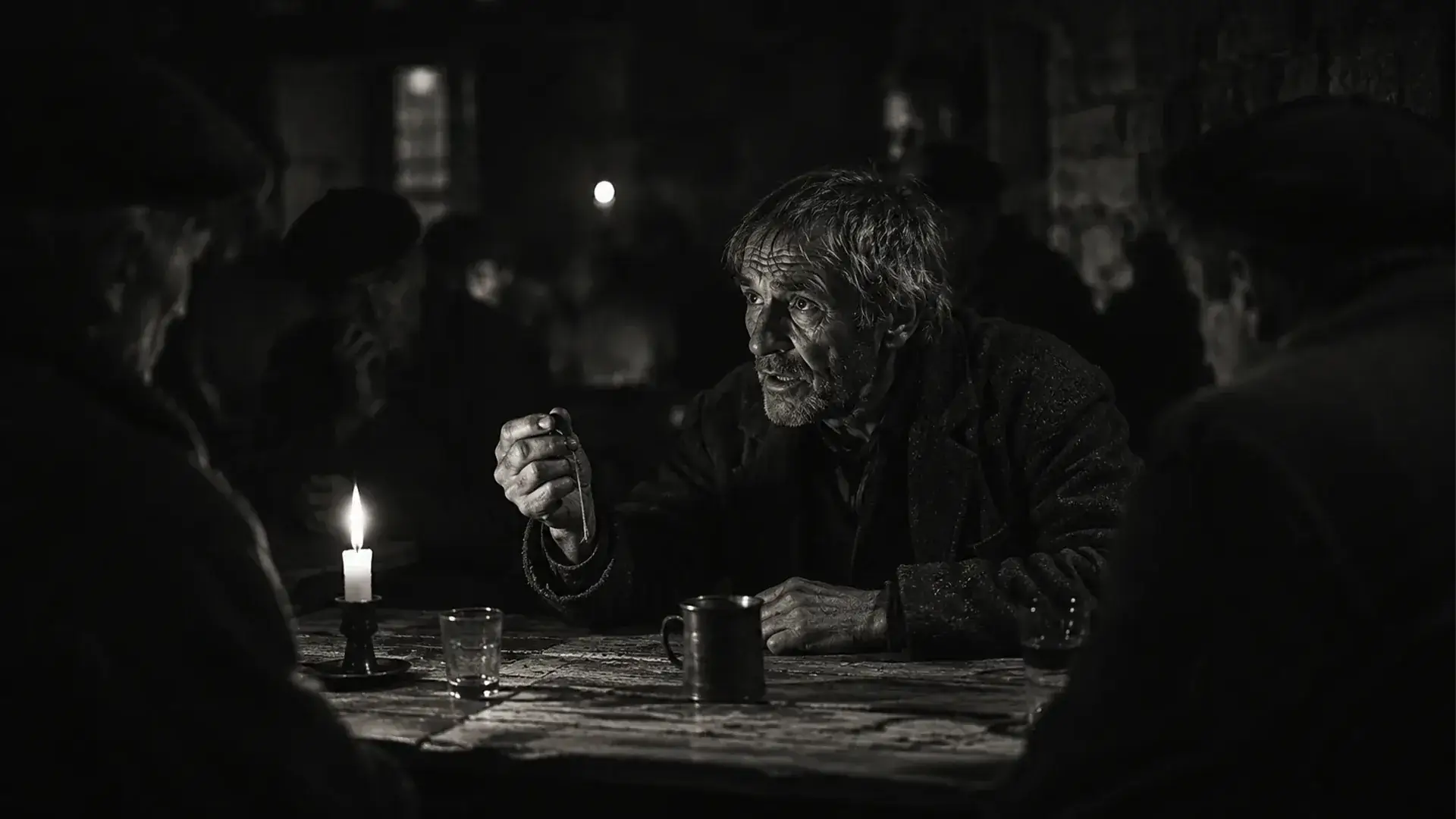
“…protesting his innocence, repeating over and over again: ‘A bit of string … a little bit of string … look, Mayor, here it is …’”
He dies in that repetition. Not from the accusation. From the inability to stop responding to it.
When Obsession Is a Tool and When It Is a Trap
Obsession is not always destructive. Michael Jordan shot a thousand free throws a day. That is obsession as engine — a relentless focus that produces mastery. The difference between productive obsession and destructive obsession is control. Does your obsession serve you, or have you become its servant?
Hauchecorne’s obsession does not serve him. It does not clear his name. It does not change anyone’s mind. It does not produce anything except a record of his own suffering. He cannot stop because he cannot accept that the effort is producing no result. And he cannot accept that because accepting it would mean accepting that the truth, in this case, has no power.
That is the hardest thing The Piece of String asks you to consider. The truth existed. The narrator confirmed it. But it did not matter. Not in Goderville. Not among people who had already decided what kind of man Hauchecorne was.
Ahab and Hauchecorne
One of the most famous stories of obsession in the classical canon is Moby Dick, told through the first person narrator Ishmael — which is why it opens with one of the most recognized lines in literature: Call me Ishmael. We see everything through his eyes.
Captain Ahab hunts a white whale that took his leg at the knee. His obsession is understood by everyone around him, named by some of them, and ignored by all of them in the end, because the ship follows where Ahab leads. His obsession has external victims. It pulls the crew with it.
Hauchecorne’s obsession has only one victim. It turns entirely inward. He does not drag anyone else down — he simply cannot stop, cannot redirect, cannot absorb the loss and go on. The whale took Ahab’s leg. Malandain’s accusation took Hauchecorne’s reason to live. In both cases, the obsession is more lethal than the original wound.
You Are Your Own Third Person Narrator
Here is the philosophical point that The Piece of String delivers at its close, and it is worth stating directly.
In life, we do not have third person narrators. We are all first person narrators in the story of our own experience — which means we are subject to all the distortions and limitations of that point of view. We cannot step outside the scene and report with omniscient accuracy.
Except to ourselves. To yourself, you are your own third person narrator. You know what you picked up. You know what you did and what you did not do. You know the string from the wallet.
The question this story poses is not whether you know the truth. Hauchecorne knew the truth. The question is what you do with that knowledge when the world around you refuses to accept it. Do you keep insisting until it kills you? Or do you find a way to carry the truth without being consumed by it?
Socrates said: know thyself. That is not a passive instruction. Knowing yourself means knowing your truth clearly enough that other people’s refusal to accept it does not become your sentence.
The Golden Mean and the Lesson Hauchecorne Could Not Learn
Aristotle’s concept of the golden mean — developed primarily in his Nicomachean Ethics — holds that virtue is the balanced middle ground between deficiency and excess. Too much courage is recklessness. Too little is cowardice. The virtuous person acts in proportion to the situation.
Applied to Hauchecorne: the truth deserved to be stated once. Clearly. With the evidence. Then perhaps again. But at some point, the proportionate response to a false accusation is to live your life. The golden mean would have been to state the truth and then let it exist in the world without requiring constant reinforcement.
Hauchecorne could not find that mean. His insistence went to excess. And the excess killed him — not because the excess was wrong in principle, but because it consumed him entirely. He became the accusation. It was the only thing he was, by the end.
This is the Aristotelian lesson encoded in the story: obsession is a virtue — the virtue of persistence, of caring about the truth — taken past its functional range. A man who cared nothing for his reputation would not have been obsessed. It was his self-respect, turned toxic by repetition, that did the damage.
What Aristotle Calls ‘Thought’
In Aristotle’s framework, “thought” is the element of tragedy that carries the deeper meaning — the idea the audience is meant to contemplate after the story ends. It is not stated outright. It lives in the plot.
The thought in The Piece of String is this: your character is not just what you do. It is what people believe you are capable of doing. And once that belief is established, it does not yield to evidence. It yields, if at all, only to time and to the deliberate, sustained work of acting differently. Read Too Early Spring on this website, which is a similar thought but told in first-person narration.
Hauchecorne did not understand, until it was too late, that the most dangerous thing his duplicity had produced was not any particular trick. It was a framework through which everything he did, including telling the truth, was interpreted as “just another trick.”
A Final Word from Jimmy
Read The Piece of String again after you finish this analysis. Read it in the original French if you can, or in Roger Colet’s translation, which is the version I use. Read the opening road scene and feel what the narrator is doing with that language. Read Hauchecorne bending down, hiding the string, pretending to look for something else. Watch Malandain watching him.
Then ask yourself: do you know anyone like Hauchecorne? Have you ever been Hauchecorne? Have you ever been so certain of your own innocence that you could not stop proving it, even when everyone had stopped listening?
This is what classical literature does. It gives you characters more real than the people you meet in daily life, as Dostoevsky said — because in classical literature, the third-person narrator tells you the truth. You know what they picked up. You know what they did. You know what it cost them.
That knowledge is why we read.
Questions or thoughts? Write to Jimmy at [email protected]