Here is a question to ask to begin our analysis:
If no one believes you, does that make you a liar?
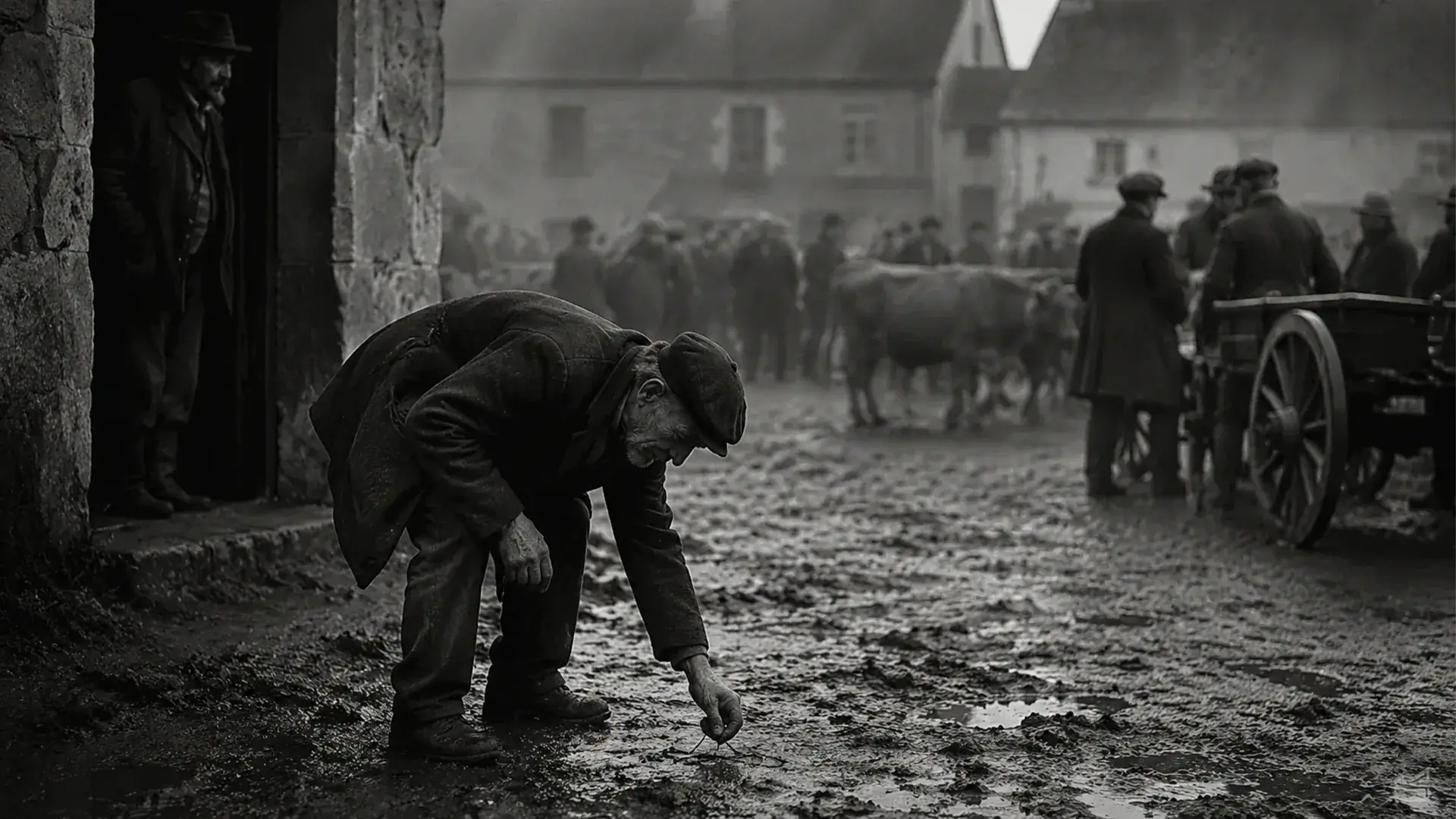
Maitre Hauchecorne of Breauté picks up a piece of string. He did not steal a wallet. He was not duplicitous in this particular instance. He was simply a thrifty Norman farmer who spotted something on the ground and put it in his pocket. What followed — his interrogation by the mayor, his humiliation in the market square, his obsessive repetition of the truth to anyone who would listen, and finally his death — is one of the most devastating short stories you’ll read.
But before we talk about what happens, we need to talk about who is telling all this to us. Because in The Piece of String, narration is not just a technical detail I usually discuss. It is the core of the story this time.
Why Jimmy Starts With the Narrator Instead of the Plot
If you have read with me before, you know I rarely give away the meaning of a story right at the beginning. Working toward meaning through the language and the evidence is the whole point of my approach. But in this case, I am making an exception — and I will explain why.
The key to The Piece of String is a single passage from near the middle of the story. After Hauchecorne realizes he is being accused not just of stealing the wallet, but of arranging for an accomplice to return it, the third-person narrator tells us this:
“He returned home ashamed and indignant, choking with anger and embarrassment, all the more upset in that he was quite capable, with his Norman cunning, of doing what he was accused of having done, and even of boasting of it as a clever trick. He dimly realized that, since his duplicity was widely known, it was impossible to prove his innocence.”
That word — duplicity — is the key. Deceitfulness. Double-dealing. Hauchecorne was known as a rascal and a clever operator. When a man like that gets accused of a clever operation, he finds that his own reputation has become a trap. Knowing this upfront allows us to read every subsequent event as a truth — truth that could only come from 3rd Person Narration.
What Third Person Narration Actually Means
The Piece of String is told in the third person. That means the narrator is outside the story entirely — omniscient, hovering over the scene, moving in and out of characters and locations, telling us what he wants us to know.
In classical literature, the third person narrator cannot lie. This is not a convention to be argued around. It is the foundational rule of the form. If the third person narrator tells us Hauchecorne picked up a piece of string, then he picked up a piece of string. Full stop. If you reject that, the story disintegrates. Nothing that follows will make sense.
I receive emails from readers who believe Hauchecorne actually stole the wallet. I understand the instinct — he is, after all, described as a double-dealer, and the circumstantial story is suggestive. But there is no evidence in the text. None. You can read it five times and you will not find a single word from the third person narrator that supports that reading. What you will find is the narrator telling us, plainly, what Hauchecorne picked up.
The beauty of classical literature is this: unlike life, we can go back and examine the evidence. Recordings can be altered. Memories are unreliable. But the third person narrator of a classical text is a fixed and permanent record. It cannot be changed.
The Moment Malandain Changes Everything
Now consider what the narrator has constructed. Hauchecorne, known throughout the region as a cunning man, bends down to pick up a piece of string. He notices Maitre Malandain — a saddler with whom he has a standing grudge over a halter — watching him from his doorway. He feels ashamed at being seen by an enemy picking something trivial out of the mud. So he hides it. Then he pretends to keep looking for something on the ground.
The narrator tells us this. We believe it – we have to. But understand what it looks like from outside: a man with a reputation for cleverness, bending and hiding and pretending. On a day when a wallet goes missing.
Malandain goes to the mayor. The mayor calls in Hauchecorne. And the mayor says something to Hauchecorne that reveals exactly how first-person testimony inside a story can be wrong even when the speaker is sincere:
“You’ll never persuade me, Maitre Hauchecorne, that Monsieur Malandain, who is a man who can be trusted, mistook that piece of string for a wallet.”
The mayor is a character inside the story. He is not the narrator. His assessment of Malandain as “a man to be trusted” carries no authoritative weight. The third person narrator never says Malandain is trustworthy. The mayor can be wrong. The narrator cannot.
What This Story Would Look Like Told Another Way
Here is an experiment that crystallizes why position of the narrator matters so much.
Imagine The Piece of String rewritten from Malandain’s first-person point of view. He tells us he saw Hauchecorne pick up the wallet. He is certain of it. He went to the mayor. He watched Hauchecorne squirm. He laughed when Hauchecorne walked by after the wallet was found. He got his satisfaction.
In that version, you would not know whether Malandain is lying. You would have no third person narrator to set the record straight. You would be left with competing claims, and the clever Hauchecorne would have every appearance of guilt.
That is the entire point. The story— with its omniscient narrator — is a story about a man we know is innocent but cannot prove it. Change the narrator and you change everything. You no longer have a tragedy about the cruelty of reputation. You have an ambiguous dispute between two Norman farmers, and Hauchecorne’s death means something entirely different.
This is why Jimmy talks about narration in every analysis. It is not a technical exercise. The narrator determines what is true in the world of the story, which in turn determines what the story is actually about.
What You Know That No One in the Story Knows
Here is an irony at the center of The Piece of String. You, the reader, know the truth with absolute certainty. The mayor does not know it. The townspeople do not know it. Even Malandain — whatever his actual motivation — operates on suspicion or calculation rather than fact. Only you and the third person narrator know what Hauchecorne actually picked up.
And Hauchecorne himself knows. The third person narrator lets us “see” what Hauchecorne thinks. The world around him operates by a different logic — one shaped not by what happened, but by what his reputation has made plausible.
In the next post, we will look at the plot and the two main characters through Aristotle’s framework for tragedy
Read the original story, then come back. The string is right there in the first few paragraphs. The narrator tells you exactly what he picked up.
Questions or thoughts? Write to Jimmy at [email protected]