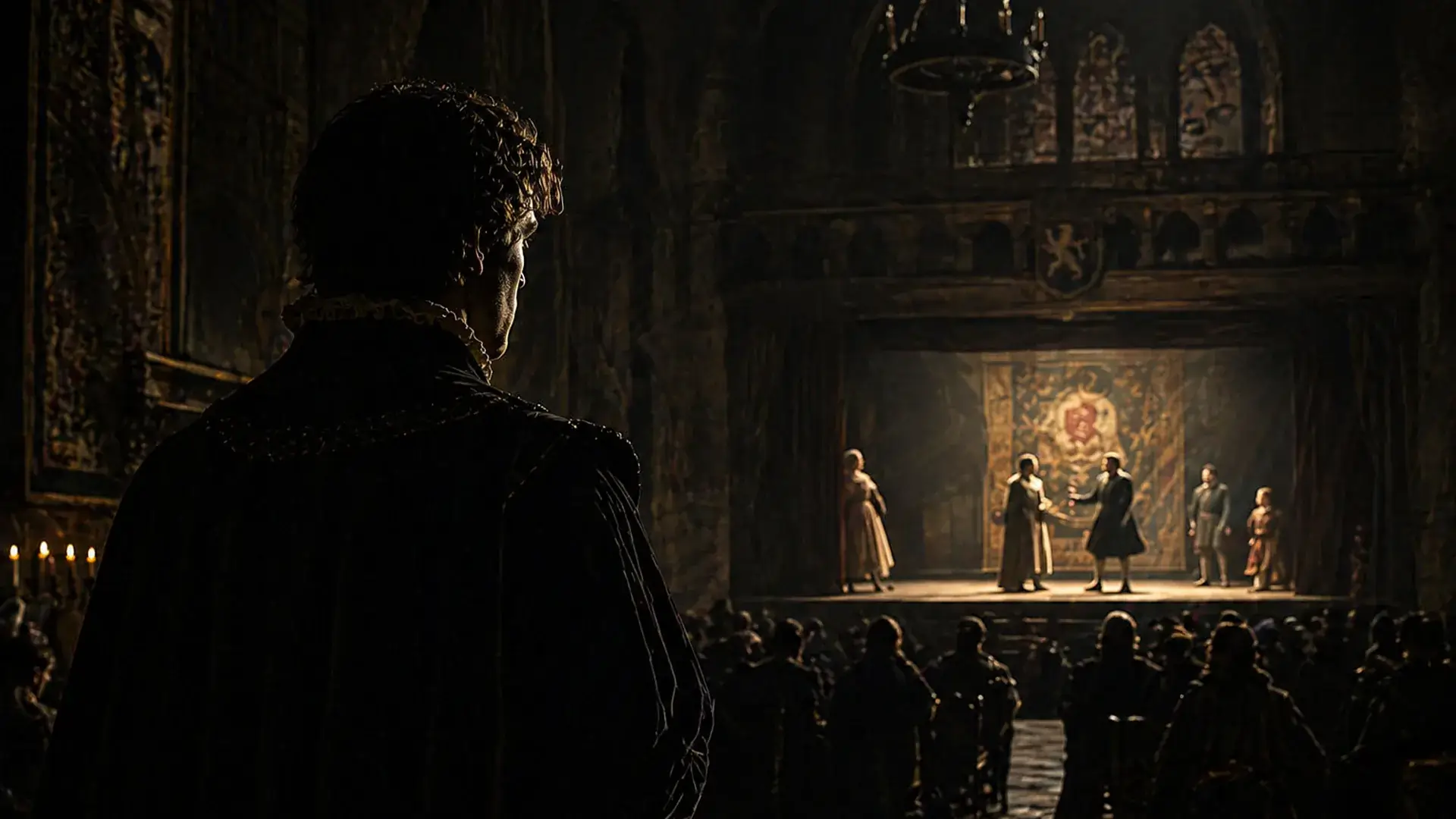
There is a moment in Act Two where Hamlet has everything he needs to act. The ghost has told him the truth. Claudius is within reach. The court has moved on and no one is watching. And Hamlet does nothing.
For 400 years that moment has been used as evidence that Hamlet can’t make a decision. That he’s weak. That the play is a study in paralysis.
It isn’t. And if you read it closely enough, you’ll see why.
Jimmy once had a client who told him something he never forgot. They were in a car together, and the client said he knew exactly what the right thing to do was — he just wasn’t sure yet that what he knew was actually true. Not doubt about the decision. Doubt about the information behind it. Those are two entirely different problems. One is a failure of will. The other is the discipline of verification.
Hamlet has the second problem. Not the first.
The key to understanding this is understanding how the play is narrated.
Hamlet is not a novel. There is no narrator stepping in to tell you what to think about what you’re seeing. It’s a drama — which means a godlike, invisible third-person narrator is presenting characters on a stage for your judgment. You watch what they do. You hear what they say. You decide what’s true.
That narrator never tells you the ghost is real. He shows you three soldiers and a scholar standing on the battlements in the cold, watching something they can’t explain, and he lets you decide. He never tells you Claudius is guilty. He shows you a king who flinches at a play and lets you decide.
This is how great narration works. It doesn’t tell you what to conclude. It gives you the evidence and trusts you to think.
Hamlet understands this instinctively. He is, in a sense, doing what the third person narrator does — gathering evidence before rendering judgment. The ghost appears and delivers testimony: your uncle committed murder. What does Hamlet do? He doesn’t act. He designs a test. He stages a play that recreates the murder and watches Claudius’s face. He brings Horatio in as a second observer so the verdict isn’t his alone. He verifies the testimony before he acts on it.
That’s not indecision. That’s the most rigorous thinking in the play.
Consider what Hamlet actually says in Act Two when he explains why he won’t act yet.
The spirit that I have seen may be the devil, and the devil hath power to assume a pleasing shape. I’ll have grounds more relative than this.
He’s not afraid to act. He’s afraid to act on testimony he hasn’t confirmed. He knows that a ghost telling you to kill your uncle is exactly the kind of thing a demon would say to damn you. So before he does something irreversible, he needs to know the testimony is true.
This is not weakness. This is the only sane response to the situation he’s in.
The play within the play works. The King sees himself and runs. Horatio confirms it. Hamlet now has his verification. And from that moment forward he doesn’t hesitate in the way he hesitated before. He kills Polonius — wrongly, passionately, but without hesitation. He rewrites the sealed orders that would have had him executed in England. He comes back. He fights in the grave. He acts.
The man who couldn’t make a decision is gone by Act Three. What replaces him is a man who verified the testimony and is now living with the consequences of knowing it was true.
This distinction matters far beyond the play.
Most people who are accused of indecision aren’t indecisive. They’re unconvinced. They haven’t verified what they’re being asked to act on. And the people pressing them to act — Claudius urging Hamlet to stop grieving, Horatio urging him to be careful, the ghost urging revenge — all have their own reasons for wanting action that have nothing to do with whether the information is sound.
Jimmy has watched this play out in business more times than he can count. Someone gets pressure to act on something they haven’t verified. They act. It goes wrong. And everyone calls it bad luck when it was actually bad judgment — someone delivered testimony and they didn’t stop to ask whether it was reliable.
Hamlet stopped to ask. That’s why we’re still talking about him.
This is also why the third person narrator matters so much in a play like this. The narrator presents the ghost’s testimony to us the same way he presents everything else in the play — without comment, without judgment, without telling us what to think. Three soldiers and a scholar see and hear the ghost before Hamlet does. That’s not an accident. That’s the narrator establishing the testimony as real before Hamlet even receives it.
The ghost is not a narrator. He’s a witness — the most consequential witness in the play. And like all witnesses, his testimony has to be weighed, tested, and confirmed before it can be acted on.
Hamlet weighs it. He tests it. He confirms it.
That’s not a man who can’t make up his mind. That’s the only man in the play who insists on knowing what’s true before he does something that can’t be undone.
The rest of them — Claudius, Laertes, Polonius — all act without verifying. Look where it gets them.
This is the first in a four-part series on Hamlet at ReadingWithJimmy.com. Next: Claudius didn’t just kill his brother — he killed everyone who trusted him.