Faust Series, Essay 4 of 5
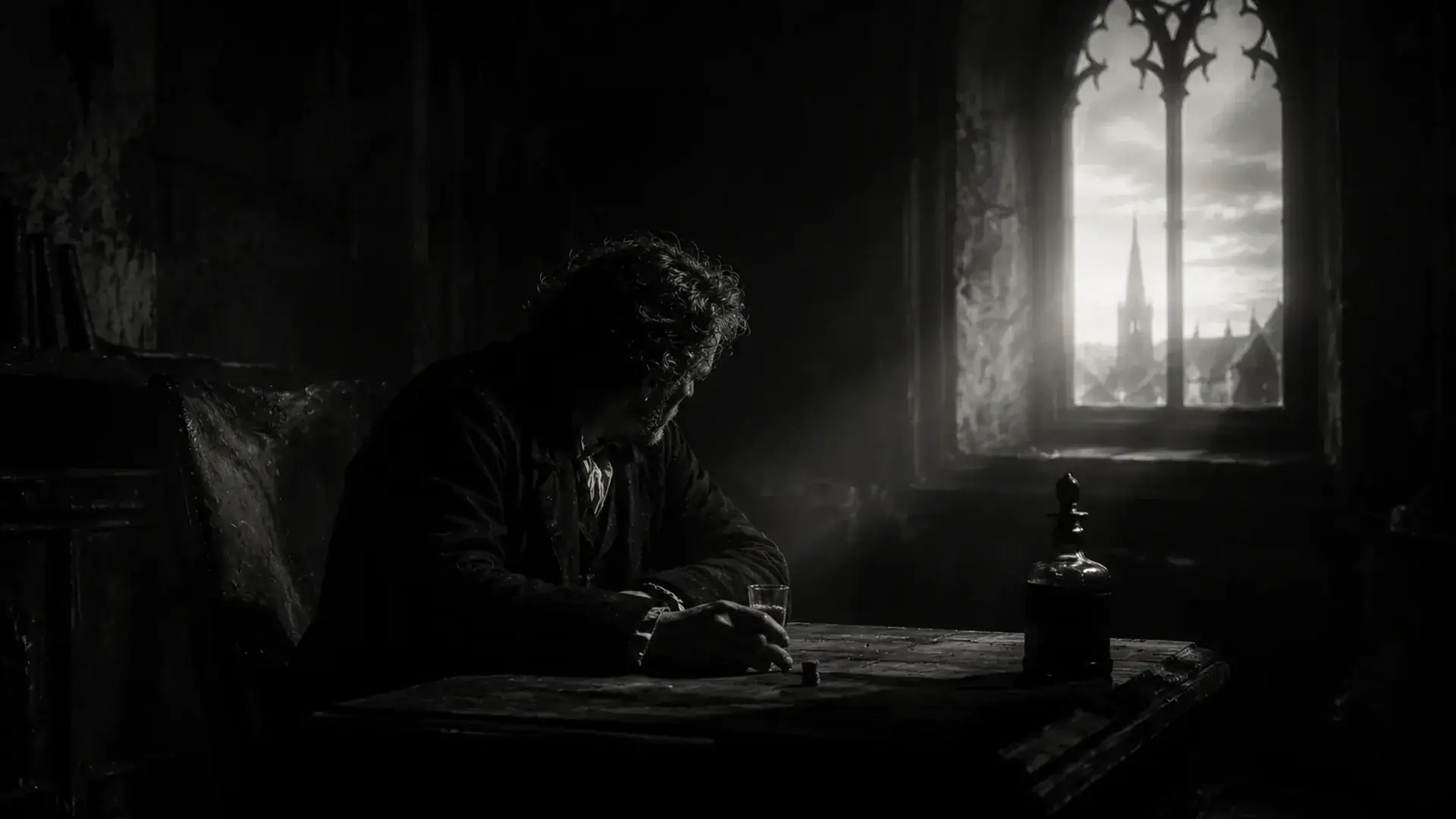
There’s a moment in Act One that most readers rush past because the devil is coming and the pact is coming and the action is about to accelerate. Faust is alone in his Gothic chamber. He has the poison cup in his hand. He’s going to drink it.
And then he doesn’t.
What stops him is not a reason. Not an argument. Not a sudden change of mind about the value of living. What stops him is a sound. The Easter bells. A sensation reaching him through one of his five senses at the exact moment he’s about to eliminate all five of them permanently.
That moment is not a footnote. It’s the thesis of the play.
We established in Essay 1 that Faust concluded nothing can be known. We established in Essay 2 that what he wants is the inmost force that binds the world. We established in Essay 3 that God permitted this whole experiment and named Faust as the test case.
Now we have to ask the question the play puts directly in front of us: what is the inmost force?
Faust spends the entire drama looking for it outside himself. Taverns, witches, Walpurgis Night, Margaret. Experience after experience, each one a reach outward. And none of them answer the question.
But standing at the edge of the suicide, poison cup raised, something pulls him back. Not theology — he already told you theology gave him nothing. Not philosophy. Not any of the disciplines he exhausted. A sound. The bells of Easter. The sensation of being alive, registering through the one channel — the senses — that only works while you’re alive.
I’ll say what I think that means. The inmost force which binds the world is not death. It’s the opposite. It’s life. It’s you. It’s me. It’s the striving thing inside us that makes us reach for one more experience, push past one more disappointment, ask one more question we can’t answer. The inmost force is the spirit that refuses finality.
And Faust can’t drink the poison for the same reason he can never say stay, thou art so fair — because both require a finality he cannot reach. He’s alive. Living things strive. Blaise Pascal said absolute rest is death, and that’s exactly right. The moment you stop striving, something essential has ended. The bells don’t give Faust a reason to live. They remind him that he already is living, and that living and striving are the same thing.
That brings us to Sisyphus. Bear with me — I’m stepping outside the story for a moment, the way I do when a concept needs a reference point to land properly.
The myth: Sisyphus was a king condemned by the gods to roll a massive boulder up a hill for eternity. He gets it almost to the top. It rolls back down. He goes back to the bottom and starts again. Up, down, up, down. Forever.
In 1942, Albert Camus wrote an essay called The Myth of Sisyphus and used that image to explore what he called the absurd — the confrontation between the human need for meaning and the world’s silence on the matter. Life is essentially meaningless, Camus argued. Humans consistently seek meaning anyway. That gap — between what we need and what the world offers — is the absurd. It’s the condition we all live in.
Sound familiar? That’s Faust in Act One. He studied everything, found nothing, concluded that nothing can be known, and now stands holding a poison cup. The rock rolled back down. He got there. He hit the wall. Life is absurd.
The existentialists — Camus, Sartre, others — took that condition seriously, wrote about it seriously, and in some cases argued it pointed toward suicide. Why roll the rock if it’s just going to come back down? Hamlet asked the same question. To be or not to be is an existential speech. It’s not theater. It’s a man doing the actual math on whether existence is worth the cost.
Faust does that math. And the Easter bells interrupt it before he finishes the calculation.
Camus had an answer to the absurd that I think is the right one, and it’s the answer Goethe builds into Faust without ever stating it directly. The answer is not to stop rolling the rock. The answer is to find meaning in the rolling itself. Sisyphus, Camus argued, triumphs over his fate the moment he accepts the struggle. It’s not getting to the top. The top doesn’t matter. What matters is the rolling. Learn to enjoy rolling the rock.
Does Faust ever learn that? No. And that’s the point.
I was talking to a young woman at my doctor’s office not long ago. I asked how she was doing and she said okay, I guess. I pressed a little — what do you mean, you guess? She said she was tired of the routine. Every day felt the same. Then I asked what she liked to do, and she lit up: travel. She wanted to see different places.
The doctor came in before I could finish the thought, but here’s what I was going to tell her: every day she works at that office is different. Not in dramatic ways. But no day is ever the same. She hasn’t been trained to see the difference. She’s waiting for the experience to arrive — travel, a new place, something from outside — instead of finding it in what’s already in front of her. She’s not rolling her rock. She’s waiting for someone to carry it.
That’s the trap Faust is in. Every experience Mephistopheles delivers is another version of travel. A new place. A new sensation. Something from outside. And after each one, Faust wants more. Thus in desire I hasten to enjoyment, and in enjoyment I pine and feel desire. That’s a logic loop. He can see it. He can say it. But the knowledge doesn’t change his behavior.
Because knowing you’re in a loop and getting out of it are two completely different things.
Marlowe understood the other ending. His Faust, at the stroke of midnight, tries to stop the clock. Stand still, you ever-moving spheres of heaven, that time may cease and midnight never come. He wants to freeze the moment — not because it’s fair, not because he’s satisfied, but because what comes next is damnation and he’ll take anything over that. It’s not stay, thou art so fair. It’s stay because I’m terrified of what happens when you don’t. Or is it stay, thou [life] are so fair!
That’s a different kind of striving. It’s striving against the ending rather than toward something. And it ends the way things end when all you’re doing is running — badly, violently, finally.
Goethe’s Faust doesn’t end that way. The play just stops. Faust flies off with Mephistopheles for more experiences. There’s no midnight, no damnation, no torn limbs. Just the continuing motion of a man who can’t stop.
The Easter bells save Faust not because they’re holy but because they’re sensory. They reach him through the body. They remind him, at the exact moment he’s about to end his body, that the body is how he knows anything at all. Five senses. That’s the equipment. When they stop, so does everything else — every experience, every comparison, every reach toward the inmost force.
He can’t say stay, thou art so fair about death, because death isn’t an experience you come back from with something to compare. It’s the one moment that ends all moments. And Faust, whatever his flaws, is a man who needs the next moment. Always the next one.
The bells give him back his next moment. And he takes it.
Are you rolling your rock? Or are you waiting for someone to carry it for you?
Read Essay 5: Margaret Knew Something Faust Never Did