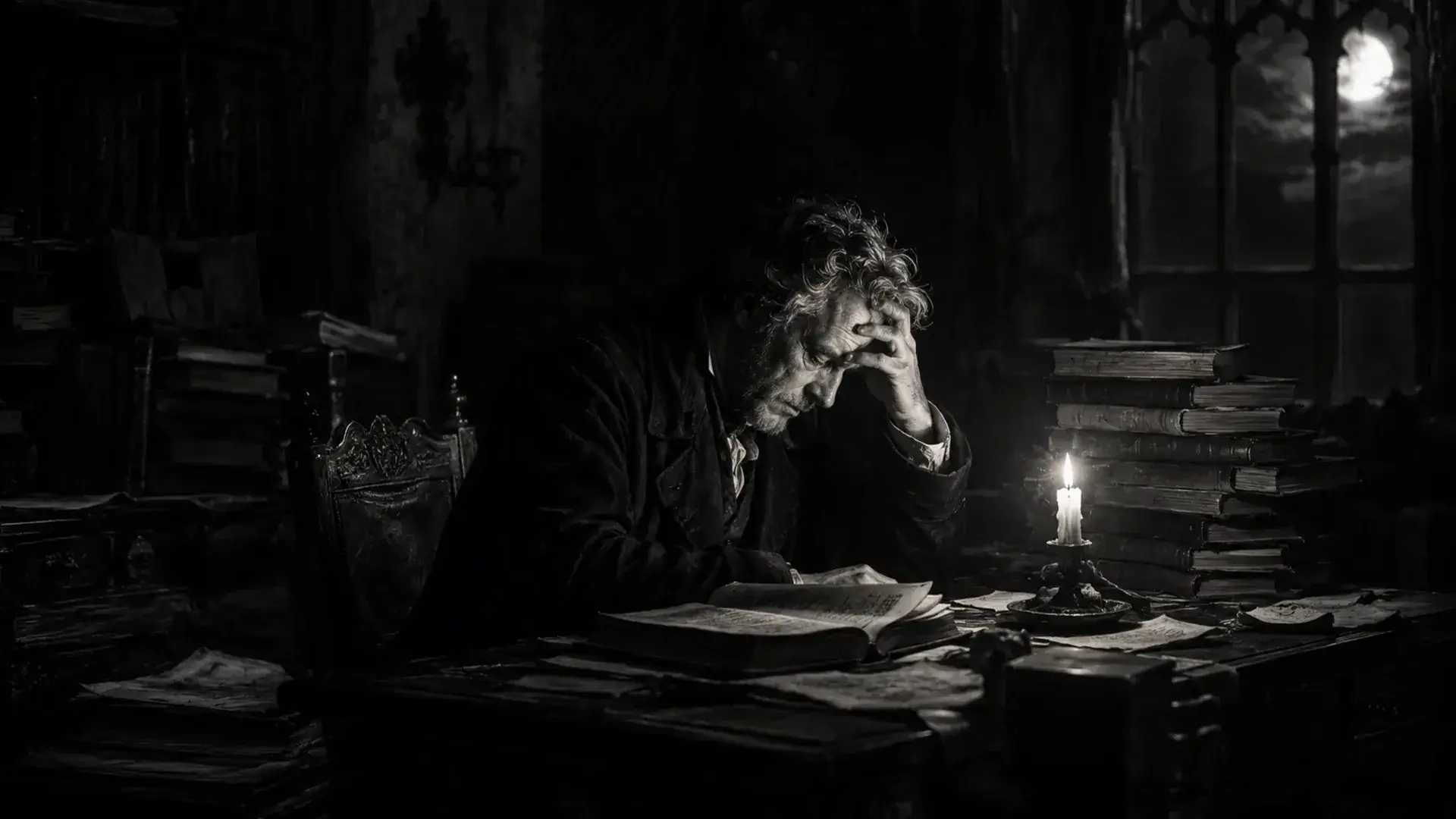
Faust Series, Essay 1 of 5
Most readers come to Goethe’s Faust and get lost in the deal with the devil. That’s understandable. It’s a dramatic premise. Man sells his soul. High stakes, big ideas, the devil himself as a supporting character. It’s hard not to lead with that.
But the drama doesn’t start there. It starts much earlier — in the very first lines Faust speaks — and it starts with a word so small most readers blow right past it.
The word is alas.
I chose Bayard Taylor’s translation of Faust for a reason I’ve stated from the beginning of this series: the language. Taylor gets close to Goethe’s German in a way that charges every line. And the first lines Faust speaks are a perfect example of why that matters.
Here is what he says:
“I’ve studied now Philosophy And Jurisprudence, Medicine, And even, alas! Theology, From end to end, with labor keen.”
Four lines. A list of disciplines. Impressive credentials. And then — right in the middle of it — that word. Alas.
Before you read another line, stop there. What is the most interesting word in those four lines? Not philosophy. Not jurisprudence. Not theology. Those are the big words. The impressive words. The ones that signal how learned this man is.
The most important word is alas.
Parts of speech matter in classical literature. I’ve said this before and I’ll keep saying it, because most of us were trained to read for plot and lost the habit of reading for language. Alas is an interjection. Its job — its only job — is to express sadness, regret, or disappointment. It interrupts. It inserts feeling into a sentence that was otherwise just a list.
You know the most famous alas in classical literature. Hamlet holds a skull and says: “Alas, poor Yorick! I knew him, Horatio.” The skull doesn’t change. The facts don’t change. But the word alas tells you everything about how Hamlet feels facing them.
Same thing here. Faust isn’t just listing his credentials. He’s grieving about them. Philosophy, jurisprudence, medicine — fine. He got through those. But even, alas, theology. Even that. Even the one field that might have answered the deepest questions gave him nothing. The word sits in that sentence like a sigh. Because it is a sigh. You can feel it.
And Taylor reinforces it. Note the punctuation: even, alas! Theology — An exclamation point after alas. A dash after theology. This is not accidental. Taylor is telling you exactly how to read this line. Slow down. Feel the weight of it. The man studied everything — including God — and came up empty.
That is not a small thing.
Here’s what ten years of study produces in Faust’s opening speech:
“And I see that nothing can be known.”
Not I haven’t figured it out yet. Not I need more time. Nothing can be known. He’s not just frustrated with his progress. He’s arrived at a conclusion about the nature of knowledge itself. And it has cut him, as he says, to the bone.
Cut to the bone. That phrase means to reduce something to its absolute minimum — the most essential, most painful core. What cuts Faust to the bone is not failure. It’s the knowledge that nothing can be known. He didn’t fail to understand the world. He succeeded in understanding that the world cannot be understood.
Most people never get there. They stay busy, stay distracted, stay satisfied with partial answers. Faust pushed all the way through — philosophy, law, medicine, theology, ten years, keen labor — and hit the wall at the end of it. The wall that says: this is as far as thinking takes you.
Do you know anybody like that?
I do. And I’ll tell you something — they’re not easy people to be around. They’re restless. They’re never quite satisfied with the conversation you’re having. They keep pushing it somewhere else. Because they’re after something that ordinary conversation doesn’t touch.
That’s Faust. In the first four lines.
But there’s one more thing in his opening speech that most readers miss. After the despair, after the declaration that nothing can be known, after the conclusion that he’s led his scholars by the nose for ten years and has nothing to show for it — after all of that, he says this:
“And no dog would endure such a cursed existence.”
No dog. An odd image for a man in a Gothic chamber surrounded by books. But it’s not accidental. It’s foreshadowing.
If you read Faust with me, you know how the devil first appears. Not as a figure in a cloak. Not with thunder and sulfur. He shows up as a black poodle — a dog — following Faust home from an Easter walk. Faust says no dog would endure what he endures. And then the devil shows up as one.
That’s Taylor’s translation doing its work. The language plants what’s coming before you even know you’re looking for it. That’s what classical literature does. It rewards the reader who slows down.
There’s a reason I spent time on a single word before we got to the pact, the devil, the Earth Spirit, Margaret — any of it. The beginning of anything is almost always the most important part. Classical literature is crafted to put its thesis in the opening lines. Alas tells you what kind of man Faust is before he does a single dramatic thing. It tells you that learning, for him, has been a long exercise in disappointment. That the more he studied, the less he knew. And that the one place he might have found peace — theology, the study of God — gave him no more than the rest.
Everything that follows — the pact, the experiences, Margaret, Walpurgis Night, the ending — flows from that word. From a man who studied everything and concluded that nothing can be known, and who refuses to stop there.
Alas!
That’s the genius of Taylor’s translation. And that’s the genius of Goethe.
Read Essay 2: What Faust Really Wants — and Why Knowing It Changes Everything