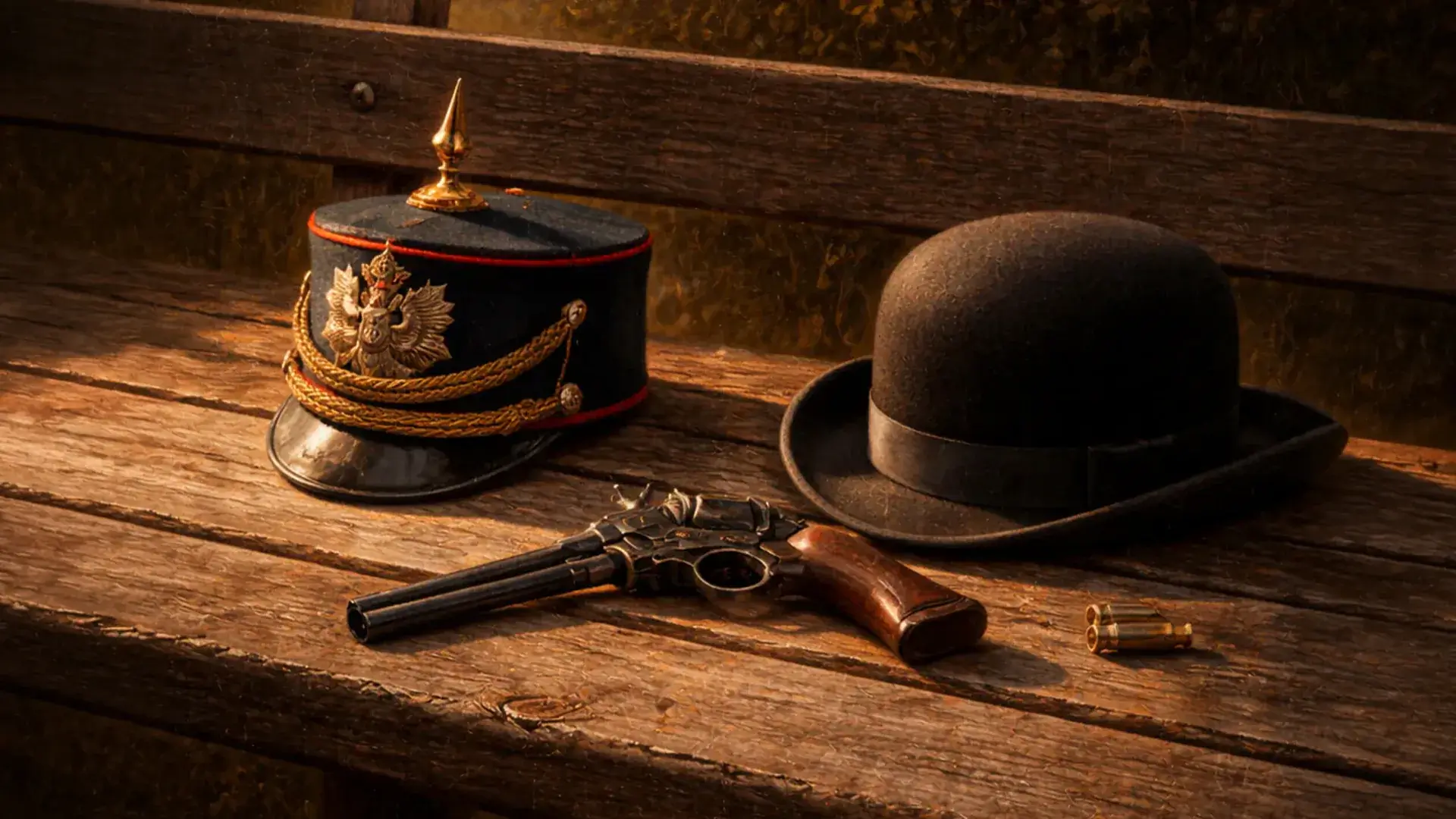
A Duel: A Reading with Jimmy Series
In this three-part blog series, Jimmy examines A Duel not as a patriotic story or a simple confrontation between enemies, but as a psychological drama about pride, fear, and identity under pressure. Maupassant gives us more than a standoff between a French civilian and a Prussian officer. He gives us a study in how men construct themselves in moments when dignity feels threatened.
These essays move through the story’s progression: from wounded pride, to courage, to an unsettling moral aftermath. Because the duel in Maupassant’s story is not merely about bullets. It is about when a man loses control.
BLOG #1 A Duel Is Not About War — It’s About the Moment You Cannot Turn Back
(Wounded Pride & Manufactured Courage)
In this first essay, we examine the beginning of the conflict — not the duel itself, but the psychological spark that makes it inevitable. Before a shot is fired, before honor is formally invoked, something subtler takes place: pride is injured. Our 3rd person narrator shows us how identity can harden under the gaze of an enemy, and how courage can begin not as virtue, but as a reaction to humiliation.
BLOG #3 Bullying, Honor, and Fortune: What A Duel Really Reveals About Character
(After the Shot: What Victory Costs)
In this final essay, we turn to the aftermath. The duel ends. A body falls. Honor appears satisfied. But our 3rd person narrator does not let the moment rest there. Instead, he leaves us with a quieter question: What does victory actually resolve? And what does it expose? The story’s true tension lies not in the shot itself, but in what remains when the noise has faded.
Strip away the uniforms.
Strip away the national flags.
What remains?
A bully.
A man trying to avoid bully.
And a system that turns ab insult into death.
The Anatomy of Bullying
The Prussian officer sneers.
He boasts.
He provokes.
He humiliates.
He invades physical space.
He escalates.
He is in a position of power — militarily, socially, psychologically.
Dubuis initially does what many people do under pressure: He withdraws.
He jumps into another carriage.
Flight. Not fight.
Is flight cowardice?
Not necessarily.
Sometimes retreat is prudence.
But the bully follows.
Escalation continues.
And eventually, fight replaces flight.
Character Is Revealed in Action
There are three types of people:
Those who make things happen.
Those who watch things happen.
Those who wonder what happened.
The Prussian makes things happen.
Dubuis reacts — until he acts.
The Englishmen watch.
Notice their position throughout the story.
They engage in conversation.
They observe the duel.
One opens an umbrella.
They are physically present.
Morally distant.
Geography matters. England is an island. Detached.
The third person narrator paints them with minimal strokes — yet the contrast is sharp.
Duel as System
The duel itself is rushed.
No seconds attempting reconciliation.
No formal pacing ritual.
No apology.
The Code Duello collapses into something improvised.
This is not aristocratic ritual.
This is chaos disguised as honor.
And yet once the challenge is issued, the structure takes over.
Honor becomes mechanical.
The machine runs.
One man dies.
Fortune
Machiavelli called it Fortune.
Chance.
The uncontrollable variable.
Dubuis did not aim carefully.
He fired.
And he lived.
Had the outcome reversed, would we call him brave?
Or foolish?
The story refuses to moralize.
It shows action.
It shows consequence.
It leaves interpretation to us.
The Real Question
What reveals character?
Words?
Or actions under pressure?
The Prussian’s words matched his aggression.
Dubuis’ restraint matched his attempt at prudence — until anger overtook him.
The Englishmen’s detachment matched their posture throughout.
In the end, A Duel is not about France or Prussia.
It is about what happens when pride, humiliation, and power collide in a confined space.
And about how once violence begins, no one fully controls how it ends.
This concludes the series on Maupassant’s The Duel. I hope you enjoyed it enough to even go back and re-read it with me! Let me hear from you: [email protected]