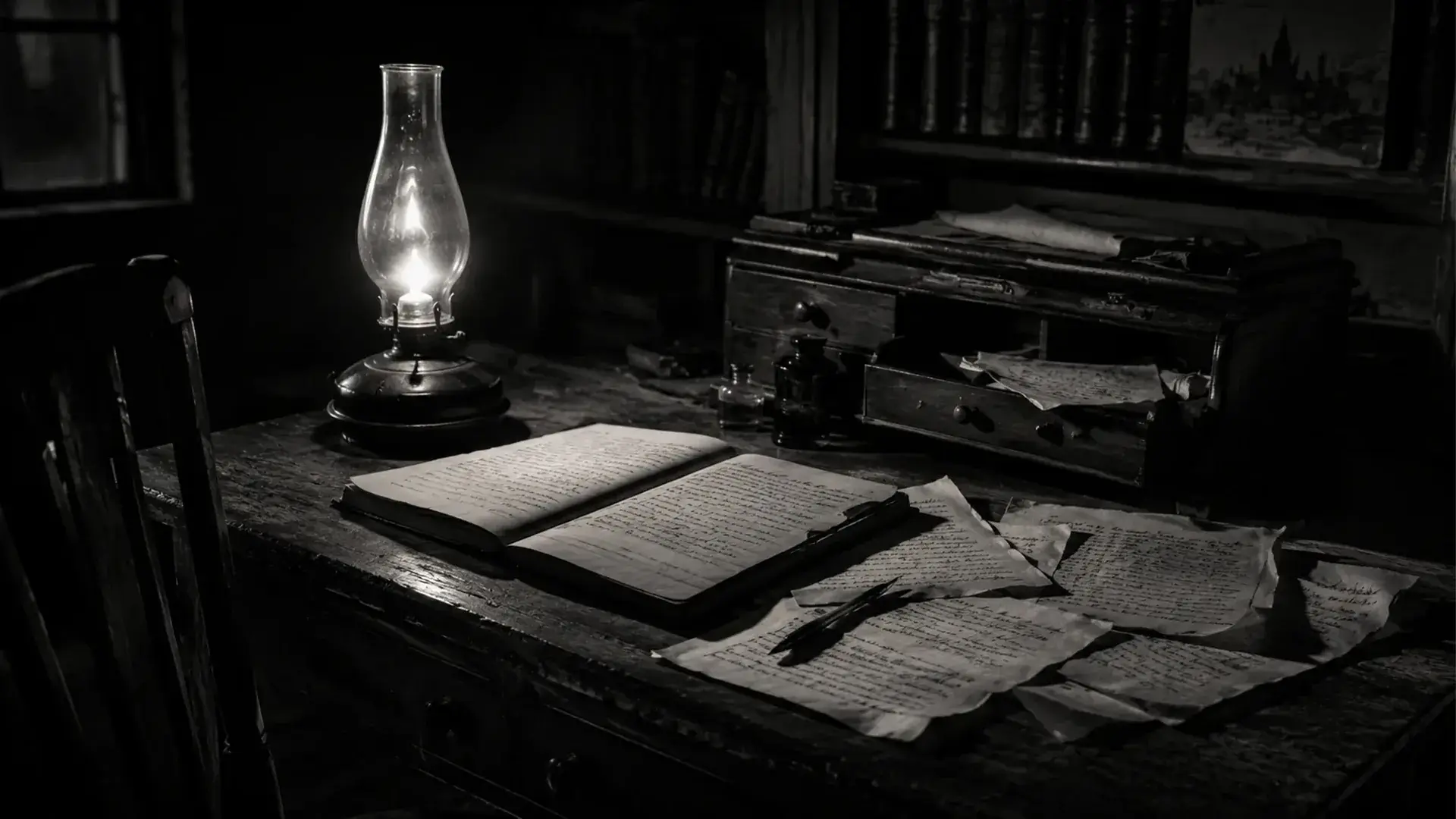
In 2,206 words, Edgar Allan Poe gives you one of the most disturbing first-person narrators in American literature.
Not disturbing because of what he does — though what he does is disturbing enough. Disturbing because of how reasonable he makes it all sound. Matter of fact, actually.
That’s the genius of The Tell-Tale Heart. And it starts with the plot.
Aristotle First (As Always)
Before we get into the story, a quick word from my favorite Greek philosopher. I know — I say this every time. But Aristotle organized everything for us, and he’s going to organize The Tell-Tale Heart for us too.
Aristotle tells us that tragedy has six elements: plot, character, diction, thought, spectacle, and song. Of those six, the two that matter most are plot and character. And of those two, the most important is plot — which Aristotle defines as the representation of human action.
So here’s my question before we even talk about what happens in The Tell-Tale Heart: where is the action in this story?
It’s not like Macbeth or Hamlet where you watch characters clash on a stage. It’s not a battlefield. It’s not a courtroom. Where is the action?
It’s all in the narrator’s mind. And yet — there IS action, isn’t there? A murder is committed. A body is cut up. Police officers arrive. And then the narrator breaks. That’s action. That’s a plot.
What Actually Happens
Let’s be clear about the plot before we analyze it.
An anonymous first-person narrator tells us — you, as he puts it — how he killed an old man. He insists he has a disease, not madness. The disease has sharpened his senses. Especially his hearing.
“I heard all things in the heaven and in the earth. I heard many things in hell.”
He loved the old man, he says. The old man never wronged him, never insulted him, never gave him any reason. But one of the old man’s eyes — pale blue, filmed over, like the eye of a vulture — when that eye fell on him, his blood ran cold.
So he made up his mind to kill the old man and rid himself of the eye forever.
He spent seven nights creeping into the old man’s room, shining a sliver of lantern light on that eye. For seven nights the eye was closed. On the eighth night, the old man woke. He sat up in the dark, listening. And our narrator stood there — perfectly still — for over an hour.
Then he heard it. A low, dull, quick sound. Like a watch enveloped in cotton. The beating of the old man’s heart.
He killed him. Dismembered the body. Concealed the parts beneath the floorboards. When police officers arrived — a neighbor had reported a scream — he let them in, chatted calmly, showed them around. And then he heard it again. The heartbeat. Coming up through the floor. Growing louder.
He confessed. That’s the plot.
Simple or Complex?
Aristotle is clear: complex plots are required for successful stories. A complex plot isn’t just a long one — it’s one where the action has consequences that turn on themselves, where what happens cannot be separated from how it happens.
The Tell-Tale Heart is a complex plot in a very small space. Beginning, middle, and end — all present, all unified. And even though the story spans a week, you never lose the thread. The narrator holds you the entire way.
2,206 words. Think about that. Every word is earning its place.
Did Any of This Actually Happen?
Here’s where it gets interesting. And I want you to think about this question before we go further in this series.
What if none of this happened?
What if everything we just described — the murder, the dismemberment, the heartbeat through the floor — what if all of it took place only inside the narrator’s mind? Not in any external reality. Just in his head.
Some critics have argued exactly that. One called it solipsism — the idea that the only reality that can be known to exist is the mind itself. Another used the doppelgänger theory, suggesting the old man is a double of the narrator. That’s absurd, isn’t it…it would mean he killed himself.
Jimmy’s view? Forget the outside critics. Use the evidence of the text itself. That’s your best and only guide.
Whether the murder happened in reality or only in the narrator’s mind — it doesn’t ultimately matter. Because in the narrator’s mind, it happened. That’s the point. And that’s what makes this story so perfectly constructed.
We’ll come back to that. In the next post, we go much closer — right into the first two sentences, where Poe packs everything you need to know about this narrator into a handful of words.
This is Post 1 of 5 in the Reading with Jimmy series on Edgar Allan Poe’s The Tell-Tale Heart. Continue with Post 2: “True! — What the First Sentence Tells You Everything.”
Read The Tell-Tale Heart with Jimmy on this website. Questions or comments? Write to Jimmy at [email protected].