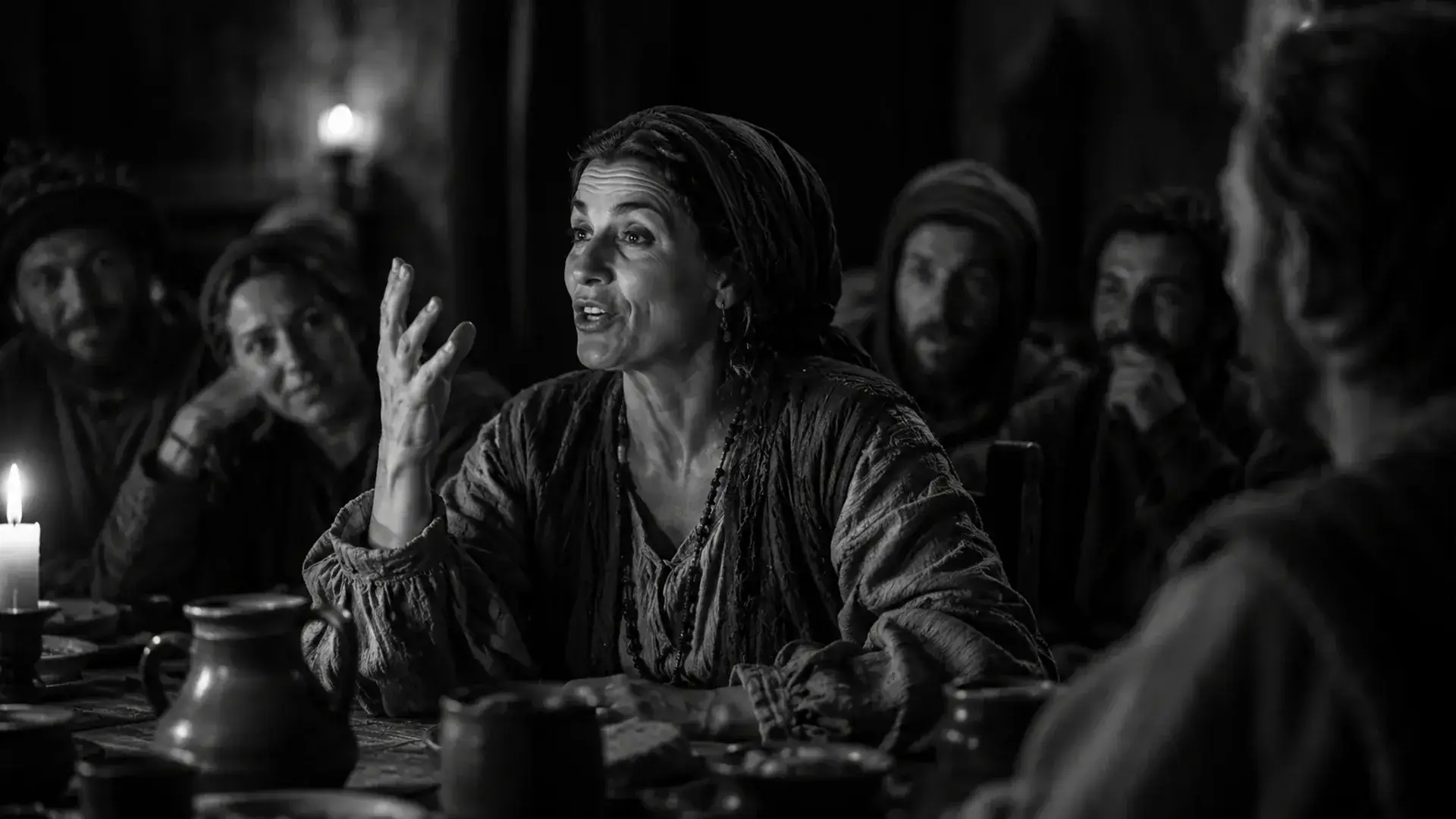
The Wife of Bath’s Tale — Analysis by Jimmy
Analysis by Jimmy — Part 3 of 4
We’ve talked about why the Wife of Bath tells us what she tells us. We’ve talked about the philosophy behind her opening lines, the rubber band theory of power, and what she does with scripture. Now we slow down and look at the language itself — the specific words she chooses, the passages that lodge in your memory, and what they reveal about a woman named Alison who has been married five times and has absolutely no interest in your approval.
This is about diction: the choice and use of words and phrases in speech or writing. Aristotle identified it as one of the six components of tragedy — of storytelling itself. In classical literature, diction is the writer’s fingerprint. It tells you things about character that the narrator never states directly.
A Note on the Translation
The Wife of Bath’s Prologue was written in Middle English, around 1390. Here is the opening line as Chaucer wrote it:
Experience, though noon auctoritee
Were in this world, is right ynogh for me
To speke of wo that is in mariage.
Jimmy reads this with you in Theodore Morrison’s translation:
“Experience, though all authority
Was lacking in the world, confers on me
The right to speak of marriage, and unfold its woes.”
The difference is not just modernization. Morrison made a specific choice in how he approached this translation. He did not try to make Chaucer sound contemporary. His goal, as he wrote in his 49-page introduction to the tales, was to use language that Chaucer himself might have used if he were writing now — language drawn from good conversation and general literate expression, not the experimental style of modernist poetry.
He kept it in verse, which matters. Many translations of The Canterbury Tales convert the poetry to prose. Morrison didn’t, because Chaucer was a rhyming writer — so exact in his rhymes, in fact, that scholars have used rhyme as one of the criteria for determining whether a poem attributed to Chaucer actually came from his pen. Morrison couldn’t reproduce the thousands of original rhyming pairs in modern English, but he kept the form, and he kept the voice. The result is a Wife of Bath who sounds like she could walk into a room today and start talking — and you would listen.
“Men May Advise a Woman to Abstain”
Here is the Wife of Bath on the Apostle Paul’s counsel regarding marriage:
“The Apostle, when he speaks of maidenhood,
Lays down no law. This I have understood
As well as you, my lords, for it is plain.
Men may advise a woman to abstain
From marriage, but mere counsels aren’t commands.”
She knows her scripture. She knows Paul. She knows that he recommends virginity — but she knows equally well that he does not command it. The word “counsel” is doing precise work here. It is not law. It is advice. And advice, she is telling these pilgrims, is something she is entirely free to ignore.
This is not ignorance talking. This is a woman who has read carefully and argued carefully. She is not dismissing Paul — she is out-arguing him on his own terms.
“That’s Not for Me”
She continues, referencing the Gospel of Luke:
“Virginity is a high and perfect course,
And continence is holy. But the source
Of all perfection, Jesus, never bade
Each one of us to go sell all he had
And give it to the poor; he did not say
That all should follow him in this one way.
He spoke to those who would live perfectly.
And by your leave, lords — that is not for me!
The flower of my best years I find it suits
To spend on the acts of marriage and its fruits.”
That is not for me. Read that line and hear who is saying it and to whom. She is standing in the middle of a group of religious pilgrims — a pardoner, a friar, a summoner — and she is telling them that the highest ideal of Christian life is simply not her path, and she has no interest in pretending otherwise.
The Passage About the Body
Now here is where the diction becomes extraordinary. She addresses the other pilgrims directly on the subject of the human body and its purposes:
Tell me this also: why at our creation
Were organs given us for generation,
And for what profit were we creatures made?
Believe me, not for nothing! Ply his trade
Of twisting texts who will, and let him urge
That they were only given us to purge
Our urine; say without them we should fail
To tell a female rightly from a male
And that’s their only object — say you so?
It won’t work, as experience will show.
Who talks like this? In public. To strangers. On a religious pilgrimage.
The Wife of Bath talks like this. And the question Jimmy asks you to sit with is not whether she is shocking — she clearly is — but why she is saying it and what it tells you about her character.
The answer, in part, is that she is not ashamed. Think of the story in Genesis: before the apple, Adam and Eve did not know they were naked. After, they hid themselves. Shame entered the world with self-consciousness. The Wife of Bath has walked back out of that garden. She is also making a theological argument: these organs were given to us by God, and God does not make purposeless things. She is turning the scholar’s argument — the one used to police women’s sexuality — back on the scholar.
The Confession of Venus and Mars
And then there is this, one of the most striking passages in the entire Prologue:
“For I belong to Venus in my feelings,
Yet have the heart of Mars in all my dealings.
From Venus come my lust and appetite.
From Mars I get my courage and my might.
Born under Taurus, while Mars stood therein.
Alas, alas, that ever love was sin!
I yielded to my every inclination
Through the predominance of my constellation;
This made me so I never could withhold
My chamber of Venus, if the truth be told,
From a good fellow; yet upon my face
Mars left his mark, and in another place.
Never — so may Christ grant me intercession —
Have I yet loved a fellow with discretion.
But always I have followed appetite,
Let him be long or short, or dark or light,
I never cared, as long as he liked me,
What his rank was, or how poor he might be.”
Lover and warrior. Venus and Mars. She is claiming both — the erotic and the aggressive — and she is blaming the stars, half-seriously, for being unable to resist either one. Alas, alas, that ever love was sin. That line is not entirely comic. There’s something real underneath it: the genuine tension between desire and the Church’s teaching that desire is a fallen thing.
But then she shrugs and moves on. She followed appetite. She didn’t care about rank or wealth when it came to the men she wanted. She was, as she cheerfully informs the pilgrims, the best thing there could be in bed.
The Colt’s Tooth
“He was in fact some twenty winters old
And I was forty, to confess the truth;
But all my life I’ve still had a colt’s tooth.”
A “colt’s tooth” is a feeling of youth — the young hunger of a horse that hasn’t yet settled into age. She’s 40, she knows it, and she doesn’t pretend otherwise. She knows what she is.
“So help me God, I was a lusty one,
Pretty and young and rich, and full of fun.
And truly, as my husbands have all said,
I was the best thing there could be in bed.”
Is this a confession? Yes. Is it a boast? Also yes. Is it entirely believable as the testimony of a woman telling the truth about herself? Jimmy thinks so. She has no motive to inflate this account. She is telling you who she was and who she still is, and the clarity of it is almost tender.
What Diction Tells You
Morrison’s choices across all these passages achieve something specific: they give us a woman who sounds contemporary without being dated. Her intelligence is on full display. Her humor is on full display. Her refusal to perform false modesty is on full display.
That is the point of pay attention to diction, to not only what people say, but what they say it. Language is not decoration. It is character. You could strip away the plot entirely and learn everything you needed to know about the Wife of Bath just from listening to how she talks — what words she chooses, when she is direct and when she deflects, when she is earnest and when she is teasing, when she invokes God and when she argues with him.
She is a woman who will not be quiet. Not because she lacks self-control, but because she has decided — empirically, through experience, on the basis of her own life — that silence is not what is owed to these pilgrims.
She has something to say. And she says it. What about you?
The fourth and final post in this series covers the Wife of Bath’s Tale itself — King Arthur’s court, the question women most desire, the ugly old woman’s bargain, and Aristotle’s guide to what makes a complex plot work.