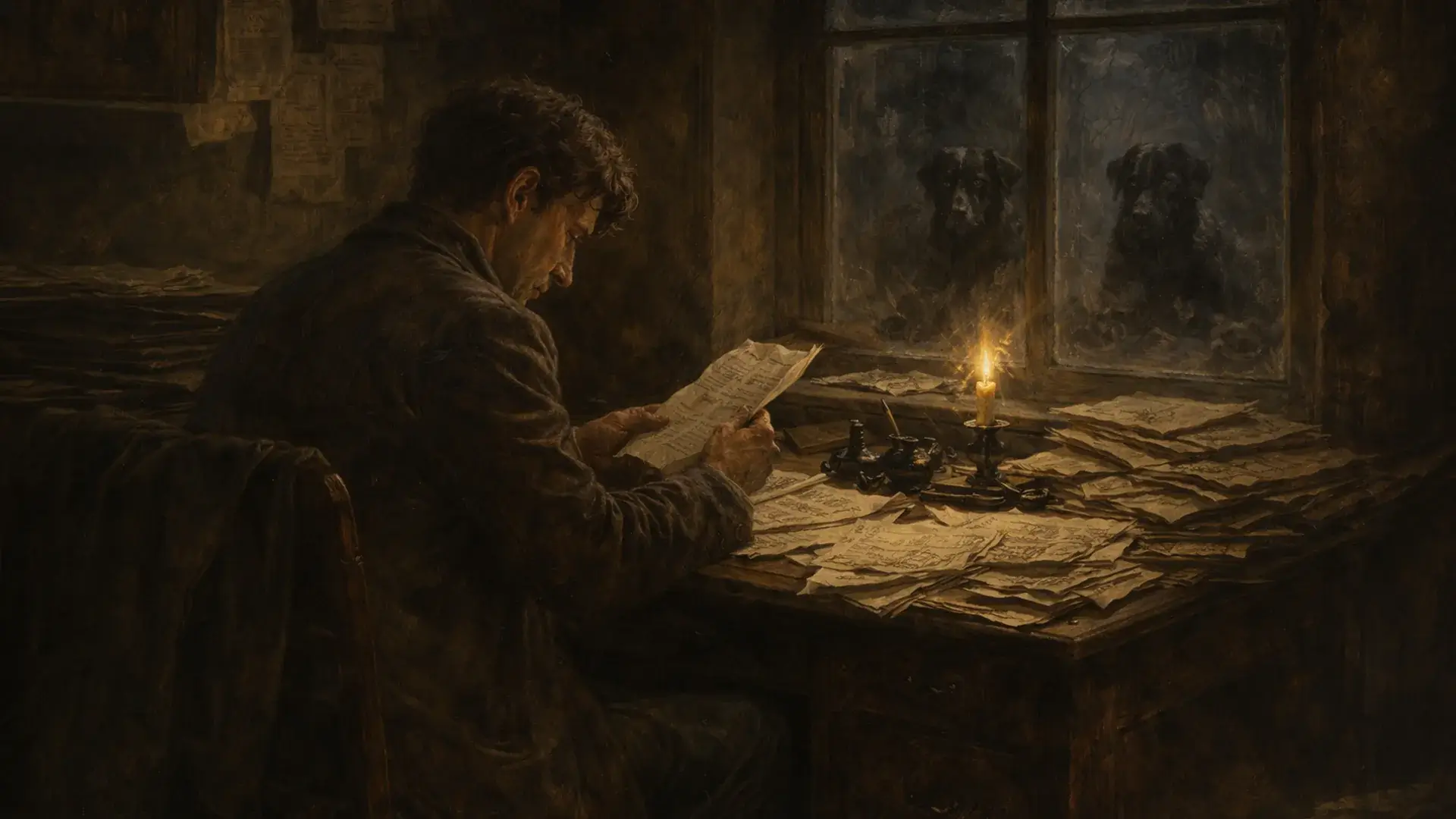
Diary of a Madman — A Reading with Jimmy Series
Most readers approach Diary of a Madman as satire. Gogol’s story is usually presented as a comic attack on bureaucracy, social climbing, or the absurd hierarchies of imperial Russia. And certainly those elements are present.
But Gogol’s story becomes far more disturbing if we read it more closely.
Because Diary of a Madman is not simply about a clerk. It is about what happens when a man’s sense of himself slowly detaches from reality — and begins replacing the world with a story he needs to believe.
At first the narrator seems merely insecure. Then he becomes defensive. Then imaginative. Then convinced.
What makes the story unsettling is that Gogol does not show madness arriving all at once. He shows it assembling itself piece by piece, until the narrator’s inner logic becomes stronger than the world around him.
Across this short series, we will follow that progression: how wounded pride becomes fantasy, how fantasy becomes belief, and how belief ultimately becomes a new reality the narrator cannot escape.
Because the tragedy in Diary of a Madman is not that a man goes mad.
It is that we see how madness is built within — one perception at a time.
In this post, we will watch the narrator’s journey into madness. The explanations that once lived quietly inside his diary and mind begin to change his behavior in the actual real world. When he declares himself the King of Spain, society responds—and he is taken away.
What follows is one of the most haunting endings in literature, where suffering briefly breaks through the madness before the mind retreats back into the world it has built.
In the opening entries of Diary of a Madman, the anonymous narrator still appears to live within the ordinary routines of life. He goes to work, walks through the city, observes people, and records his thoughts in a diary.
But something has already begun to shift.
His perceptions are no longer simply observations of the world. They are becoming explanations. Each event he encounters is interpreted, reinterpreted, and woven into a narrative that makes sense to him.
The turning point in the story occurs when this process accelerates.
It begins with the dogs.
The Talking Dogs
After observing the director’s daughter in the street, the narrator hears something extraordinary: two dogs appear to be speaking to one another.
At first even he seems surprised. He pauses and considers the possibility that he may be mistaken. Perhaps he misunderstood what he heard.
But the doubt does not last long.
Instead of rejecting the event as impossible, he begins reasoning why it might actually be true.
Perhaps animals can speak after all. Perhaps science has not yet discovered it. Perhaps people have simply overlooked this ability.
But, the narrator does not test his perception against reality and experience.
Instead, he adjusts reality to fit the perceptions.
This moment is extremely important because it shows us how the narrator’s mind works. The mind is confronted with something unusual, and rather than dismissing it, the narrator begins building a logical framework that allows the experience to remain valid.
Madness, in this story, does not appear as chaos.
It appears as logic operating on faulty assumptions.
Something snaps.
Rationalization
The narrator’s reasoning is actually quite recognizable. People do this all the time.
When we encounter something that contradicts what we expect, we often attempt to explain it rather than discard it. We search for reasons that allow the event to make sense within our existing beliefs.
Psychologists sometimes refer to this process as rationalization — explaining behavior or perceptions with logical arguments, even when those explanations may not be appropriate.
The narrator does exactly this.
He hears dogs speaking and immediately begins developing explanations that preserve the experience rather than question it.
Once that step occurs, the door to further interpretations opens very quickly.
Following the Evidence… or So He Thinks
The narrator becomes fascinated by the dogs. He follows them through the city and traces them to an apartment building.
Here we encounter one of the first clear contradictions in the diary.
He claims to follow the dogs to the fifth floor of the building. But later, when he returns to investigate further, he ends up searching on the sixth floor.
Small inconsistencies like this begin to appear throughout the diary.
The narrator himself does not notice them.
But the reader does.
This is an example of what literary critics call an unreliable narrator — someone whose account of events cannot be fully trusted. Yet in this story the unreliability is not a weakness. It is the very thing that allows us to see the narrator’s mind at work.
We are watching someone interpret reality incorrectly without that personal actually realizing it.
Brillant.
The Dog Letters
The most remarkable moment in this part of the story occurs when the narrator discovers a bundle of papers that he believes contain letters written by the dogs.
He reads them carefully.
The letters appear to describe the life of the director’s daughter, Sophie. They gossip about the people in her household and reveal private details about thoughts and feelings.
At first glance the scene seems almost comic. The idea of dogs writing letters is absurd.
But something more interesting may be happening here.
The letters describe the narrator himself.
And they do not describe him kindly.
Mirror, mirror on the wall…
In the supposed letters written by the dog Maggie, the narrator appears as an awkward and ridiculous figure — a shabby clerk who sits in the office sharpening quills and whose appearance provokes laughter.
The description is humiliating.
Yet the narrator does not recognize that he may be reading his own thoughts.
Instead, he becomes furious.
He accuses the dog of lying and insists that someone else must have written the letters in order to insult him.
What we are witnessing is extraordinary.
The narrator may actually be (and no doubt is) the one writing these letters within his own diary — constructing a story in which the dogs speak, write, and reveal truths about the people around them. But because the information contained in those letters threatens his self-image, he refuses to accept it. Imagine that: he wrote the descriptions, but can’t accept them as “reality.”
The mind protects itself.
Even when confronted with its own reflection.
Evidence of a Divided Mind
This part of the story reveals something very subtle about the narrator’s condition.
On one level he is constructing the narrative of the dogs and their correspondence. But on another level he reacts to that narrative as though it were written by someone else.
It is as if two parts of the mind are operating at once.
One part observes and records.
The other part defends itself from what those observations reveal.
This is why the diary form of narration is so powerful in the story. We are not watching events unfold from the outside. We are witnessing the narrator’s thinking as it develops.
The contradictions appear naturally because they are occurring inside his mind.
The Moment That Changes Everything
Up to this point, the narrator’s unusual perceptions remain mostly contained within the diary itself. He writes about them, interprets them, and explains them, but he has not yet acted on them in a way that would alarm the people around him.
When the narrator reads in the dog’s letters that Sophie may be attracted to another man — an officer — something inside him snaps.
His explanations escalate.
Soon afterward he discovers an article about Spain and becomes fascinated with the idea that the Spanish throne has no heir. From that small piece of information he constructs a startling conclusion.
He himself must be the King of Spain.
The logic is absurd, of course. But…perfectly logical to our narrator!
To the narrator it feels perfectly reasonable.
When Thoughts Become Actions
This is the true turning point of the story occurs.
The narrator does not simply write about his new identity in the diary. He begins acting as if it were true.
He stops going to work.
He appears in the office and signs documents with the royal name Ferdinand VIII.
He visits the director’s house and behaves as though Sophie were destined to marry him.
The thoughts that once existed privately in his diary are now shaping his behavior in the real world.
And this is the moment (behaviors so out of the ordinary and against what is accepted reality) when society reacts, has to react.
The Line Between Mind and World
One of the most unsettling aspects of Diary of a Madman is how clearly Gogol shows the boundary between private imagination and public action.
People can think almost anything.
Inside the mind, strange ideas may come and go without consequence. But when those ideas begin to guide behavior — when a person begins acting according to a reality that others cannot see — the conflict with the world becomes unavoidable.
The narrator crosses that line.
What had once been a series of explanations inside his diary now becomes a new identity that he tries to live out in public.
And once that happens, the consequences arrive quickly.
The Logic of Madness
What makes Gogol’s story so powerful is that the narrator’s descent into madness never appears completely random.
Each step grows naturally from the one before it.
He hears dogs speak.
He explains why that might be possible.
He reads letters written by those dogs.
He interprets those letters as evidence about the world around him.
He discovers information about Spain.
He explains that information in a way that places himself at the center of the story.
The logic is flawed, but the reasoning is continuous.
And that continuity is what makes the story so unsettling.
Because the reader can see exactly how the narrator arrived where he did.
The mind has been building this reality piece by piece.
One explanation at a time.
In the end, Diary of a Madman leaves us with a troubling realization which we will explore in Blog #3. The narrator does not simply lose his mind in a single moment. We have watched the process unfold step by step—observation becoming interpretation, interpretation becoming belief.
And that may be Gogol’s most unsettling insight: madness rarely arrives all at once. More often, it grows quietly within the mind, one explanation at a time.