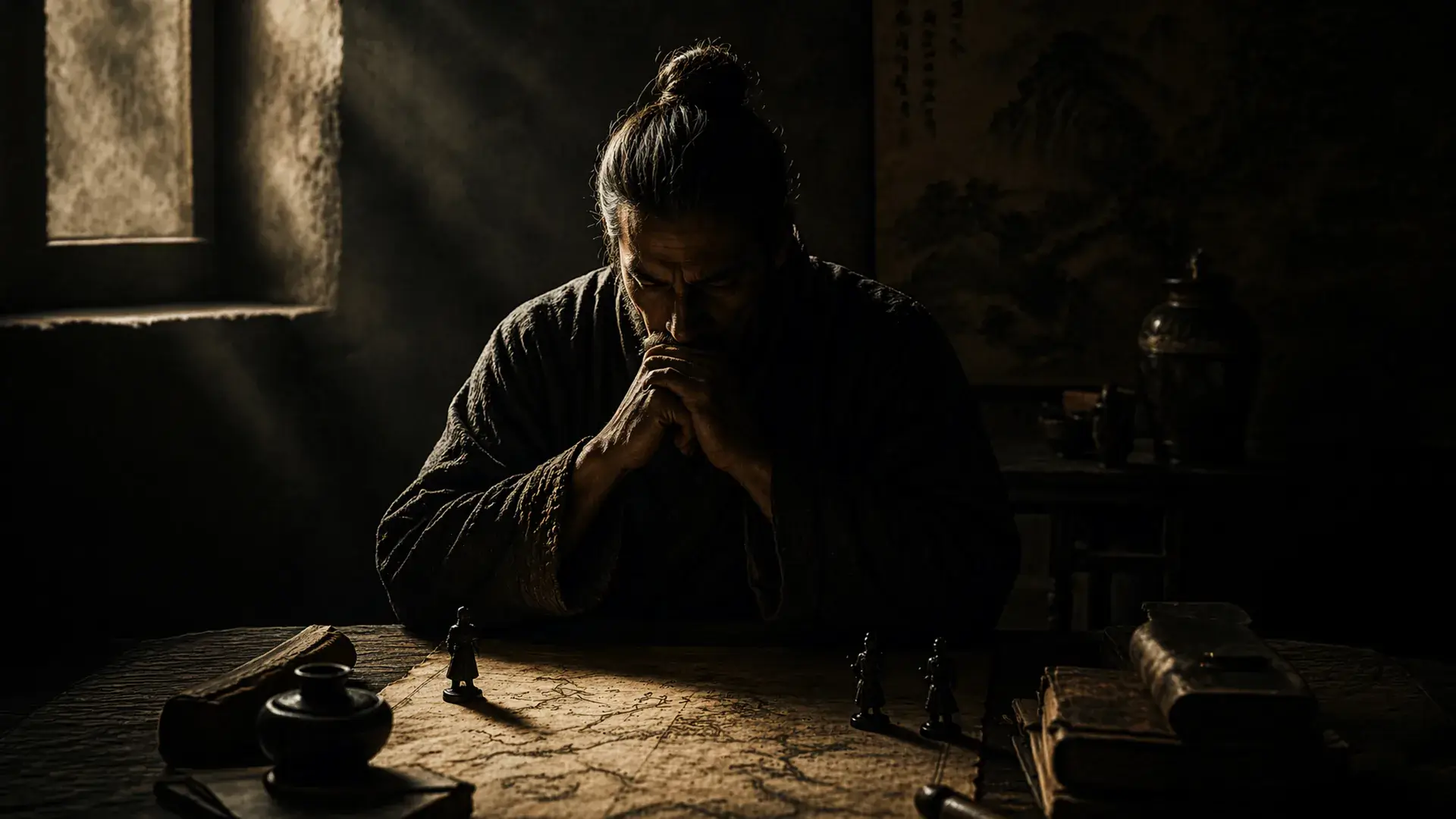
Ethics — Sun Tzu Series, Essay 2
This second essay argues that The Art of War is not a manual for domination. It is a sustained argument about cost — and Sun Tzu’s most important ethical claim is that the man who fights without calculating what he stands to lose has already made his worst mistake.
Most people come to The Art of War looking for an advantage.
They want the edge. The tactical insight. The line they can quote in a meeting or apply to a negotiation. They want Sun Tzu to hand them a weapon.
What they find instead — if they read carefully — is a warning.
Sun Tzu does not open his book by telling you how to win. He opens it by telling you what prolonged war costs.
The First Thing Sun Tzu Warns Against
Though we have heard of stupid haste in war, cleverness has never been associated with long delays. There is no instance of a country having been benefited from prolonged warfare.
That is not the opening of a conquest manual.
That is a man telling you to think before you move.
Sun Tzu is not interested in glorifying war. He is interested in resolving conflict with the least possible damage to the state — to resources, to people, to time. The ideal outcome in The Art of War is not the most decisive victory. It is the victory that required the least expenditure to achieve.
And the highest form of that ideal is this: winning before the fighting begins.
The general who wins a battle, Sun Tzu tells us, makes many calculations before the battle is fought. The general who loses makes few.
Read that again. The battle is decided before anyone takes the field. Everything that happens after the first engagement is the consequence of decisions already made — or not made.
That is not a military observation alone. That is an ethical one.
Cost Is the Moral Framework
When most people think about ethics, they think about right and wrong.
Sun Tzu thinks about cost.
That is a different framework, and it is worth understanding clearly.
Sun Tzu does not ask: is this war just?
He asks: can you afford this war? Have you calculated what it will drain from you — financially, psychologically, physically — if it runs longer than expected? Have you honestly assessed whether the outcome you want is worth the price of getting it?
One of my clients once engaged in litigation with a major competitor. It ran for over ten years. By the time it ended, the original point of contention had long since become irrelevant. What remained was a decade of legal fees, organizational distraction, and the slow erosion of energy that could have gone toward building something.
Sun Tzu would not have been surprised. He warned against exactly this.
If your arguments are prolonged, the cost is not merely financial. You drain yourself psychologically. Emotionally. The resources of the state — whatever your “state” happens to be — are not infinite.
The man who enters a prolonged conflict without calculating this is not being brave.
He is being careless.
The Word “Prolonged” Is Entirely Subjective
Here is where it gets complicated.
The word prolonged means something different depending on who is using it — and when.
When the United States made the decision to strike Iran’s nuclear infrastructure, the problem had been studied for nearly ten years before the planes took off. Was that prolonged? Or was that the preparation that made the outcome possible?
It depends on who you ask. It depends on what they know. It depends on what they have already paid.
This is why definitions matter. This is why narrators matter. We discussed in Essay 1 that words only mean what experience makes them mean. Prolonged is one of those words. So is victory. So is necessary.
Sun Tzu gives you the principle. He cannot give you the definition. That part is yours.
Deception Is Not Dishonesty — It Is Strategy
Sun Tzu’s most famous line is also his most misunderstood: All warfare is based on deception.
People hear that and flinch. They want to argue with it. They want to say: I don’t want to deceive anyone. I want to tell the truth.
Sun Tzu is not talking about personal morality. He is talking about the nature of conflict.
In any contest of wills — in war, in business, in negotiation — the opponent is trying to read your intentions, predict your movements, and position against you. The moment you become entirely predictable, you become entirely vulnerable.
Deception in Sun Tzu’s sense is not lying for its own sake. It is the discipline of not revealing your full hand before you need to.
When a competitor posts a challenge to your product’s ratings, baiting you into a public dispute — the deceptive move is to stay silent. To prepare. To write the white paper that calmly establishes the facts, and have it ready when the moment arrives rather than firing back in the moment the bait is set.
That is not dishonesty. That is strategy.
The competitor expected a reaction. You gave them silence. And silence, in that situation, is the most disorienting response possible.
All warfare is based on deception. Including the warfare of knowing when not to speak.
There Are Things You Must Not Do
One of the most striking passages in The Art of War is this:
There are roads which must not be followed, armies which must not be attacked, towns which must not be besieged, positions which must not be contested, commands of the sovereign which must not be obeyed.
That last clause tends to stop people. Commands of the sovereign which must not be obeyed?
But here is the concept underneath it, and Sun Tzu understood it 2,500 years before the Marine Corps put a name to it: what matters is not the order. What matters is the intent.
In Marine doctrine, the commander’s intent is defined as a concise expression of what must be accomplished and why — a statement that guides subordinate action even when plans change, even when orders are absent. The intent gives you the freedom to exploit opportunity, to respond to conditions on the ground, to make decisions the original plan could not anticipate.
Sun Tzu’s point is the same. There are moments when following the specific command violates the deeper objective it was meant to serve. In those moments, the soldier who follows orders blindly is not being loyal. He is being careless with the very thing the orders were designed to protect.
The ethics of The Art of War are not about obedience. They are about understanding what the conflict is actually for.
The Conflict You Are Already In
Sun Tzu is writing about states. About armies. About generals who must calculate before they commit resources that cannot be recovered.
But the calculation applies at every scale. You don’t get the raise you wanted. Do you fight it now, in the wrong moment, with incomplete information? Or do you wait, prepare your case, and choose the moment when conditions favor you?
You find yourself in an argument that has been running for months. Are you winning? Or are you both draining resources — time, goodwill, energy — that neither of you can afford to lose?
An argument that solves nothing is not a draw. It is a loss for both parties.
Sun Tzu is not telling you to avoid conflict. He is telling you something more important: that entering conflict without strategy is not courage. It is waste. And waste is its own kind of defeat, even when no one formally surrenders.
What Sun Tzu Is Actually Teaching
The ethics of The Art of War come down to this: War — conflict — is of vital importance. It is a matter of life and death, a road either to safety or to ruin. Therefore it is a subject of inquiry which can on no account be neglected.
Not glorified. Not avoided. Studied.
The man who studies his conflicts — who calculates, who understands the cost of prolonged engagement, who knows when to strike and when to wait, who grasps that the best victories are the ones already decided before the fighting starts — that man is not more aggressive than his opponent.
He is more honest.
Honest about what conflict costs. Honest about what he can afford. Honest about whether the outcome he wants is worth the price of reaching it.
That is Sun Tzu’s ethics. Not right versus wrong.
Cost versus consequence.
You’ve been reading with Jimmy. This is Essay 2 of a three-part series on The Art of War by Sun Tzu. In Essay 3, we turn to Sun Tzu’s hardest demand — not knowing your enemy, but knowing yourself.