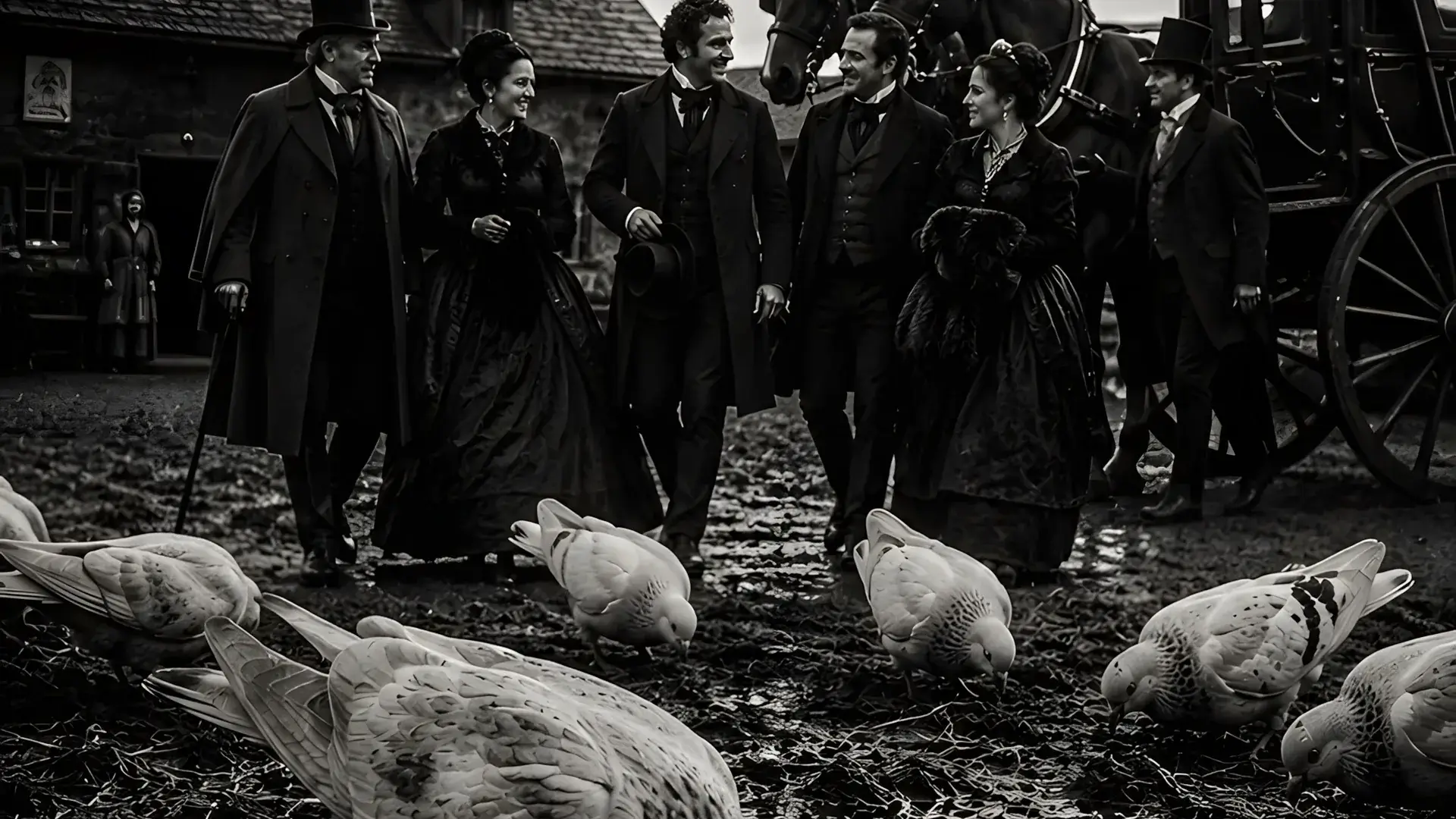
By the time Boule de Suif reaches its final pages, this story has already asked you to notice two acts of sacrifice from the same woman — and to notice how differently the acts were received by the other characters.
The first is food: hungry and proud, Elisabeth watches her fellow travelers go without food on the road out of Rouen, then offers to share her own which she had thoughtfully brought with her. Though they look down upon her as a common prostitute, they take it “gratefully, hunger overriding their contempt.”
The second sacrifice is herself. At the town of Totes, a Prussian officer refuses to let the group leave until Elisabeth gives herself to him of her own free will. She hates the Prussians; she tried to kill one who was billeted on her in Rouen, which forced her to leave. So at first, she refuses.
Her companions — the same people who ate her food without a second thought — spend days working on her conscience rather than working on him or agreeing with her; after all, they are at the mercy of Prussians as well.
One of the characters — the Comte — calls it “such a painful sacrifice.” Loiseau simply calls her “that tart” and wonders how much longer she’ll keep them waiting, as if it is her “duty” to give into the Prussian’s demands.
And so eventually, she goes. And the group is free to leave.
What happens next is a detail this story that is classical “literature charged with meaning.” I’ve often told you that is what makes classical literature great literature – the language. It’s what Ezra Pound said about great writing.
Here is the exact sentence:
“The coach, ready at long last, was standing at the door, while an army of white pigeons with pink eyes and black pupils were preening themselves in their thick plumage and strutting about between the legs of the six horses, pecking for food in the steaming dung.”
If you forget the story for a moment and read this sentence, its meaning is pretty clear: there are a bunch of birds pecking for food in the horse dung. That’s a pretty disgusting image, isn’t it?
But now think about the story we just read and re-read that sentence. Elisabeth’s first sacrifice was food. What are the pigeons pecking for? Her next sacrifice at the pressure of her companions was herself. The pigeons are “preening themselves in their thick plumage and strutting about.” What do her companions do throughout the story?
You see what I mean? The pigeons have become the travelers, who appropriately, are pecking in the horse dung. They are, in fact, disgusting.
Language charged with meaning. That’s what classical literature does!
In Macbeth, the witches all chant and leave: “Fair is foul. and foul is fair: Hover through the fog and filthy air.” What does this chant mean? Is it just a simple rhyme? When we read it together, you’ll find that it means everything is upside down – if fair is foul, and foul is fair, it means everything is confused! What is good is bad, and what is bad is good. It’s foggy and filthy (from the battle) and this confusion is “hovering.” The whole play is about this upside down world!
In Johnny Bear, a John Steinbeck story on this website, there’s a fog in the story that starts out as a fog that rolls in at night. That fog becomes more than just fog because it signals the fog that often clouds the reality of a situation.
These kinds of changes in common words happen ONLY in classical literature, shaped by narrators trying to get a point across by charging the language with meaning.
The third-person narrator in this story never tells you what the pigeons represent. He doesn’t have to. By the time the pigeons show up, the characters themselves have all defined themselves. You see, we, the readers, who put the charge, the meaning, in the common words and change them into powerful statements.
Because words mean things. They are our way of representing the reality around us, and there is no more difficult reality to represent then the complexity of a human being. Just think about these people in this story and how you got to know them!
By showing you what they do! The narrator showed us, and we drew conclusions. From the time they all got into the coach until the time they left back in that coach, we saw each of them reveal themselves to us by their actions.
Selfishness is easy to spot in someone else and remarkably hard to catch in the mirror. This story hands us the mirror anyway. Read Boule de Suif with Jimmy — and see for yourself what these people, and maybe the rest of us, would rather not notice about ourselves.