Faust Series, Essay 5 of 5
The ending of Goethe’s Faust confuses people. Faust flies off with Mephistopheles for more experiences. The play just stops. No damnation, no reckoning, no clear moral resolution. If you came to this drama expecting the devil to collect, you feel cheated.
But there is a reckoning in this play. It’s just not Faust’s.
It belongs to Margaret. And what happens to her in the final prison scene — what she says, what she refuses, what she chooses — is the most important moment in the entire drama. More important than the pact. More important than Walpurgis Night. More important than any of the experiences Mephistopheles engineered for Faust.
Margaret, at the end, does the one thing Faust cannot do across the entire length of the play.
She looks inward.
Let’s be clear about what Margaret’s experience actually is, because there’s a temptation to read her as a victim and stop there. She’s young, she’s innocent, she’s pursued by a learned man with the devil helping him. All true. But the text doesn’t let you stay in that reading.
Here is what happens. Faust pursues Margaret with Mephistopheles providing access and cover. In the course of that pursuit: Margaret’s mother dies from a sleeping potion Faust provided so he and Margaret could be together undisturbed. Margaret’s brother Valentine is killed by Faust in a sword fight — with the devil’s help, yes, but Faust strikes the death blow. Margaret, pregnant, kills the child she and Faust conceived together.
Some people push back on that last point when they email me. They say Margaret was desperate, she was alone, she wasn’t in her right mind. All of that may be true. But she says she did it. The text says she did it. You believe the text. The third-person narrator doesn’t lie to you, and Margaret herself doesn’t deny it.
Intent doesn’t cancel action. Faust didn’t intend for Margaret’s mother to die. He gave her a potion to make her sleep. She died. He killed her. These are not complicated ethical calculations. They are consequences of actions, and actions are what Aristotle said drama is built from. Character is determined by what people do, not what they meant to do.
Faust set this system in motion. Margaret is inside it. And the consequences stack up with the indifference that consequences always have toward the people who caused them.
Now here is where the play makes its sharpest turn.
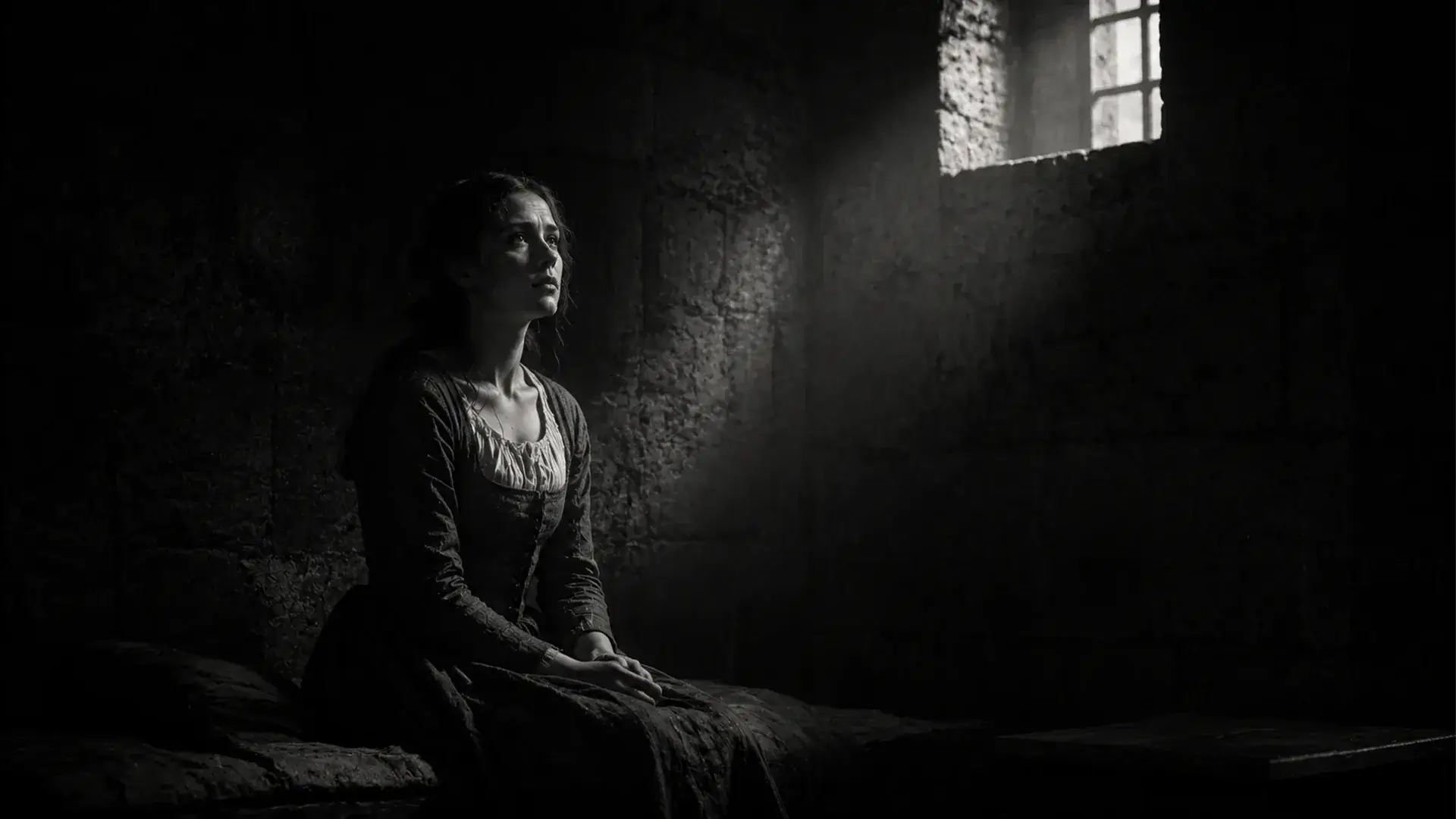
Faust, after everything, goes to the prison where Margaret is awaiting execution. He goes with Mephistopheles. He demands she be rescued. He has a plan, an escape route, the devil’s logistics at his disposal. He’s there to save her.
Margaret refuses.
She will not leave. She recognizes her guilt. She chooses to face what she has done rather than escape it with the man who helped her do it. And in her final words, she calls on God — not Faust, not Mephistopheles, not any earthly rescue — and she shudders at the thought of Faust. He has become evil to her. Not complicated. Not ambiguous. Evil.
“Henry! I shudder to think of thee.”
Henry is Faust’s given name. She’s not talking to the scholar, the lover, the man who pursued her. She’s talking to someone she now recognizes clearly for what he is. And she shudders.
Then the voice from above: She is saved.
And Faust flees with Mephistopheles for more experiences.
What did Margaret do that Faust couldn’t?
She stopped looking outside herself for the answer and looked inside. She didn’t run. She didn’t take the exit Faust offered. She sat with what she had done, accepted the weight of it, and submitted to judgment — not Faust’s judgment, not the court’s judgment, but God’s. The same God who spoke in the Prologue. The same frame the narrator established before the first earthly scene.
She is saved because she does the thing the entire play argues is the only thing that matters: she achieves self-knowledge. Not comfortable self-knowledge. Not flattering self-knowledge. The kind that makes you shudder. The kind that says I did this, these are my actions, I cannot run from the consequences of who I am.
Faust cannot do that. Not once in the entire play. He is, as I said in the analysis, a man absorbed with himself who uses people and things to entertain himself. The experiences Mephistopheles delivers are not windows into the world. They are mirrors. And Faust refuses to look at what the mirror shows him.
Margaret is the mirror. Her suffering is the direct consequence of Faust’s pursuit. Her prison cell is what his deal with the devil actually produced when it touched another human life. And when he shows up to rescue her, he’s not there for her. He’s there because seeing her pale and suffering in a vision disturbed him. It was his experience of her suffering. Not her suffering itself.
That is the distinction is the ethical center of the play.
Walpurgis Night matters here too, and I want to spend a moment on it because it looks like a digression and isn’t.
The scene is a chaotic festival — witches, spirits, fifteen characters speaking in verse, noise and motion and strangeness. It reads like Goethe threw it in between the Margaret scenes because the play needed variety. He didn’t. There’s a reason for everything in classical literature.
Those fifteen characters are experiences. Each one embodies something Faust is chasing. The Herald speaks about marriage — fifty years of strife compounded, bliss and friction together, neither one without the other. That’s the golden mean Aristotle talked about. Not the absence of strife but the long endurance of it. Because that’s what living is.
Another character argues that the devil must be real — the devil must be something sure, or how should there be devils — which sounds like logic but is actually a loop. It proves nothing. It just asserts. Faust is surrounded by characters doing exactly what he does: reaching outward, generating arguments, collecting sensations, never arriving anywhere.
And in the middle of all this noise, Faust dances with a young witch. Another experience. Another reach outward. The system working exactly as designed.
Then comes the vision of Margaret — pale, a red line around her throat like a blade — and Faust is disturbed enough to go to her. But even this, even the moment that should break the pattern, becomes another experience he moves through rather than into. He sees her. He goes to her. She refuses him. He flees. On to the next.
Here’s what I take from this play, having read it with you and thought about it the way I think about all classical literature — as a mirror for how others lead their lives and how to lead our own.
Faust is a portrait of a specific kind of intelligence that is also a specific kind of failure. He is genuinely brilliant. His question — what is the inmost force that binds the world — is a serious question that serious people spend their lives on. His dissatisfaction with easy answers is not a flaw. His refusal to stop at the surface of things is, in some ways, admirable.
But intelligence aimed entirely outward, at the world, at experiences, at the next sensation — without any corresponding movement inward — produces exactly what Faust produces. Consequences he doesn’t own. People he doesn’t see clearly. A deal with the devil he never fully reckons with. And a logic loop — in desire I hasten to enjoyment, in enjoyment I pine and feel desire — he can articulate perfectly and escape not at all.
Margaret can’t articulate any of it. She’s not a scholar. She doesn’t have Aristotle or Nostradamus or the Earth Spirit. She has her actions and their consequences and the willingness to face both without flinching.
That’s enough. It turns out that’s everything.
The lesson of what not to be is genius. Goethe never tells you what Faust should have done. He doesn’t need to. Margaret shows you. And showing is always – always – more powerful than telling.
Look inside. That’s where the inmost force is. It was always there.
This concludes the Faust series. Return to Essay 1: Faust Doesn’t Begin with Despair. It Begins with One Word.