A blog series on reading Alice in Wonderland to develop your critical thinking
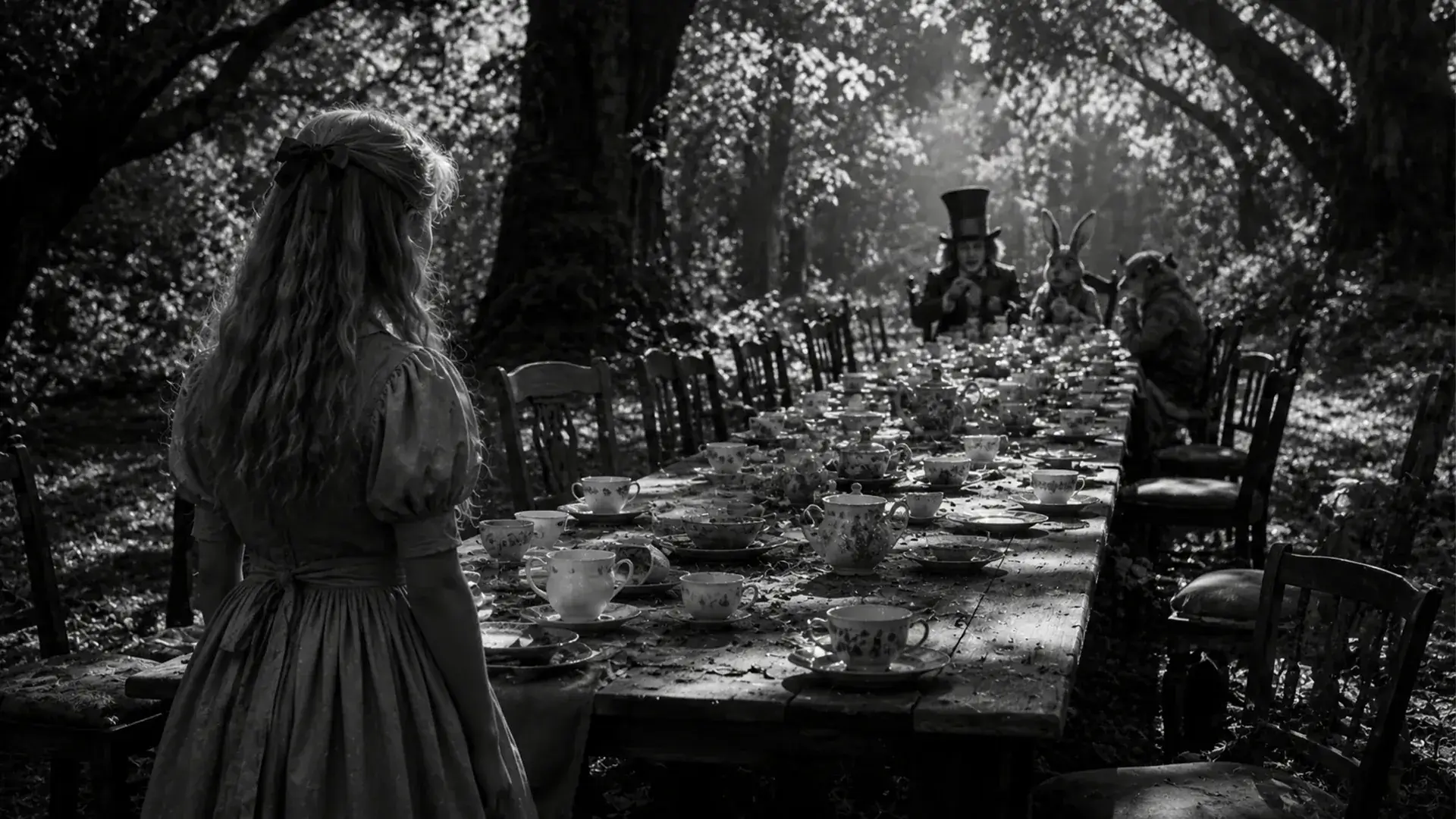
Alice arrives at the March Hare’s house to find a long table set for many guests, three creatures crowded into one corner of it, and a sign on the door that might as well read: abandon logic, all ye who enter here. She sits down anyway. She has been doing that all through Wonderland — walking into rooms she wasn’t invited into, sitting at tables that weren’t set for her, staying when she should probably leave.
The Mad Tea Party is the strangest chapter in a strange book. The conversation is illogical, the riddle has no answer, the watch is broken, and time itself has stopped at six o’clock. Most readers, encountering it for the first time, conclude that Carroll simply let his imagination run loose.
That’s the wrong conclusion. The Mad Tea Party is one of the most precisely constructed chapters in the book. The chaos is not accidental. It has a logic. You just have to read slowly enough to find it.
Saying What You Mean Is Not the Same as Meaning What You Say
It starts with a correction. Alice says she means what she says. The Hatter informs her that saying what you mean is not at all the same thing as meaning what you say. Then he offers three examples so precise they stop you cold:
I see what I eat is not the same as I eat what I see.
I like what I get is not the same as I get what I like.
I breathe when I sleep is not the same as I sleep when I breathe.
Each of those pairs looks symmetrical. They use the same words. But reverse the order and the meaning collapses entirely. You can see a bush without eating it. You don’t get everything you like. The dormouse, who adds the third example in his sleep, has the most extreme case: if you only breathe when you sleep, you’re dead when you’re awake.
The Hatter is not mad. He is a logician. The madness is that he’s right, and Alice — who thought she was making a perfectly sensible point about honesty — has to sit with that.
Time Is a Him
Alice complains that the riddle — why is a raven like a writing desk? — has no answer. She says they are wasting time. The Hatter corrects her again: time is not an it. Time is a him. And you don’t waste him. You get along with him, or you don’t.
The Hatter explains that he and Time had a falling out at a concert — the Queen accused him of murdering the time while singing, and ever since, Time has refused to cooperate. It is always six o’clock. Always tea time. The cups never get washed because there is never a between-time in which to wash them. So they move around the table, cup by cup, using clean ones until they run out, then coming around to the dirty ones again.
That image — three creatures moving in a circle around an endless table, never finishing, never cleaning up, always at the same hour — is one of the most precise pictures of being stuck that literature has produced. It is not random. It is the logical consequence of a quarrel with time. When you stop cooperating with the forward movement of things, you go in circles. The mess accumulates. You just keep moving to the next clean cup.
Alice eventually asks what happens when they come back to the beginning again. The March Hare changes the subject. It’s the one question at the tea party that nobody answers. Carroll leaves it open. So will we.
The Duchess’s Kitchen: Where Chaos Gets Physical
A chapter earlier, Alice walked into the Duchess’s kitchen and found a different kind of chaos — not logical but physical. The cook was throwing fire irons and saucepans at the Duchess and the baby. The Duchess sat and took it without flinching. The baby sneezed and howled alternately without pause. There was too much pepper in the soup.
In the middle of this, the Duchess delivered a maxim: if everybody minded their own business, the world would go around a great deal faster than it does. Alice, to her credit, immediately spotted the flaw. If the world went around faster, what would that do to day and night? The Duchess’s moral has no logical connection to its cause. Pots are being thrown. The solution offered is minding your own business. The two things are unrelated.
That’s the pattern of chaos in Wonderland: the response is always disproportionate to the event, and the explanation always misses the point. The Queen orders heads cut off because the roses are the wrong color. The Duchess hands out morals that don’t fit the situation. The Hatter’s watch tells the date but not the time. Rules exist, but they don’t connect to anything.
Rules Only Hold Where They’re Agreed Upon
Here is the through-line connecting the Tea Party, the Duchess’s kitchen, and most of what Alice encounters in Wonderland: rules only hold where they are agreed upon. The moment you enter a space where the other parties have different rules — or no rules, or rules that change mid-game — your own rulebook becomes useless.
Alice came from a world where things mean what they say, lessons stay learned, and manners produce predictable results. In Wonderland, none of that holds. Saying what you mean is not the same as meaning what you say. Time is a person you can quarrel with. The correct behavior at a procession is apparently to fall on your face, except Alice never heard that rule, so she just stands there — and it turns out, that works too.
What Alice is learning — the hard way, the only way — is that the rules she was given before she fell asleep were rules for one specific place and time. They are not universal. They are not permanent. And when you end up somewhere that operates differently, the question is not why don’t these people follow the rules? The question is what are the rules here, and do I accept them? That’s a harder question. It requires you to look at a situation clearly rather than through the lens of what you already know.
The Word Alice Uses
When Alice receives the thimble as a prize from the Dodo — her own thimble, handed back to her with ceremony — she thinks the whole thing is absurd. It’s one of the few times she uses that word in the entire book. Absurd: wildly unreasonable, illogical, inappropriate.
But she doesn’t laugh. She bows and accepts the thimble, because they are all looking at her so gravely that laughing feels wrong. That small detail matters. Alice is learning that even in an absurd situation — especially in an absurd situation — you read the room. You don’t impose your own reaction on a moment that calls for something else. That’s not surrender. That’s awareness.
The Mad Tea Party ends with Alice walking out in disgust — the Hatter tells her she shouldn’t talk if she doesn’t think, and that’s the line she won’t cross. She leaves. Neither the Hatter nor the March Hare notices or calls after her.
She says, walking away through the wood: It’s the stupidest tea party I ever was at in all my life. And she’s right. But she stayed until she had learned what it had to teach her. That’s not stupidity. That’s exactly what you’re supposed to do with a difficult situation: stay long enough to understand it, leave before it breaks you.
— Next in the series: The Grass Is Always Greener — Alice Finally Reaches the Garden
Reading with Jimmy analyzes canonical texts through close reading of language, character, and structure. Watch the full video analysis at readingwithjimmy.com.