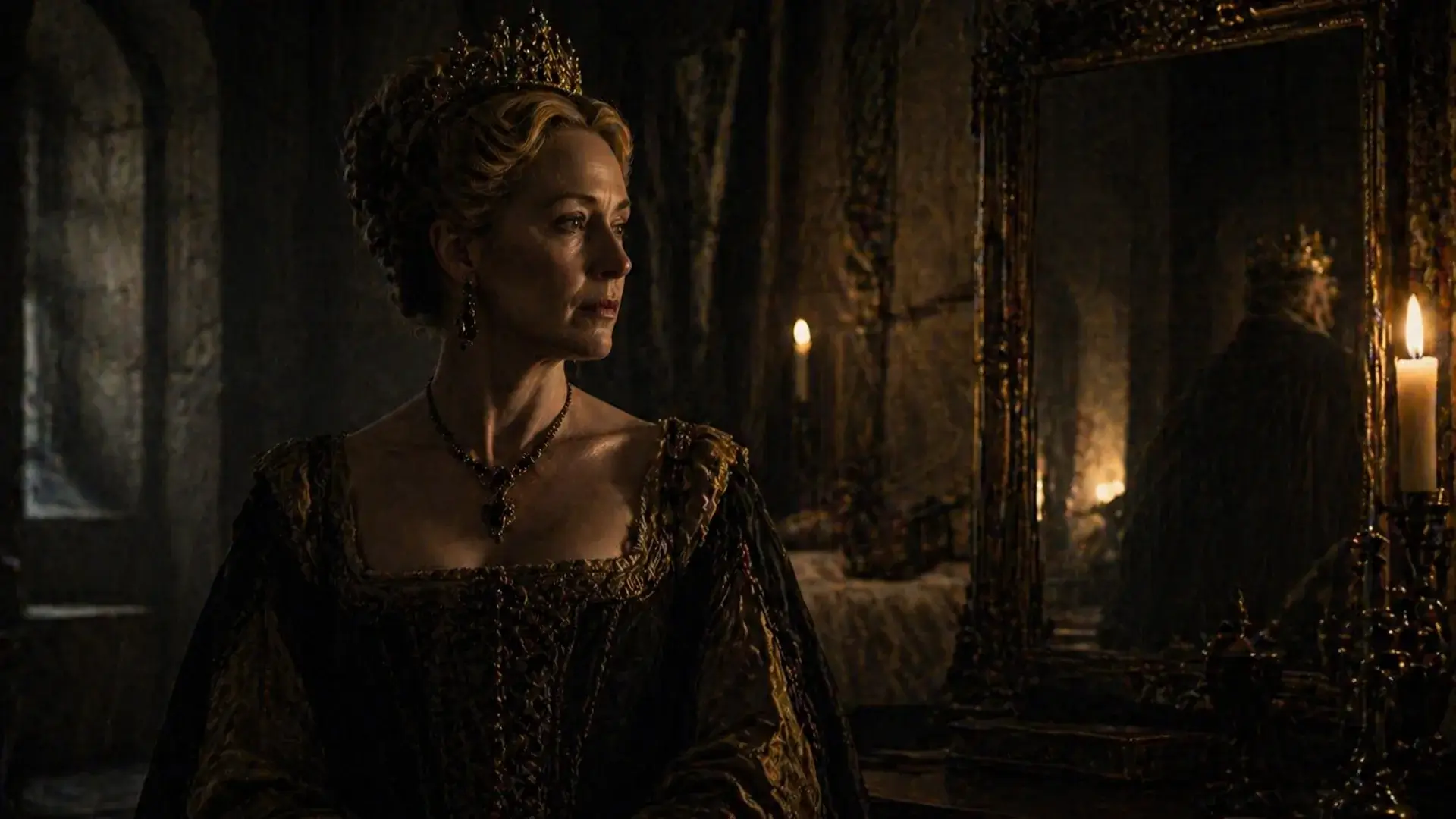
Everyone in Hamlet is watching someone else.
Polonius watches Hamlet through Ophelia. Claudius watches Hamlet through Rosencrantz and Guildenstern. Horatio watches the King at Hamlet’s request during the play within the play. The soldiers watch the battlements. Hamlet watches everyone.
Gertrude watches nothing.
Not because she’s stupid. Not because she’s complicit. Because she has decided — somewhere below the level of conscious thought — that there are things she cannot afford to see. And in a play full of people who see too much, she is the one who sees least. That’s not a minor character flaw. That’s the most disturbing thing Shakespeare puts on the stage.
Jimmy once got a call from a bank VP he hadn’t heard from in a while. When he asked what was going on there was silence — and then she said she had lost her father the week before. They talked for half an hour. What stayed with him wasn’t the grief itself. It was something she said near the end of the conversation — that she had seen it coming for a long time and hadn’t let herself look directly at it. She knew. She just couldn’t afford to know yet.
That’s Gertrude. For five acts.
The bedroom scene in Act Three is the hinge of her character.
Hamlet has killed Polonius. The ghost has just appeared — visible to Hamlet, invisible to Gertrude. And Hamlet turns on his mother with everything he knows. Claudius killed your husband. The man you married within weeks of your husband’s death is a murderer. This is what you chose. This is what you are living inside.
Gertrude’s response is not denial. It’s not defense. It’s this:
Speak no more. These words like daggers enter in my ears. No more, sweet Hamlet.
She’s not saying it isn’t true. She’s saying she cannot bear to hear it. There is a difference between those two things and Shakespeare knows exactly which one he’s writing.
The ghost knows it too. He appears not to help Hamlet make his case but to stop him from making it. Step between her and her fighting soul. Her soul is fighting. That means something is landing. The ghost isn’t protecting Gertrude from a false accusation. He’s protecting her from a truth she isn’t equipped to survive intact.
This is where perception in Hamlet becomes more than a literary theme. It becomes a question you have to answer about yourself to yourself.
What you do when seeing the truth clearly may require you to dismantle everything you’ve built your life around.
Gertrude remarried quickly. There are practical reasons — Claudius needed the marriage to legitimize the throne, and Hamlet wasn’t there to take it. But there are also human reasons that Shakespeare leaves deliberately unspoken. She was a queen. She had a position, a court, a life. To see Claudius clearly would have meant seeing everything she had accepted in marrying him. Some truths are too expensive, too painful to look at directly.
Jimmy has known people like this. You may too. Not murderers — but people living inside institutions, marriages, partnerships, where the truth of what was actually happening was available to them if they chose to look. They didn’t choose to look. Not because they were weak exactly. Because the cost of seeing was higher than the cost of not seeing. At least for the moment. At least until the point when the bill comes due.
Gertrude’s bill comes due in the final scene. She drinks from the cup Claudius prepared for Hamlet. He tells her not to drink. She drinks anyway — whether from thirst, from habit, from wanting to do something maternal for a son she has failed, we don’t know. Shakespeare doesn’t tell us. The third person narrator presents the action and leaves the interpretation to us.
What we know is that the cup was always there. The poison was always in it. Gertrude just never looked.
Ophelia is the other side of this.
Where Gertrude chooses not to see, Ophelia sees everything and has no framework to hold it. Hamlet’s behavior. Her father’s manipulation. The court’s indifference. She doesn’t have Gertrude’s position or Hamlet’s intelligence or Horatio’s steadiness to metabolize what she’s experiencing. She just absorbs it until there’s nothing left to absorb.
Her madness in Act Four is not a subplot. It’s what happens when perception has no outlet — when you see too much and have nowhere to put it and no one willing to tell you the truth about what you’re seeing. She answers questions by singing because direct language has stopped being adequate to what she knows.
Jimmy noted something in the analysis that most readers miss. Ophelia never really had a choice in this play. Her father told her what to feel about Hamlet. The court told her what to feel about her father’s death. Hamlet told her he never loved her — and then died in her grave fighting Laertes to prove that he did. She was pulled in every direction by people who needed her to see things a certain way and never once asked what she actually saw.
That’s not a minor tragedy inside the major one. That’s Shakespeare showing you what it costs a person when everyone around them controls the frame of their perception.
Seeming versus being.
It’s Hamlet’s first argument in the play. His mother asks why he seems so sad. He corrects her immediately — it isn’t seems, it’s is. He is sad. He isn’t performing grief. He isn’t wearing the costume of a grieving son. He is one.
That distinction — between what things appear to be and what they actually are — runs through every act, every character, every scene. Claudius seems like a king. He is a murderer. Hamlet seems mad. He is the clearest thinker in the room. Rosencrantz and Guildenstern seem like friends. They are instruments. Polonius seems like a wise counselor. He is a busybody who dies for his nosiness.
And Gertrude seems like a woman who didn’t know. Is she?
Whether she is one — that’s the question Shakespeare leaves open. It’s open on purpose. Because the answer depends entirely on how honestly you’re willing to look at what the text actually shows you versus what you want it to show you.
Which is exactly the kind of reader Hamlet is asking you to be.
This is the third in a four-part series on Hamlet at ReadingWithJimmy.com. Previously: Claudius didn’t just kill his brother — he killed everyone who trusted him. Next: The ghost is not a plot device — he’s the root cause of every death in Hamlet.