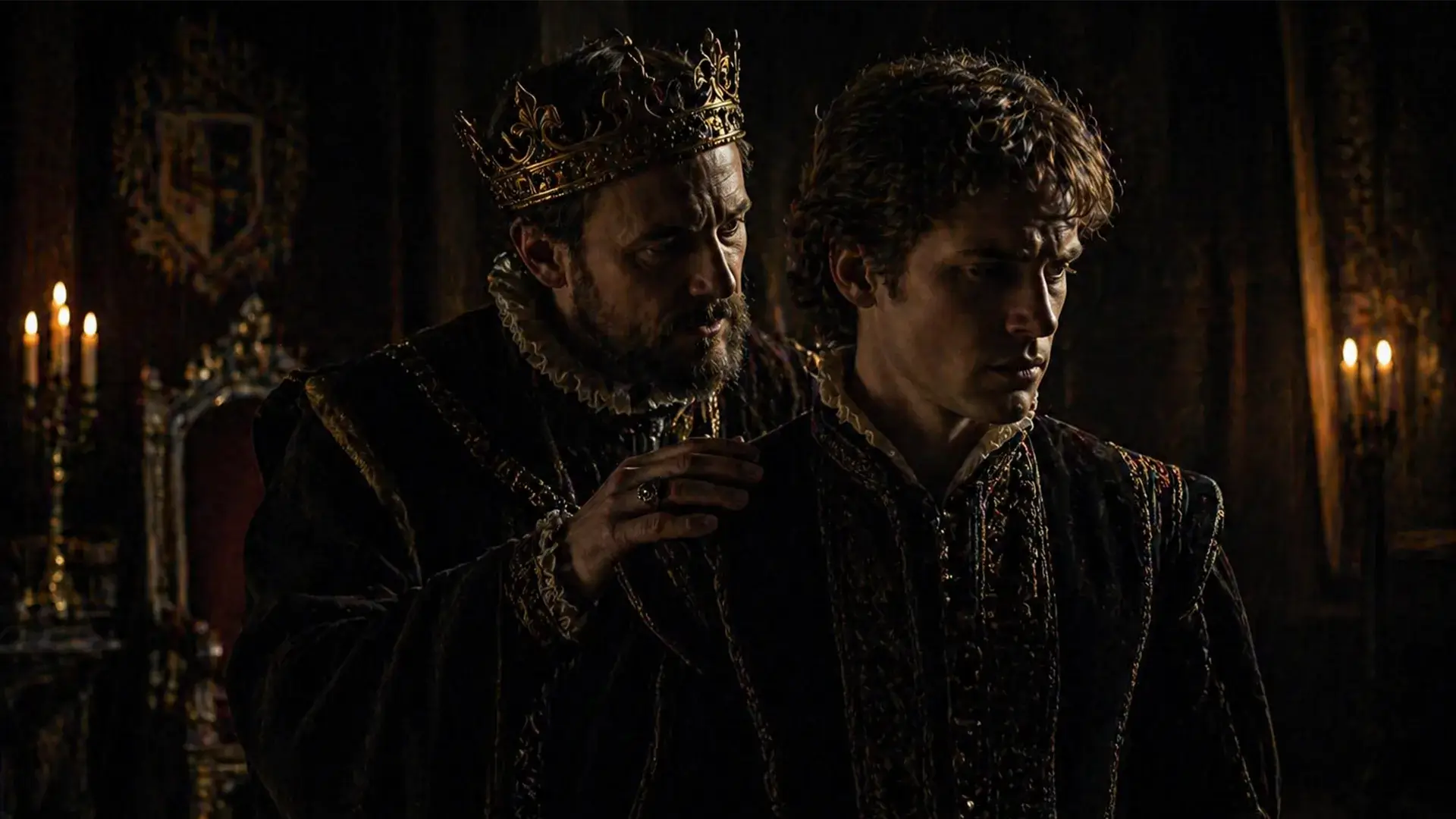
There is a moment in Act Four where Claudius takes a grieving son whose father has just been murdered and turns that grief into a murder plot. He does it in about twelve lines. He asks Laertes whether he loved his father. He lets the question sit. Then he steers the answer exactly where he needs it to go.
It is one of the most efficient acts of manipulation in all of classical literature.
And if you’ve spent any time in the world, you’ve seen it before. Not on a stage. In a boardroom. In a family. In a friendship. You’ve met Claudius. You probably didn’t recognize him at the time.
Jimmy once watched a client lose a twenty-five year relationship because someone new walked in the door and played him the same way Claudius plays Laertes. Identified the grief. Named it. Redirected it. By the time the client realized what had happened, the relationship was gone and the damage was done. The manipulator had moved on.
That’s what Claudius does to everyone around him for five acts. And almost no one sees it coming.
The ethics of Hamlet are not abstract. They’re not a philosophy seminar about the morality of revenge. They’re a case study in what happens when one man in a position of power has no conscience and everyone around him does.
Claudius kills his brother to become king. He marries his brother’s wife to consolidate the throne. He sends his nephew (Hamlet) to England with sealed orders for his execution. He plots with Laertes to kill Hamlet with a poisoned blade — and adds a poisoned cup as a backup, just in case the blade doesn’t work. His own wife drinks from that cup. He shouts don’t drink — too late. She’s already gone.
Not once in five acts does Claudius tell the truth to anyone.
That’s not a villain constructed for theatrical convenience. That’s a character study in what a man without conscience actually looks like from the inside of a story. Shakespeare doesn’t tell you he’s evil. He shows you what he does and lets you conclude it yourself.
This is where understanding narration changes how you read the ethics.
Because Hamlet is third person narration — a godlike narrator presenting characters for our judgment without commentary — you have to determine the ethics yourself from what the characters do and say. The narrator never steps in and says Claudius is a bad man. He just shows you Claudius lying to Laertes, lying to Gertrude, lying to the court, lying to himself in that brief prayer scene in Act Three where he confesses his offense and then does nothing about it.
That prayer scene is the most revealing moment in the play for understanding Claudius’s ethics. He knows what he did. He knows it was wrong. He even kneels down and tries to pray about it. And then he gets up, walks back into the court, and keeps plotting to kill his nephew.
Conscience without consequence is not conscience. It’s evil.
Hamlet has genuine conscience. It costs him everything — it’s the thing that stops him from killing Claudius at prayer, the thing that makes him verify before he acts, the thing that makes him feel the weight of Polonius’s death even though it was a mistake. His conscience is real because it actually governs his behavior.
Claudius’s conscience is performance, an act. He feels guilty enough to kneel. Not guilty enough to stop.
The ethical question the play forces you to answer is not whether revenge is right or wrong. That’s the question most people think they’re supposed to be answering. The real question is more uncomfortable.
What do you do when you know the truth and the person who needs to answer for it is protected by everyone around them who doesn’t?
Hamlet knows Claudius killed his father. Horatio knows. The audience knows. And Claudius sits on the throne, delivers speeches about grief and loyalty, and sends his nephew to his death with a smile.
The truth is completely isolated. One man knows it and can’t prove it to anyone who matters without being dismissed as mad.
Jimmy has seen this too. Not murder — but the isolation of truth inside an institution that has decided the truth is inconvenient. The person who knows what actually happened gets called difficult, unstable, obsessive. The person who did it keeps their position. You’ve seen it. Maybe you’ve lived it.
That’s what Shakespeare is showing you in Claudius. Not a cartoon villain. A recognizable human being who decided the cost of truth was too high and spent the rest of his life managing the consequences of that decision — by eliminating anyone who threatened to expose it.
Laertes is the clearest victim of this. He comes back from France with soldiers and genuine grief and a legitimate grievance. His father is dead. His sister is losing her mind. He wants answers and he wants justice.
Claudius gives him neither. He gives him a target.
By the time Laertes agrees to the poisoned blade he has been so thoroughly manipulated that he believes he’s acting on principle. That’s what makes Claudius dangerous. He doesn’t force people to do what he wants. He makes them think they want to do it themselves.
Laertes realizes the truth too late — on the floor of the fencing hall, bleeding from the same poison he agreed to use on Hamlet. His last act is to tell Hamlet who was really responsible. Even then, it costs him everything to say it.
There is a line from Gertrude in Act Four that Jimmy has never forgotten.
So full of artless jealousy is guilt, it spills itself in fearing to be spilt.
She says it almost in passing. But it is one of the most precise observations about conscience in the entire play. Guilt, when it has nowhere to go, leaks. The person carrying it starts to spill it precisely because they’re so afraid of being exposed. They overexplain. They overreact. They move too fast and too hard against anyone who seems to know too much.
Watch Claudius across five acts with that line in mind. Every move he makes against Hamlet — the trip to England, the sealed orders, the fencing plot — is guilt spilling itself in fearing to be spilt. He’s not eliminating a threat. He’s trying to bury a truth that keeps finding its way back to the surface.
It never works. It never does.
This is the second in a four-part series on Hamlet at ReadingWithJimmy.com. Previously: Hamlet is not about a man who can’t make up his mind. Next: Hamlet’s mother didn’t know — and that’s the most disturbing thing in the play.