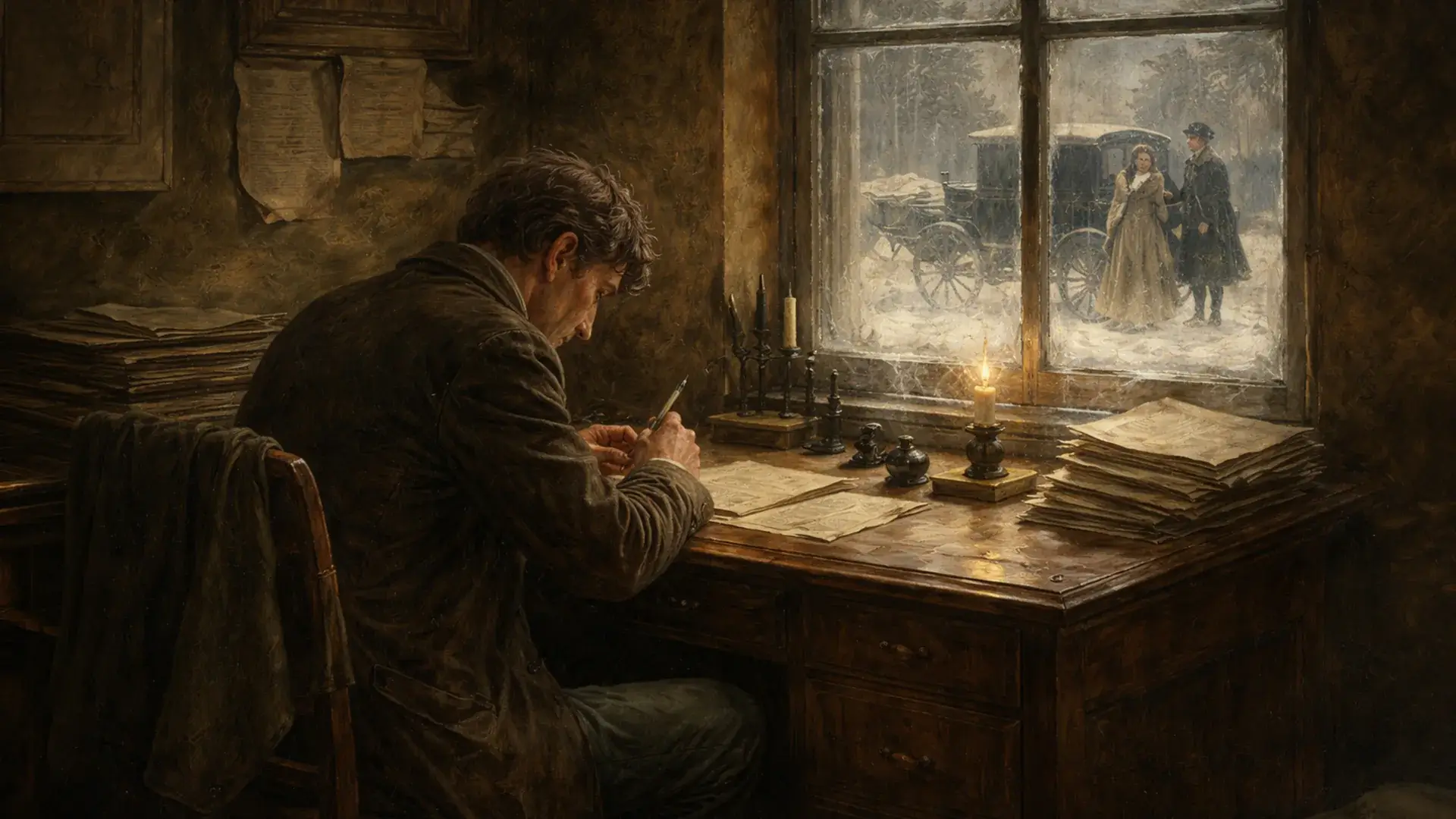
Diary of a Madman — A Reading with Jimmy Series
Most readers approach Diary of a Madman as satire. Gogol’s story is usually presented as a comic attack on bureaucracy, social climbing, or the absurd hierarchies of imperial Russia. And certainly those elements are present.
But Gogol’s story becomes far more disturbing if we read it more closely.
Because Diary of a Madman is not simply about a clerk. It is about what happens when a man’s sense of himself slowly detaches from reality — and begins replacing the world with a story he needs to believe.
At first the narrator seems merely insecure. Then he becomes defensive. Then imaginative. Then convinced.
What makes the story unsettling is that Gogol does not show madness arriving all at once. He shows it assembling itself piece by piece, until the narrator’s inner logic becomes stronger than the world around him.
Across this short series, we will follow that progression: how wounded pride becomes fantasy, how fantasy becomes belief, and how belief ultimately becomes a new reality the narrator cannot escape.
Because the tragedy in Diary of a Madman is not that a man goes mad.
It is that we see how madness is built within — one perception at a time.
Most readers approach Diary of a Madman expecting a story about insanity. The title practically tells us what we are about to see. By the end of the story, the narrator believes he is the King of Spain and has been confined to what he believes is the Spanish court.
So yes, the story ends in madness.
But if we follow the narrator’s diary carefully, we notice something important: madness does not arrive suddenly. It develops slowly, almost logically, as the narrator explains the world to himself one perception at a time.
And that is what makes Gogol’s story so fascinating and such a classic; where else can you see someone going…insane?
A Note About the Narrator
Before discussing the story itself, it is worth noting something about the translation we read.
In Andrew R. MacAndrew’s translation, the narrator is never named. In some translations and commentaries, you will encounter the name Poprishchin. But in this version, the narrator remains anonymous.
That detail is actually important.
Without a name, the narrator becomes less a specific character and more a type — an ordinary civil servant whose inner life we are allowed to observe through his diary. The anonymity also reinforces the diary form itself. This is simply a man writing about his days, his thoughts, and his perceptions.
And because it is a diary, we are reading what is going on inside his mind.
The Story Begins with an “Extraordinary” Event
The narrator opens his diary entry with a curious statement:
Something extraordinary happened today.
Yet what follows at first appears ordinary. He wakes up late, asks his servant the time, and prepares for work. At this point nothing seems particularly unusual.
But the way he describes the world around him immediately reveals something about his thinking.
He records a criticism from his superior, who complains that he is always in a muddle — running around, making mistakes in his clerical work, and failing to organize documents properly.
The narrator’s response is interesting.
Instead of accepting the criticism, he dismisses his boss as a “vicious old crane” and suggests that the man must envy him for sitting in the director’s office sharpening quills.
This is our first glimpse into how the narrator interprets the world.
He does not simply observe events.
He explains them to himself. Something we all do, perhaps. It’s called, interpretation!
Envy and Interpretation
The narrator’s explanation reveals a great deal about his character, his inner life.
If someone criticizes him, it cannot simply be criticism. It must be jealousy. If someone outranks him in the bureaucracy, that position must somehow be undeserved. If others enjoy status or prestige, he searches for reasons to reinterpret that advantage.
In other words, he is constantly comparing himself with others and in that comparison, coming up short.
Those comparisons produce something that the narrator himself recognizes: envy.
Envy is one of the classic vices described in Christian theology — the pain we feel when others possess what we believe we ought to have. Whether the narrator understands this clearly or not, his diary reveals that the idea is shaping his thinking.
Every observation becomes a comparison.
Every comparison becomes an explanation.
And every explanation reinforces the narrator’s sense that the world is somehow misjudging him.
Watching the World
As the narrator walks through the city, we see how active his mind is. He observes other civil servants, strangers on the street, and the behavior of people around him.
But these observations are rarely neutral.
He constantly interprets what he sees. He layers his perceptions with a story, a judgement.
He suspects motives, assigns intentions, and imagines thoughts in the minds of others. In psychological terms, we might call this projection — attributing your own feelings or attitudes to other people.
The narrator does not simply observe the world.
He interprets it through the lens of his own concerns. That’s something we all do, don’t we? But to understand reality, we have to take our own “coloring” out of the perception.
And what concerns our narrator most is status.
The Director’s Daughter
One moment in particular reveals this clearly as he is on the street.
When the director’s daughter appears, the narrator presses himself against a wall to avoid being seen. His coat is old and out of fashion, and he is suddenly conscious of his appearance.
That single detail tells us a great deal.
He knows exactly where he stands socially.
The director’s daughter belongs to a world above him — a world of rank, wealth, and refinement. The narrator may encounter that world in the office, but he cannot truly enter it.
Envy.
His reaction shows embarrassment, admiration, and longing all at once.
The director’s daughter is an important figure in the narrator’s imagination as we see his slow decent into madness.
The Extraordinary Event
It is only after all of this that the narrator records the “extraordinary” event he mentioned way back at the beginning of the entry.
He hears two dogs talking.
At first even he is surprised. He wonders whether he might be mistaken. But almost immediately he begins trying to explain the event logically.
Perhaps animals are capable of speech. Perhaps science has not yet discovered it. Perhaps he has simply misunderstood something he heard.
Notice what he is doing.
Instead of dismissing the event as impossible, he begins building explanations that allow the perception to remain true.
This moment is crucial.
Because the narrator is not yet behaving irrationally in the world around him. It’s only in his own mind. He is not acting out these thoughts.
But in his diary we can see how his mind works when confronted with something that contradicts ordinary experience.
He begins constructing explanations. Justifications. Turning his imaginations into, well, reality.
Inside the Mind
That is what the diary form allows us to witness.
A diary is not a polished story told after the fact. It is a record of thoughts as they occur. The narrator writes what he sees, what he hears, and how he interprets those things.
And because we are reading his diary, we are not observing the narrator from the outside.
We are inside his mind. We never know what another mind is thinking, do we?
This is what makes the story so compelling.
We are not merely told that a man goes mad. We watch the process as it unfolds — perception by perception, explanation by explanation.
Before the Madness
At this early stage of the story, the narrator has not yet done anything that would cause alarm among the people around him. He still goes to work. He still moves through the world as a civil servant. His thoughts remain largely private.
But in his diary we can see something beginning to shift.
His interpretations are becoming more elaborate. His explanations are becoming more imaginative. And his sense of reality is slowly being replaced by the reality he is building about the world around him.
The madness has not yet been translated in behavior.
But the foundations of behavior are already being created.
What We Are Watching
In Diary of a Madman, Gogol allows us to witness something unusual in literature: the gradual transformation of perception into belief and into a person’s reality.
At first the narrator simply records what he sees.
Then he interprets it.
Then he explains it.
And eventually those explanations become more convincing to him of the world around him – his reality…his interpretation of things.
The tragedy in this story is not that a man suddenly loses his mind.
It is that we see how the mind begins to build madness within — one explanation at a time.
In the next post, we will watch the narrator’s journey into madness. The explanations that once lived quietly inside his diary and mind begin to change his behavior in the actual real world. When he declares himself the King of Spain, society responds—and he is taken away.
What follows is one of the most haunting endings in literature, where suffering briefly breaks through the madness before the mind retreats back into the world it has built.