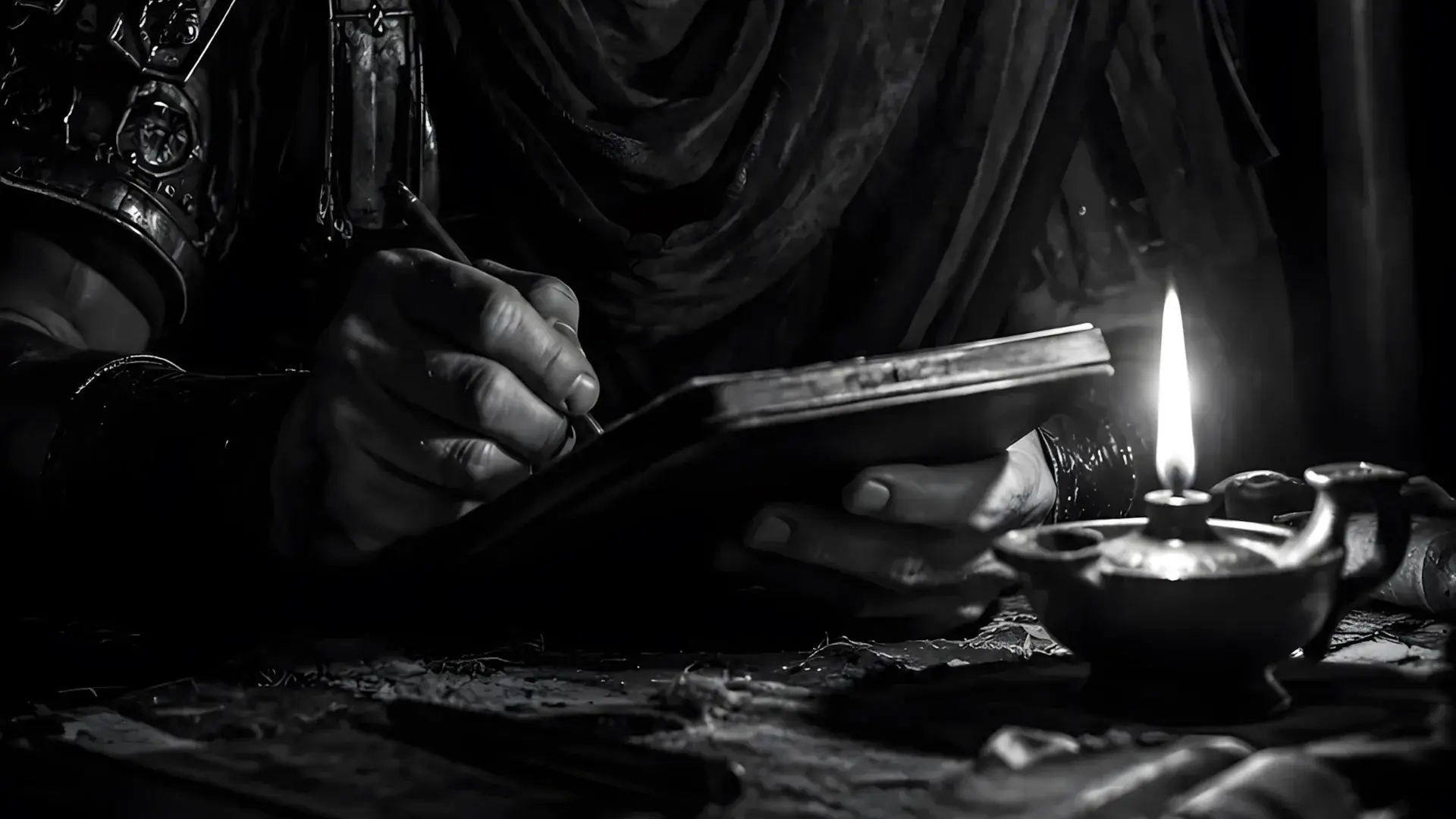
In Meditation V, entry 13, Marcus Aurelius wrote this:
I am composed of the formal and the material; and neither of them will perish into non-existence, as neither of them came into existence out of non-existence. Every part of me then will be reduced by change into some part of the universe, and that again will change into another part of the universe, and so on forever.
He was writing this on a battlefield. In 170 AD. Without a telescope, a laboratory, or a mathematical framework.
Albert Einstein proved the same thing in 1905 with E=mc².
Matter cannot be created or destroyed. It only changes form.
What Marcus Actually Understood
The formal and the material. In Marcus’s language, the formal is the animating principle — the reason, the soul, whatever gives the body its shape and function. The material is the physical body itself. His claim: neither of them will disappear. Because neither came from nothing.
This was not a wild guess. The Greek philosopher Parmenides, writing centuries before Marcus, had argued that being is eternal and unchanging — that nothing can transition from non-existence to existence. Marcus had read this. He’d absorbed it. And he was applying it to what it means to die.
If nothing can come from non-existence, then nothing can return to it. Therefore, death is not extinction. Death is change.
The Science That Came Later
Einstein’s law of conservation of mass-energy states that the total amount of matter and energy in a closed system remains constant. Matter converts to energy, energy converts to matter, but the total doesn’t change. You cannot create it or destroy it. You can only rearrange it.
Anton Lavoisier formulated the law of conservation of mass in the late 18th century — about sixteen hundred years after Marcus. Einstein extended and unified it in the early 20th. It’s now considered one of the fundamental laws of physics.
Marcus got there first. Not with mathematics. With thought.
Jimmy finds this extraordinary. Not because Marcus predicted physics. But because the argument he was making — the philosophical argument against fearing death — was grounded in the same fundamental observation that physics eventually confirmed. Things don’t end. They change.
Atoms and What They Mean
Your bones have atoms. Your blood has atoms. Your thoughts — which are electrical, which are energy — are part of the same system. When you die, those atoms don’t disappear. They become something else. Always. That’s not poetry. That’s physics.
Carl Sagan said we are made of star stuff. He meant it literally: the heavy elements in your body — carbon, nitrogen, oxygen, iron — were forged in the cores of stars that exploded before our sun was born. When the star died, its material scattered and eventually became, among other things, you.
Marcus Aurelius, standing at the Danube in winter armor, writing to himself by lamplight, had the same thought. He didn’t have Sagan’s data. He had Parmenides and Heraclitus and his own mind working the problem through.
The conclusion he reached was the same. And the conclusion matters, because he wasn’t writing physics. He was writing a rule for living without fear.
Why This Matters More Than It Should
Marcus returns to this idea again and again throughout the Meditations. Meditation VIII.18: “That which has died falls not out of the universe. If it stays here, it also changes here, and is dissolved into its proper parts, which are elements of the universe and of thyself. And these too change, and they murmur not.”
They murmur not. The atoms don’t complain about the change.
Neither should we. That’s the argument. Not a comforting platitude — a structural observation. The thing you’re afraid of isn’t extinction. It’s change. And you’ve been changing your whole life. Cell by cell, thought by thought, year by year.
You’re already doing the thing you’re afraid of. You just don’t recognize it by that name.
Read the Meditations with Jimmy at readingwithjimmy.com. Questions and reactions to [email protected].