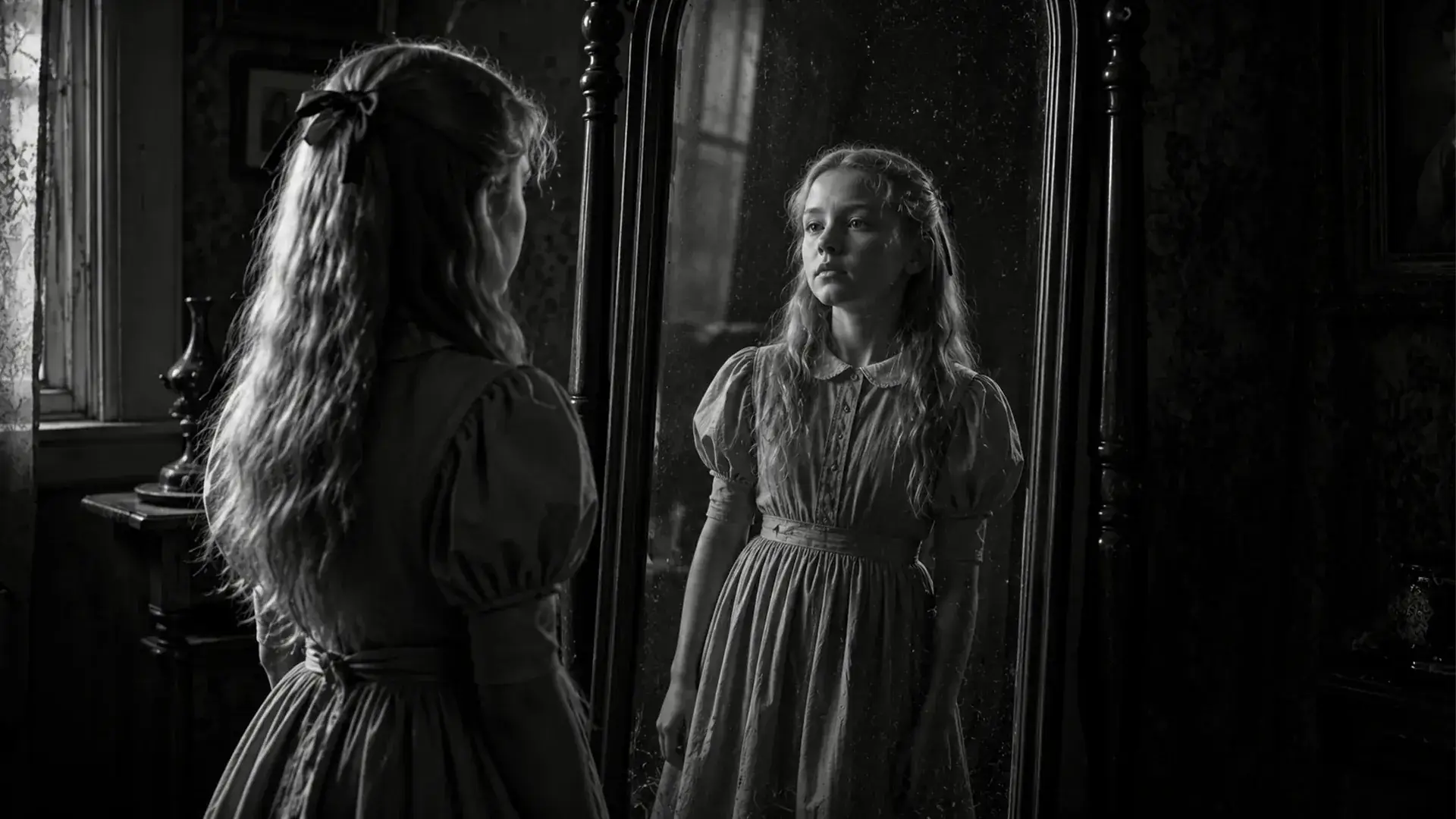
A blog series on reading Alice in Wonderland to develop your critical thinking
Alice has been in Wonderland for three chapters and already she’s the wrong size, lost her manners arguing with a pigeon, and burst uninvited into a stranger’s house. What she hasn’t done is answer a single question about herself — because every time one comes up, she realizes she doesn’t know the answer.
That’s not a subplot. That’s the plot.
Aristotle, who knew something about storytelling, said the most important element of any story is the plot — the representation of human action. Not the characters, not the spectacle, not the language. The plot. And in Alice’s Adventures in Wonderland, the plot is one long, relentless, sometimes comic investigation into a single question: who are you?
The Story Is a Dream — and That’s the Point
Before we follow Alice through Wonderland, we need to understand what Wonderland is. It’s a dream. Alice falls asleep on the riverbank, dreams the whole adventure, and wakes up at the end. The narrator tells us this. It’s not a twist — it’s the frame.
That frame matters because of what dreams do. They don’t follow rules. Cause and effect break down. Things that couldn’t happen, happen. And yet — and this is the part that’s easy to miss — dreams are not random. They are the mind’s attempt to sort out reality. The confusion you experience in a dream is usually confusion you were already carrying. Wonderland is not Alice’s escape from her questions. It’s where those questions get impossible to avoid.
Watch what happens every time Alice tries to recite something she learned — a poem, a multiplication table, a fact about geography. It comes out wrong. Not slightly wrong. Unrecognizably wrong. The knowledge she brought into the dream keeps slipping. In Wonderland, what she knew before she fell asleep is not reliable. The only thing she can test is who she is right now, in this moment, in this encounter. And that turns out to be a harder question than any poem.
The Caterpillar Asks First
The question gets asked directly in Chapter Five, and the creature who asks it is not gentle about it. The caterpillar, perched on his mushroom, opens with: Who are you? Three words. No preamble. And Alice, who has been holding herself together through a good deal of Wonderland strangeness, falls apart.
Her answer: I — I hardly know, sir, just at present. At least I know who I was when I got up this morning, but I think I must have been changed several times since then. That is not the answer of a child who has lost track of her name. That is the answer of someone who has discovered that identity is not a fixed thing. She has grown and shrunk, argued with creatures about whether she exists at all, and watched her own knowledge fail her. She doesn’t know who she is because Wonderland keeps changing the conditions under which she would normally answer that question.
The caterpillar doesn’t help her. He tells her she’ll feel differently when she changes — a reference to his own transformation, which he finds perfectly ordinary. He’s a caterpillar. Changing is what he does. For Alice, that’s cold comfort. She doesn’t want to change. She wants to get back to a self she recognizes.
The Cheshire Cat Has the Best Answer
Later, Alice meets the Cheshire Cat and asks which way she ought to go. The Cat’s reply is one of the most logically airtight exchanges in the book:
“That depends a good deal on where you want to get to.”
“I don’t much care where.”
“Then it doesn’t matter which way you go.”
Alice pushes back: so long as I get somewhere. And the Cat agrees: Oh, you’re sure to do that, if you only walk long enough. There is no flaw in that logic. If you don’t know where you want to go, any direction gets you somewhere. The Cat is not being absurd. He is being precise. And what makes the exchange sting a little is that it applies directly to Alice’s larger problem: a person who doesn’t know who she is has no fixed direction. She will get somewhere, eventually. But she won’t know when she’s arrived.
The Question That Never Stops
What Carroll understood — and what makes this book last — is that who are you is not a question with a final answer. Alice asks it of herself repeatedly, in different forms, under different pressures. When she’s the wrong size, she wonders if she’s been swapped for a different child. When she can’t recite her lessons correctly, she wonders if her mind is still hers. When creatures challenge her, she defends a self she’s not entirely sure of.
This is what growing up actually looks like from the inside. Not a smooth progression from child to adult. A series of encounters with a world that doesn’t operate the way you were told it would, each one forcing you to revise your understanding of yourself. Alice is brave, afraid, lonely, curious, angry, polite, and reckless — sometimes in the same chapter. She’s not confused because she’s a child. She’s confused because the question is genuinely hard.
The caterpillar’s question doesn’t get a clean answer in Chapter Five. It doesn’t get one by the end of the book either. What Alice gets instead is something more useful: practice. Chapter by chapter, she learns to hold her ground a little longer, argue a little more precisely, and trust her own observations a little more firmly. By the time she faces the Queen of Hearts, she has discovered something the caterpillar couldn’t tell her: you find out who you are by watching what you do when the pressure is on.
Aristotle Was Right About This Too
Aristotle said a successful plot must produce two emotions in the reader: pity and fear. Then, at the end, catharsis — relief, release, the feeling of having been through something and come out the other side.
Read Alice with that in mind and see if it doesn’t hold. You feel pity when Alice cries, alone, at the wrong size, with no one to help her. You feel fear when the Queen starts ordering executions. And when Alice wakes up on the riverbank, safe, in the ordinary afternoon, the catharsis is real — it was only a dream, and she is fine, and she already knows she’ll carry the dream with her.
That’s a complete story. That’s a plot Aristotle would have recognized. The fact that it’s dressed in talking caterpillars and vanishing cats doesn’t change the structure underneath. If anything, the dream logic makes the emotional truth more direct — in a dream, you can’t hide from the questions. Neither can Alice.
— Next in the series: Actions Define You — The Pigeon, the Serpent, and What You Do When No One Believes You
Reading with Jimmy analyzes canonical texts through close reading of language, character, and structure. Watch the full video analysis at readingwithjimmy.com.