A blog series on reading Alice in Wonderland to develop your critical thinking
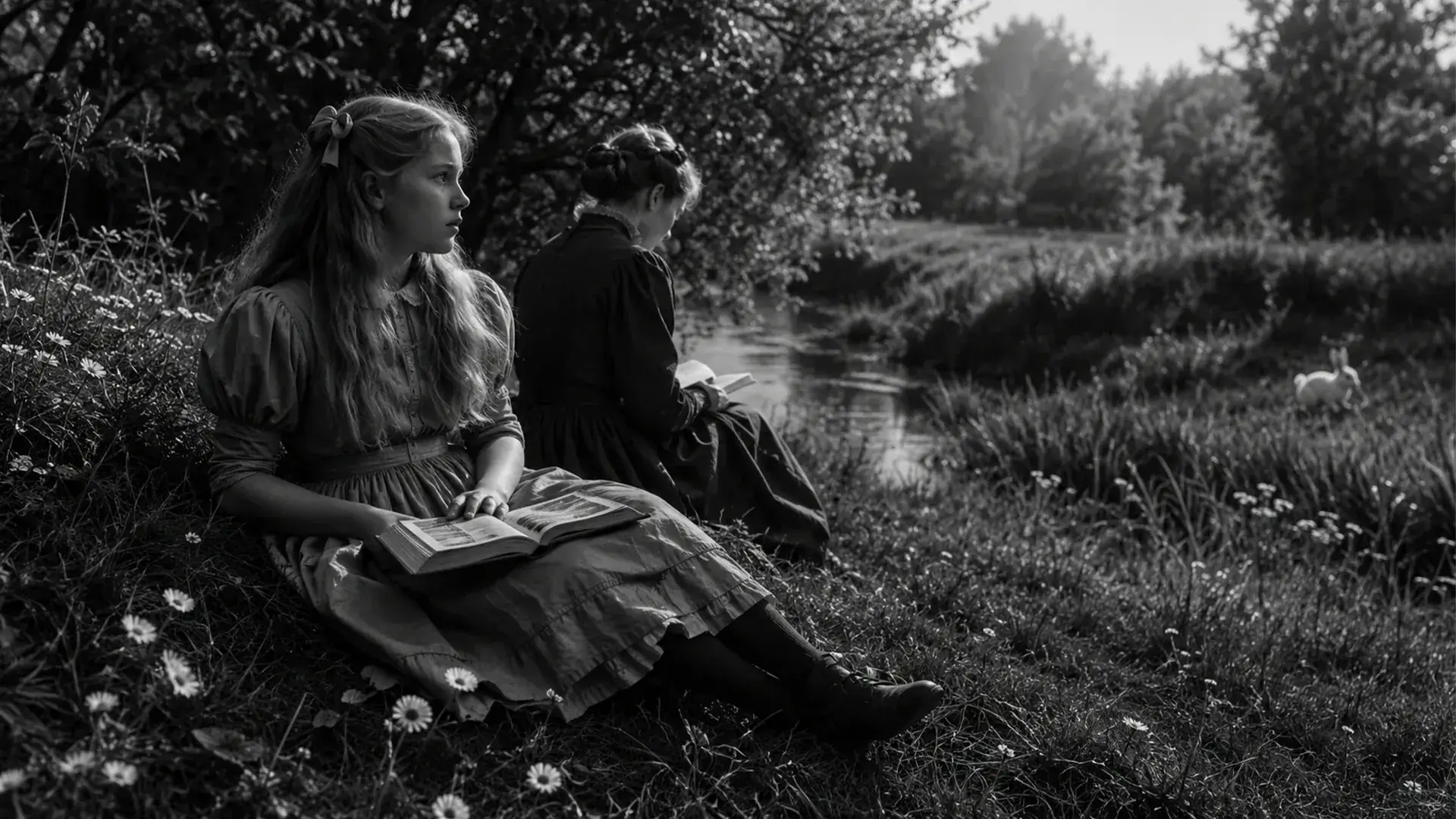
Lewis Carroll wrote 57 words before a single thing happened in Alice’s Adventures in Wonderland. No rabbit yet. No rabbit hole. Just a little girl sitting on a riverbank, bored, glancing at her sister’s book and finding it useless because it had no pictures. Fifty-seven words to say, essentially, Alice was tired.
That’s not throat-clearing. That’s craft. And the first page of this story is one of the best arguments I know for why reading slowly matters.
The Sentence Does More Work Than You Think
Start with the structure. Carroll could have written: Alice was tired. Subject, verb, done. Instead he wrote 57 words that enrich that simple fact until it becomes a complete world. She’s sitting on a bank — not a building, the sloped edge of a river, where daisies grow. She’s with her sister. She has looked at her sister’s book and rejected it because it had no pictures or conversations. She is considering whether making a daisy chain would be worth the trouble of getting up.
That last detail is a tell. She is so bored she is evaluating the energy cost of picking flowers. Carroll, through his third-person narrator, never uses the word bored. He shows it. That difference — between telling and showing — is one of the oldest rules of writing, and it’s right there in the first sentence if you’re reading slowly and carefully enough to find it.
Who Is Telling This Story?
Here’s a question worth sitting with: who is speaking in that first sentence?
It’s not Alice. If Alice were telling the story, it would start: I was beginning to get very tired. It’s not Alice’s sister either — if her sister were narrating, she would place herself in the scene: Alice was sitting beside me on the bank. What we have instead is a narrator positioned outside the story entirely. A third-person narrator. And that matters for one reason above all others.
A third-person narrator can read minds.
You cannot read another person’s thoughts. Neither can Alice’s sister. But the narrator of Alice’s Adventures in Wonderland can and does — from the first sentence forward. What is the use of a book, thought Alice, without pictures or conversations? That’s inside her head. The narrator put us there. Keep that in mind as you read this story, because it’s going to matter. A great deal.
Punctuation Is Not Decoration
The first two sentences of Alice are full of punctuation marks, and every one of them is doing a job. The colon after nothing to do is a strong stop — not the end of a thought, but a pause that signals: something is being added. The commas pace the rhythm of the sentence, giving your reading voice — the voice in your head — room to breathe. The question mark after without pictures or conversations tells you Alice’s voice goes up. She’s not stating a fact. She’s questioning the entire premise of books that don’t engage her.
Then there are the parentheses in the second sentence: (for the hot day made her feel very sleepy and stupid). Parentheses are a sidebar. An aside. The sentence makes complete sense without them — she was considering whether the pleasure of making a daisy chain would be worth the trouble of getting up — but with them, you get one more layer: it’s hot. She’s not just bored. She’s bored and sluggish with a slightly stupid-feeling, the way a very hot summer afternoon makes everyone feel. The parentheses give you the weather and the physical sensation in seven words without interrupting the sentence to do it.
This is what punctuation actually does. It’s not grammar police work. It’s rhythm. It guides your reading voice the way a musical score guides a performer.
The Word You Don’t Know Is the One That Matters
Take the word peeped. Once or twice she had peeped into the book her sister was reading. You probably think you know what that means. But look it up anyway, because the definition does something the word alone doesn’t. To peep is to look quickly and furtively through a narrow opening. That’s not casually glancing. That’s the look of someone who doesn’t expect to find anything worth seeing but checks anyway, just in case. That one word tells you Alice’s whole relationship with her sister’s book before she confirms it has no pictures.
Or take the word bank. Most people, on first read, picture a financial institution. Then they keep reading, and there are daisies, and a river nearby, and a white rabbit running through grass. Bank here means the sloped ground alongside water. One wrong definition and the whole opening scene collapses. This is why reading with a dictionary — or at minimum a search engine — is not optional. It’s the price of admission and understanding AND appreciation!
Ready Before She Knows It
Here is what those 57 words accomplish that a lesser writer would have skipped: they establish that Alice is ready.
Not ready in the sense of prepared. Ready in the sense of restless. A mind that has rejected the book in front of it, that is calculating whether flowers are worth the energy, that asks what is the use of a book without pictures or conversation — that is a mind looking for something to happen. It is a mind that will follow a rabbit.
The white rabbit appears at the end of the second sentence — when suddenly a white rabbit with pink eyes ran close by her — and he does not wait. All of those words before him, all that boredom and heat and furtive peeking, exist to make that moment land. The rabbit is the call. Alice is already waiting for it, even if she doesn’t know it yet.
That’s what the first page of Alice’s Adventures in Wonderland does. It doesn’t just start a story. It makes an argument: a restless, questioning mind, given the right provocation, will go anywhere.
In the posts that follow, we’re going to watch that mind work — through identity crises, illogical arguments, ungovernable croquet games, and a garden that turns out to be nothing like she imagined. The whole journey starts here, on a hot afternoon, with a bored little girl and a book she didn’t want to read.
— Next in the series: Who Are You? The Central Question of the Plot
Reading with Jimmy analyzes canonical texts through close reading of language, character, and structure. Watch the full video analysis at readingwithjimmy.com.