Aristotle said the most important element of a story is plot — the representation of human action. Not theme. Not message. Action. What do the characters do?
In Beowulf, what they do is fight. And the thing they’re fighting, over and over, across three confrontations spanning fifty years, is the same thing: evil. This is not a story with a complicated moral ambiguity at its core. The lines are drawn clearly. And that clarity is not a weakness. It’s the point of the poem.
The Plot, Briefly
The scene is Viking territory, 6th-century Scandinavia. Hrothgar, king of the Danes, has a problem: a monster named Grendel has been raiding his Mead Hall, Heorot, for twelve years — coming in the night and eating his warriors. Hrothgar is a generous and wise king, but he is helpless against this particular evil.
Beowulf, the greatest warrior of the Geats — a man said to have the strength of thirty men — hears of Hrothgar’s trouble. Without being asked, he assembles fourteen of his best men, sails across the sea, and presents himself at Heorot. He will kill Grendel.
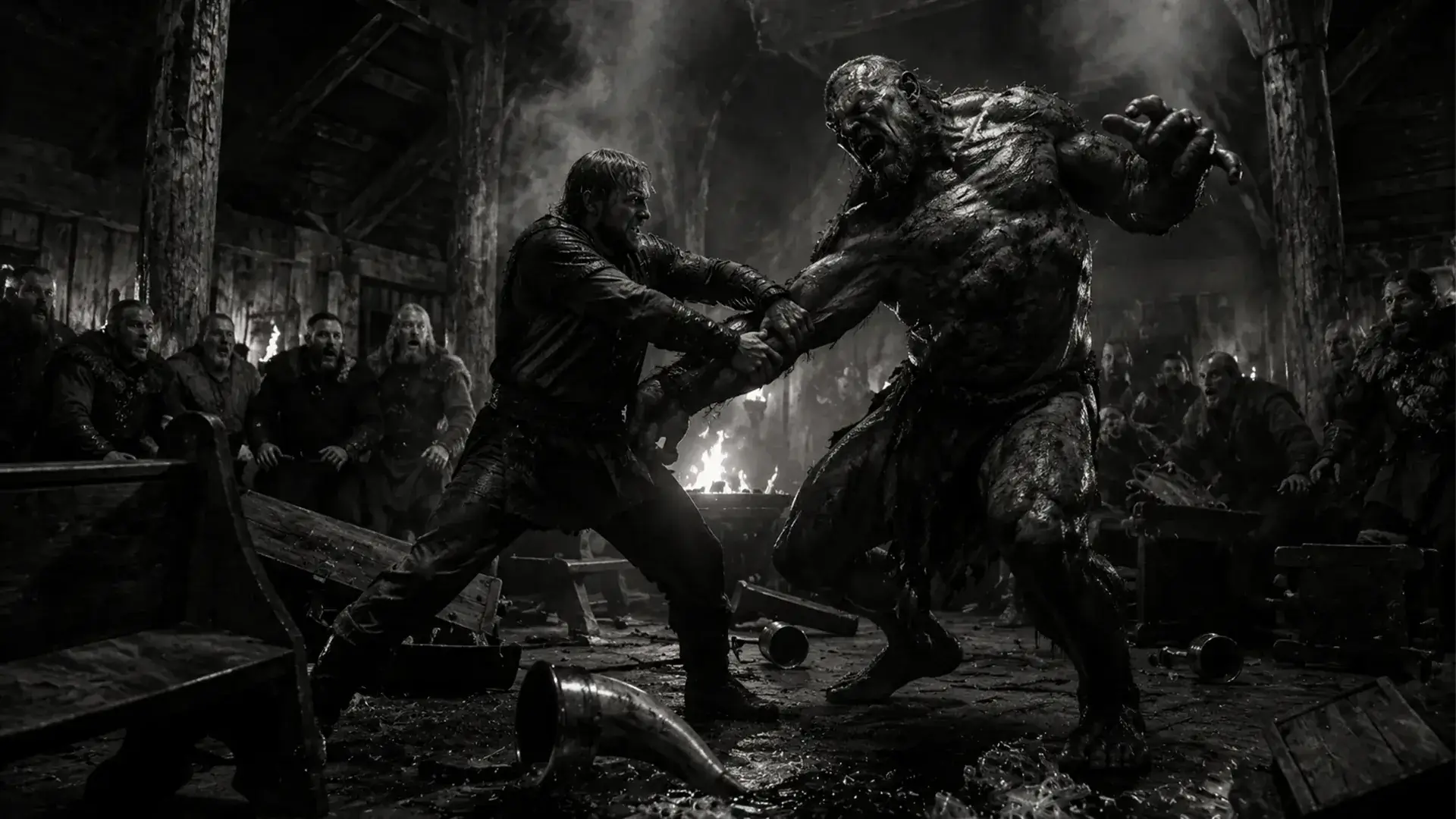
Which he does. There’s a ferocious battle in the hall; Beowulf grabs Grendel bare-handed and tears off his arm. Grendel flees, mortally wounded. Beowulf hangs the arm in the hall as a trophy.
Then Grendel’s mother comes for revenge. She kills Hrothgar’s closest advisor, Escher. Beowulf tracks her to her underwater lair, finds a giant sword, and kills her too. He returns with Grendel’s head.
He goes home a hero, eventually becomes king of the Geats, and rules for fifty years. Then a dragon begins terrorizing the kingdom. A slave — beaten by his masters, desperate for a way out — stumbles upon the dragon’s hoard and steals a jeweled cup to buy his freedom. The dragon wakes. Beowulf goes to confront it. He kills the dragon but dies from his wounds. His last request: build him a tower by the sea so sailors can see it and remember.
Every time Jimmy sees a lighthouse now, he thinks of Beowulf.
The Characters — and What They’re Made Of
Aristotle gave us four standards for characters: goodness, propriety, credibility, and consistency. Beowulf satisfies all four. Here’s who’s in the story and what matters about each of them:
Beowulf. Brave, strong, loyal, motivated by a desire for glory. He never hesitates, never doubts. He arrives without being summoned. He was scorned as a boy — the Geats thought him lazy, noble but slow — and yet he became exactly what a hero is. He doesn’t change dramatically through the poem because he was always going to be this; the story is really the revelation of what was always there.
Hrothgar. Generous, wise, once a fierce warrior. But he can’t protect his people from Grendel. He’s not weak — he’s simply not the right instrument for this particular fight. He gives Beowulf some of the best advice in the poem. He knows what pride does to kings.
Grendel. Descended from Cain — we’ll address that genealogy directly — and therefore evil. Not ambiguously evil. Not misunderstood evil. Evil. The narrator doesn’t leave room for sympathy: no crime could ever be enough, no savage assault quench his lust for evil. He preyed on Hrothgar’s warriors for twelve years. He is what he is.
Grendel’s Mother. Also evil, but with an additional motive: maternal revenge. Her son came home to die. She responded the only way she knew how. She gives Beowulf a harder fight than Grendel did.
The Dragon. Greedy, vengeful, lethal. Dragons have symbolized evil across cultures for thousands of years. In Christian and chivalric traditions specifically, the dragon is the symbol of the devil. Beowulf kills it. But the dragon kills Beowulf too. Not every victory is free.
Wiglaf. The warrior who stays. Everyone else ran when the dragon came. Wiglaf stood. He was miserable — the poem is explicit about that — but he remembered what kinship should mean. He fought beside Beowulf and helped deliver the killing blow. He is the question the poem asks each of us: when your moment comes, do you stay or do you run?
Unferth. Jealous and insecure when Beowulf first arrives — he challenges him openly, tries to diminish him. But after Beowulf kills Grendel, Unferth changes. He gives Beowulf his own sword. Of all the human characters in this story, Unferth is the one who clearly grows.
The Slave Who Changed Everything
One character nobody talks about deserves attention. He has no name. He was someone’s slave, beaten by his masters, running from everyone when he stumbled onto the path that led to the dragon’s hoard. He stole one cup — a jeweled cup — and brought it to his master to buy his freedom.
It worked. The cup pleased the lord. The slave was pardoned.
And the dragon woke up, burned the city, and set in motion the chain of events that killed Beowulf.
The poem tells us directly: the cup brought peace to a slave, pleased his master, but stirred a dragon’s anger. And this is one of the deepest lessons in the whole epic — not a warrior’s lesson, but a practical one for every life being lived right now: there are positives and negatives to every action you take.
Think about chess. Every move gains something and loses something. The slave gained his freedom. He bought it with a cup. But the cup cost Beowulf his life. You trace the root cause of Beowulf’s death back far enough and it ends with a desperate man who found a hidden path. The poem doesn’t judge him. It just shows you the chain.
What Makes These Characters Believable
Aristotle required credibility — characters whose attributes and actions conform to what we’d expect of real people in their circumstances. Some readers balk here. There are no such monsters, they say. No such dragons.
Jimmy’s answer to that: have you looked around these days? Really? You don’t see any monsters?
What is a monster? A creature that preys on people, night after night, for twelve years? Something that eats people alive while they sleep? We have no shortage of things in the world that meet that description if you’re willing to define the term broadly enough. You may have met a monster. You have certainly seen what they leave behind.
There are more things in heaven and earth, Horatio, than are dreamt of in your philosophy. That’s from Hamlet. It fits here.
Next post — the final one: The Monk in the Margins. How Christianity quietly replaced Odin, what Beowulf blaming himself first tells us about heroism, and the lessons from this poem that belong in your life today.