There’s a story that has survived over a thousand years — passed from mouth to mouth around fire-lit halls in a language we can barely pronounce today — and most people have never read it. If they have, they read it in school, skimmed it, and moved on.
That’s a mistake. Because Beowulf is not just a children’s monster story. It’s the first great work of English literature, and it contains more hard practical wisdom about courage, pride, reputation, and death than most books written in the last hundred years.
We’ve been reading it together — all eight parts — and now it’s time to understand and appreciate what we read. Let’s dig in.
When Was It Written, and Who Wrote It?
Most historians date the writing down of Beowulf from its oral tradition to somewhere between the early 8th and 11th centuries — with the early 8th century as the most common estimate. To understand what England looked like at that time, we turn to Bede the Venerable, an Anglo-Saxon monk and historian who died on May 25, 735. Bede documented his era in meticulous detail, and he described 8th-century England as a land in the middle of transformation — specifically, the spread of Christianity.
That detail matters enormously for this poem. Keep it in the back of your mind. We’ll come back to it.
The Translation Problem
Here’s a difficulty we face right away: we can’t read Beowulf in its original language. No one can — not without years of study in Old English, a tongue so different from what we speak today it reads like a foreign language. Here are the first three lines of the poem as originally composed:
Hwæt! We Gardena in geardagum, þeodcyninga, þrym gefrunon, hu ða æþelingas ellen fremedon
If you can’t pronounce that, you’re in good company. Jimmy can’t either.
So we depend on translators — and there are more than a half-dozen translations of Beowulf worth knowing about. Jimmy chose Burton Raffel’s translation for this reading. Here’s how Raffel handles those same opening lines:
Hear me! We’ve heard of Danish heroes, Ancient kings and the glory they cut For themselves, swinging mighty swords!
Compare that to Lucien Dean Pearson, the translation Jimmy studied in college:
Hear! We have been told the glory in days now gone of Spear-Danes, people-kings, and how the nobles did their feats of arms.
And there’s a third version that renders those same lines as: “Praise of the powers — prowess of people-kings of spear-armed Danes and long-days sped we have heard, and what honor the Earthlings won.”
Is any one of these better or worse? That depends on what you’re asking a translation to do. Raffel had a specific goal, and he stated it plainly: he wanted to recreate something roughly equivalent in modern English that carries a reasonable measure of the force and flavor of the original. Jimmy thinks he delivered exactly that — and that’s why his translation is the one we read.
Why the Translator’s Choices Matter
When you read any classic in translation, you are trusting someone. Raffel devoted an entire paragraph in his translator’s notes to just one word in the original: higemaeoum. Some scholars read it as two words. Some read it as an adjective meaning “weary of mind.” Others as a noun meaning “reverence.” These aren’t trivial differences — they change the feeling of entire passages.
The point is that the translator goes through tremendous effort to make these poems readable for us. Unless you’re willing to spend years learning Old English, you extend trust to your translator. Jimmy trusts Raffel. If you find a translation you prefer, write [email protected] But this is my website, and Raffel is the choice, because the rhythm is closer to what the oral poem must have sounded like being recited aloud.
And that word — “oral” — is where we’re headed next.
This Poem Was Never Supposed to Be Read
Before Beowulf was ever written down, it was spoken. Recited. Sung in great mead-halls to audiences who weren’t reading along in books — because there were no books, and most people couldn’t read anyway. Beowulf belongs to what we call oral tradition, and understanding that changes everything about how the poem works.
This website and YouTube channel – readingwithjimmy – brings back oral tradition with a twist: you can follow the words! That’s why our tagline – better than audiobooks – makes so much sense.
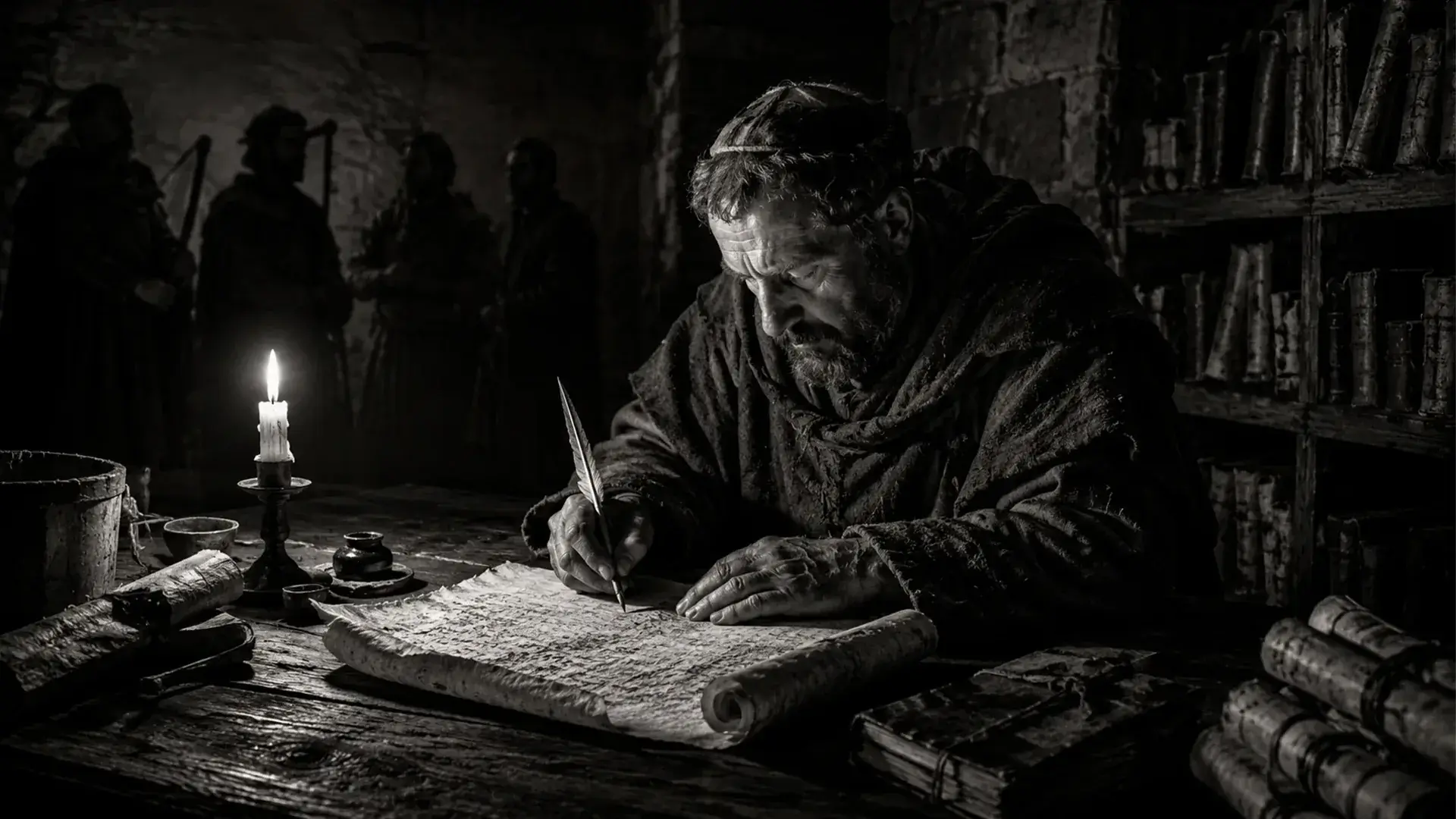
We’ll explore oral tradition in depth in the next post. For now, the thing to hold onto is this: you’re not just reading an old poem. You’re reading the echo of a performance — a story that was shaped and reshaped by the memory and skill of countless storytellers before one monk finally sat down and wrote it out.
That monk’s fingerprints are all over the poem too. We’ll get to that.
Next post: The Storyteller Is the Story — oral tradition, the narrator who’s inside and outside the story at the same time, and why your imagination is a better director than Netflix.