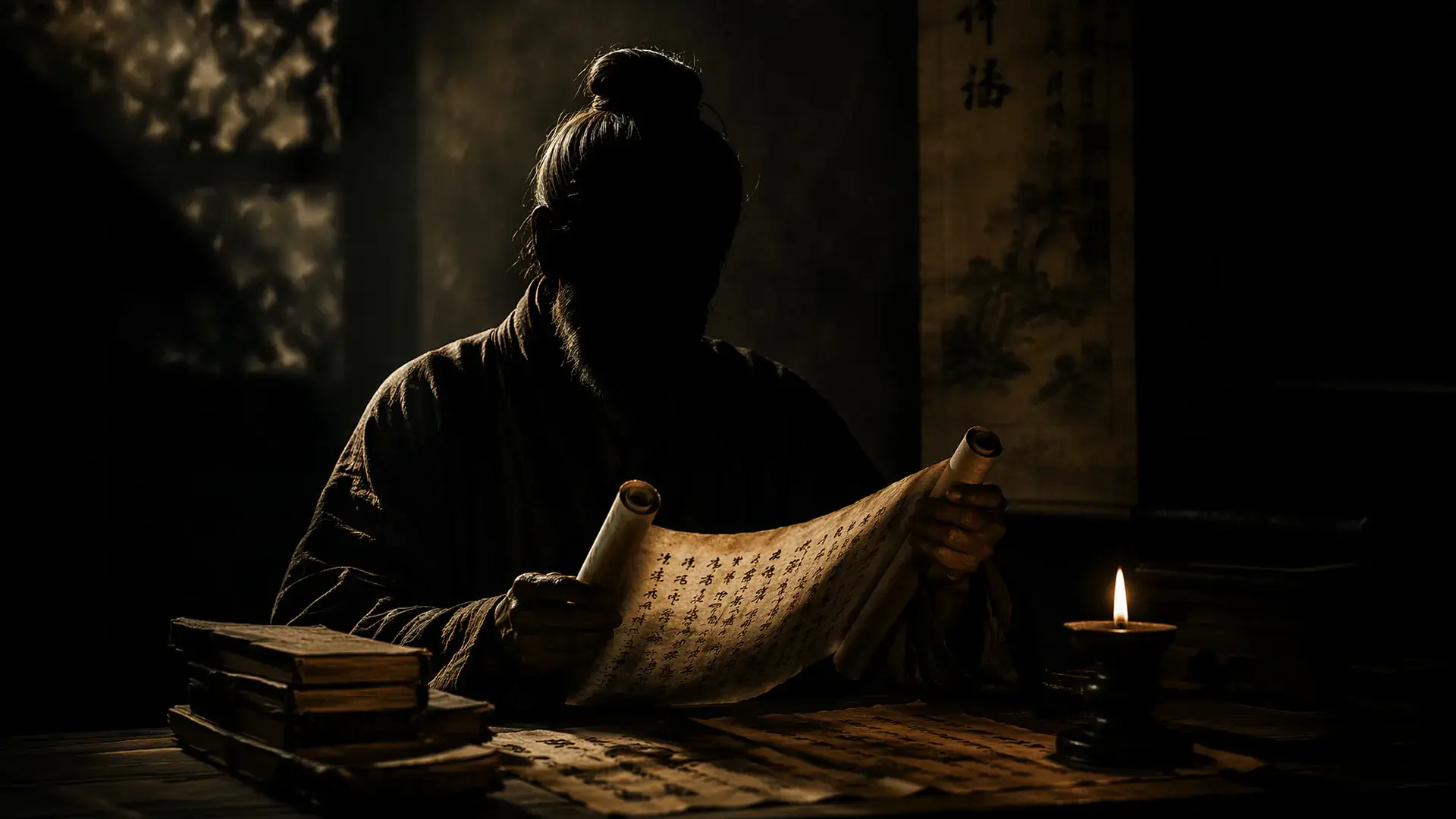
Narration — Sun Tzu Series, Essay 1
This first essay argues that The Art of War is not simply a military manual attributed to a famous general. It is a text delivered by a narrator no one can identify — and that problem is not a footnote. It is the first thing the book teaches you.
Most readers open The Art of War and go straight to the strategy.
They want the wisdom. The maxims. The famous lines. They want to know what Sun Tzu said about deception, about timing, about knowing your enemy.
And that’s exactly where they make their first mistake. Because before you can understand what Sun Tzu said, you have to ask a more uncomfortable question: Who is doing the talking?
The Clue Is in the First Line of Every Chapter
Open The Art of War to any chapter. Any one at all.
Every chapter begins the same way: Sun Tzu said…
Read that carefully.
If Sun Tzu wrote this book — if this is his text, his words, his philosophy — why would he refer to himself in the third person? Why would he say Sun Tzu said rather than simply saying it?
He wouldn’t.
Which means someone else is narrating. There is an anonymous voice outside the story, telling us what Sun Tzu said. We never see that narrator. We never learn who he is. We have no way to verify him. We simply have to take his word for it.
This is third-person narration. And third-person narration is not neutral. It is a choice. It is a structure. And that structure asks something of us before we ever get to a single line of strategy: Do you trust this narrator?
At Reading with Jimmy, we always start with the narrator. Always. Because the narrator determines everything. Not just what you know, but what you’re allowed to know. Not just what is said, but what is withheld. And in third-person narration, you HAVE TO trust the narrator, of the story simply won’t make any sense.
Sun Tzu Is Like Homer
You can Google who wrote The Art of War and you will find the standard answer: an ancient Chinese military general, 6th century BC, Master Sun.
That’s the attribution. It’s not the same as proof.
The more honest answer is this: we cannot prove the entire text, line for line, is the work of a single man living at one time. It is more like Homer and the Iliad — a great name attached to a body of tradition, accumulated over time, organized by unknown hands.
It is, like any third-person narrative, a work that has the narrator OUTSIDE the story, the drama.
Homer. Sun Tzu. Authorship attributed, origin uncertain, narrator unnamed.
In oral tradition, this was normal. People didn’t write things down — they transmitted them. The name attached to the tradition was the authority, not the proof.
But here is what that means for us as readers: the anonymous narrator asking us to trust him is asking a great deal. He is asking us to believe that what follows is genuinely what Sun Tzu said, thought, and meant — with no way to verify any of it. It is what every third-person narrator expects from the readers: complete trust. That is why careful reading of classical literature is a must! As in life, who is telling you something and why they are telling you that something help you discern the truth.
And the moment you realize this, you are reading more carefully. Which is exactly where you should be.
Notice the Colon
There is one more thing to observe before we move on. And it might seem like a small thing. It isn’t. After Sun Tzu said, there is always a colon.
Punctuation marks are not decoration. They are the rhythm of language. They tell your inner voice when to pause, when to stop, when to expect more. A period is a full stop. A question mark lifts your voice. An exclamation point sharpens it.
A colon is a half-breath. It says: what follows will explain, expand, or deliver what I just set up.
So when the narrator writes Sun Tzu said: — he is not just attributing a quote. He is preparing you. He is building a frame and asking you to step inside it.
He is using the colon to say: trust me, and listen to what comes next.
That’s a subtle exercise of authority. And you accept it, or the text makes no sense.
Words Only Mean What Experience Makes Them Mean
This brings us to the real problem underneath the narrator problem.
Even if we trust the narrator, even if we accept that what follows is genuinely what Sun Tzu said — we still have a second problem.
Words.
Aristotle said: define your terms. If you and I cannot agree on what a word means, communication is lost before it begins. Lewis Carroll understood this. In Through the Looking-Glass, Humpty Dumpty tells Alice that words mean exactly what he chooses them to mean, nothing more and nothing less. Alice objects. Humpty doesn’t care. He has decided he is the master of his own language.
Most of us find Humpty absurd. But if you think about it, he is only doing what everyone does — using words that carry private meanings accumulated through private experience.
The student of Agassiz thought he knew what “fish” meant. He had the textbook definition. He had the Latin taxonomy. He had the abstract category.
Agassiz gave him a sunfish and told him to look at it. Not describe it. Not classify it. Look at it. For three weeks. Until the fish was decomposing on the table.
At the end of three weeks, that student’s word “fish” meant something entirely different than it did at the beginning. It was no longer an abstraction. It was that specific fish, observed, studied, turned over in the mind until the word was charged with meaning.
Ezra Pound said it directly: literature is language charged with meaning. Language gains meaning through experience. Two people can use the same word and mean entirely different things — because the experience behind the word is different.
Which means this: when the anonymous narrator tells us what Sun Tzu said about war, and when you read the word war — you are not necessarily reading the same word Sun Tzu meant.
Not yet.
What Does “War” Mean to You?
Here is a question worth wrestling with: Does a war-fighter’s definition of war mean the same thing as a politician who has never been in one?
I had an uncle named Teddy, my mom’s brother. Growing up, he seemed like a passive man. He never raised his voice. He did whatever his wife asked without question. She went on vacations alone while he stayed home and kept house. I used to think: what kind of man is that?
Then my mother died.
Sitting around her apartment, we told stories. And at some point, my uncle Teddy started talking. He began narrating his experience in World War II — which, I came to learn, was something most war-fighters almost never do (talk about their experiences).
He had landed at Normandy. After that, he was part of what they called hedgerow fighting. His job, night after night, was to go into those hedgerows and kill Germans.
As he described what he had done, he cried. I don’t know if it was because my mother — his sister — had just died, or because of the men he had killed. I never asked.
But I can tell you this: when my uncle Teddy used the word war, it was not the same word the rest of us were using.
His word was language charged with meaning — the weight of Normandy, the darkness of hedgerows, decades of silence that made him look weak to a kid who had no idea, no clue.
My word was abstract. His word was that specific fish, studied under conditions that could never be replicated in a classroom.
The First Thing The Art of War Teaches You
Before Sun Tzu gets to strategy, before he talks about deception or timing or knowing your enemy — the book itself, by its very structure, raises two questions that the rest of the text depends on.
Who is telling you this?
And do the words they use mean what you think they mean?
Those are not rhetorical questions. They are the conditions of understanding. And they apply not only to classical literature but to every conversation you have, every claim you encounter, every narrator — in a text or in life — who asks for your trust.
The anonymous narrator of The Art of War cannot be verified. He can only be evaluated by what he delivers.
Just as any one of us is evaluated.
You’ve been reading with Jimmy. This is Essay 1 of a three-part series on The Art of War by Sun Tzu. In Essay 2, we’ll take the definition problem further — into the question of what war actually means, and why the answer depends entirely on who has lived it.