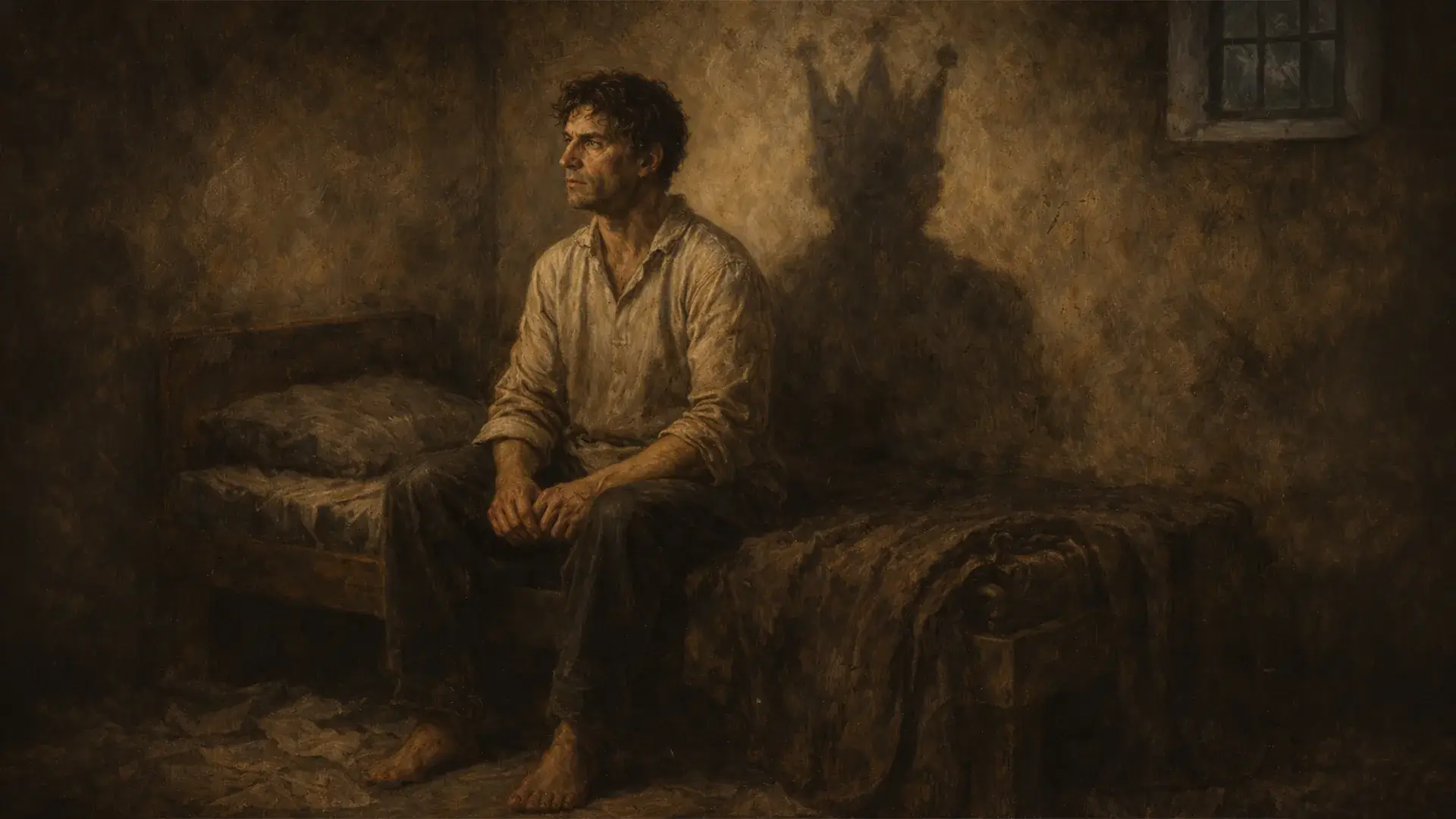
Diary of a Madman — A Reading with Jimmy Series
Most readers approach Diary of a Madman as satire. Gogol’s story is usually presented as a comic attack on bureaucracy, social climbing, or the absurd hierarchies of imperial Russia. And certainly those elements are present.
But Gogol’s story becomes far more disturbing if we read it more closely.
Because Diary of a Madman is not simply about a clerk. It is about what happens when a man’s sense of himself slowly detaches from reality — and begins replacing the world with a story he needs to believe.
At first the narrator seems merely insecure. Then he becomes defensive. Then imaginative. Then convinced.
What makes the story unsettling is that Gogol does not show madness arriving all at once. He shows it assembling itself piece by piece, until the narrator’s inner logic becomes stronger than the world around him.
Across this short series, we will follow that progression: how wounded pride becomes fantasy, how fantasy becomes belief, and how belief ultimately becomes a new reality the narrator cannot escape.
Because the tragedy in Diary of a Madman is not that a man goes mad.
It is that we see how madness is built within — one perception at a time.
In the end, Diary of a Madman leaves us with a troubling realization which we will explore in Blog #3. The narrator does not simply lose his mind in a single moment. We have watched the process unfold step by step—observation becoming interpretation, interpretation becoming belief.
And that may be Gogol’s most unsettling insight: madness rarely arrives all at once. More often, it grows quietly within the mind, one explanation at a time.
By the final pages of Diary of a Madman, the anonymous narrator no longer merely suspects that he might be the King of Spain.
He knows he is the King of Spain.
But all the people around him, don’t.
What began earlier in the diary as a series of unusual interpretations has now hardened into certainty. The narrator no longer questions his conclusions. He projects those conclusions, those ideas to the world around him.
And once that happens, the story moves toward its most disturbing stage.
Because when a person begins acting according to a reality that exists only in the mind, the world eventually responds, has to respond.
The Moment the World Intervenes
Up to this point in the diary, most of the narrator’s strange ideas have remained private. They appear in his writing, but the outside world has not yet fully confronted them.
That changes once he begins behaving publicly as the King of Spain.
He appears in the office and signs documents with a royal name. He abandons his duties as a clerk. His explanations of the world no longer resemble anything that the people around him recognize as normal.
At that point the reaction of society becomes inevitable.
The narrator is seized and taken away.
But here is where Gogol does something remarkable: by staying inside the narrator’s mind – keeping the diary narration – we see the narrator never understanding what has actually happened. In other words, the narrator never “sees” how his reality is so different from the reality of others.
Remarkable.
The Asylum Becomes the Spanish Court
When the narrator arrives at the institution where he has been confined, he interprets everything according to the reality he has constructed in his mind.
To him, this is not an asylum.
It is Spain.
The attendants become Spanish officials. The punishment he receives becomes royal ceremony. The cruelty he experiences is interpreted as a form of courtly ritual.
Even physical suffering does not break the illusion.
Instead, the narrator continues building explanations that allow his beliefs to remain intact.
This is the final stage of the process we have been watching throughout the story. Earlier in the diary, the narrator explained strange perceptions in ways that preserved them. Now he explains the entire world in a way that preserves his identity.
Reality no longer corrects him.
Reality is reinterpreted.
The Pain Behind the Illusion
At first the scenes in the asylum almost appear comic. The narrator’s interpretations are so absurd that they resemble satire.
But the tone begins to change.
As the narrator is beaten and humiliated, something else begins to emerge from beneath the madness.
Pain.
The narrator is suffering physically, but he still attempts to explain the experience within the framework of his delusion. He tells himself that these punishments must be part of royal protocol, or perhaps a custom of the Spanish court.
The explanations continue.
But the body cannot ignore pain forever.
And eventually the illusion begins to crack.
The Cry for His Mother
Near the end of the story, the narrator suddenly cries out for his mother in one of the most dramatic scenes in all of literature.
It is one of the most striking moments in the entire narrative.
Up to this point, the diary has been filled with pride, resentment, envy, and elaborate explanations about the world. But in this moment something appears: a childlike plea for comfort.
The voice changes.
The narrator is no longer a civil servant comparing himself to others. He is no longer the self-proclaimed King of Spain. He is simply himself, a human being in distress calling for the one person who once cared for him.
The moment is deeply emotional. Almost spiritual.
For an instant, the madness seems to fall away.
And the reader sees the vulnerability that has been hidden beneath the narrator’s elaborate explanations throughout the story.
But Then the Madness Returns
But Gogol does not allow that moment to resolve the story.
Almost immediately after the narrator’s emotional plea, the diary returns to the strange logic that has governed the entire narrative.
The narrator suddenly asks a bizarre question about a wart on someone’s nose.
The shift is abrupt. So abrupt it funny, tragic, confusing all at the same time.
After the emotional depth of the plea to his mother, the mind snaps back into the strange, disconnected reasoning that has defined his madness.
And with that final line, the story ends.
Why the Ending Matters
Diary of a Madman does something more unsettling.
It lets us watch the entire process of madness unfold from inside the narrator’s mind.
At the beginning of the diary, the narrator is simply interpreting the world around him. Each strange perception is explained in a way that allows it to remain believable.
Those explanations accumulate.
Gradually they form a new reality.
By the end of the story, that new reality becomes stronger for the narrator than the world’s itself.
And even when suffering and emotional vulnerability break through for a moment, the mind quickly returns to the structure it has built.
What the Story Reveals
The tragedy in Diary of a Madman is not merely that a man becomes insane.
It is that we are able to see how the mind constructs insanity.
At every step the narrator is trying to explain what he sees. He is trying to make the world understandable. Each explanation seems reasonable to him at the moment it is made.
Isn’t that what we all do?
But together those explanations slowly become reality itself.
And by the end of the story, the narrator is living entirely inside the structure his mind has created.
The Real Tragedy
That is why Gogol’s story remains so powerful.
It is not simply a story about madness.
It is a story about the way the human mind tries to organize experience, interpret events, and protect itself from humiliation or pain.
The narrator does not begin as a monster or a villain. He doesn’t even end as a monster or villain.
He begins as a man trying to explain the world. And he ends as a man who explains it – but his explanation doesn’t match everyone else’s.
The explanation becomes justification.
Justification becomes belief.
And belief eventually becomes reality – his reality.
The tragedy in Diary of a Madman is not that a man goes mad.
The tragedy is that we see how madness is built within the mind — one explanation at a time.