A&P: A Story of a Moment
A close reading of John Updike’s A&P—how Sammy sees, understands, and chooses to act
A&P, first published in The New Yorker in 1961, is often read quickly. It’s short. The setting is familiar. The situation seems simple.
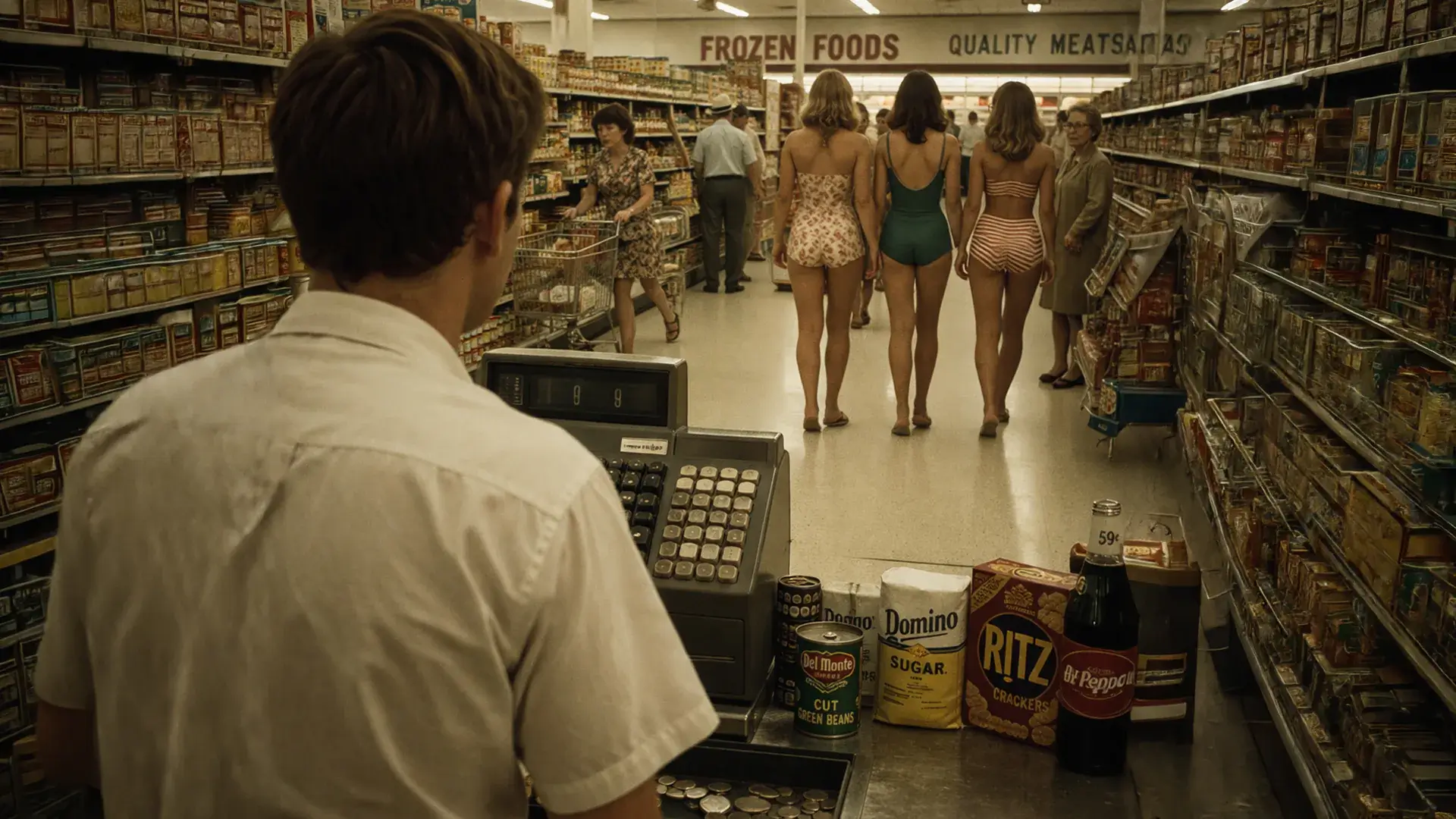
A teenage cashier. A grocery store. Three girls who don’t quite belong in that space.
And because of that, many readers move through it the same way the customers move through the store—efficiently, without stopping.
But this is not a story that rewards speed.
A&P is a first-person narrative.
Everything we see, hear, and understand comes through Sammy—the cashier telling us the story after it has already happened.
That matters. Because what we are reading is not just an event. It is someone recounting an event.
The three short essays that follow take up questions about Sammy – and about each of us:
What kind of narrator am I?
What kind of world am I in?
And what, exactly, am I paying attention to?
In Blog #2, we’ll examine the world of A&P – the middle ground, the center, the balance. Where behavior is structured, expectations are enforced, and anything that falls outside of it is quickly corrected back into place.
If Sammy is the observer, then the A&P is the system within which he’s observing.
And it is not incidental. Or just a chance. All observers operate in some type of system. Some type of atmosphere. Some type of world.
The A&P, for example, sits in the middle of town .
That detail is easy to pass over. But it shouldn’t be.
Because the middle is not just a location—it’s a condition.
Aristotle’s Golden Mean – balance. Stay in the middle. Don’t stray.
Nothing extreme happens in the middle.
Things are moderated. Contained. Managed.
And that is exactly how the A&P functions. Until the girls show up. They certainly are not in the middle.
Watch how people behave inside the store.
They move:
- along aisles
- with carts
- following lists
Even their attention is structured. You’ve seen that yourself in department stores. Grocery stores.
When the girls enter—out of place, visibly different—the customers have to react.
They look. But then what happens?
They snap back.
Not drift. Not linger. Not engaged.
They correct themselves back to the middle.
Return to carts.
Return to lists.
Return to the system.
Sammy calls them “sheep.”
That word can sound dismissive, but within the story it’s observational. Because what he’s noticing is not stupidity—it’s patterned behavior. Automation. Almost mindless.
People are deciding in that moment what to do. They default to the middle. The routine.
And the system reinforces that.
It’s not just the layout. It’s not just the routine. It’s the language.
When Lengel confronts the girls, he doesn’t cite a rulebook. He uses a word:
“We want you decently dressed when you come in here.”
“Decently.”
On the surface, it sounds reasonable. But it’s a moral judgment. It functions as a boundary.
It defines:
- what belongs
- what doesn’t
- what is acceptable
- what must be corrected
And once defined, it must be enforced.
This is where Sammy’s story tightens. Because now the system is no longer passive—it is acting.
Lengel is not angry. He is not erratic. He is doing exactly what the system requires of him.
He is maintaining it.
And the others—customers, coworkers—align with that maintenance. Well most of them.
They watch.
They gather.
They reinforce the moment simply by participating in it.
Except for Sammy. And even he “appears” to fall in line.
This is why the reading that treats the A&P as just a job—a place Sammy doesn’t like, something he wants to escape—falls short of what’s really happening here.
The evidence points to a crescendo of events that leads to Sammy’s departure from the middle, from the status quo. And keep in mind, there is:
No resentment.
No buildup.
No indication he’s been waiting for an excuse to leave.
What we see instead is something more precise:
A system operating exactly as designed with an individual pushing back on that system.
And in that push, something becomes visible. Something you have seen…we have seen.
The rebel.
Once “decency” asserted itself publicly—once a behavior is corrected in front of others—the system reveals itself as a system.
Most people go through life not knowing they are in a system. Not knowing they are observers, and by making observations they, like Sammy, can change things.
Not everyone accepts the system once they recognize it. And if they do, not everyone will move “against the grain.”
Most return to the middle. To the status quo. To the balance.
But every now and then, a Sammy emerges.
In the final Blog #3, we’ll take a deeper look at why Sammy quits—not as a sudden reaction or a gesture for attention, but as the result of a moment he has already seen, understood, and chosen to act on.