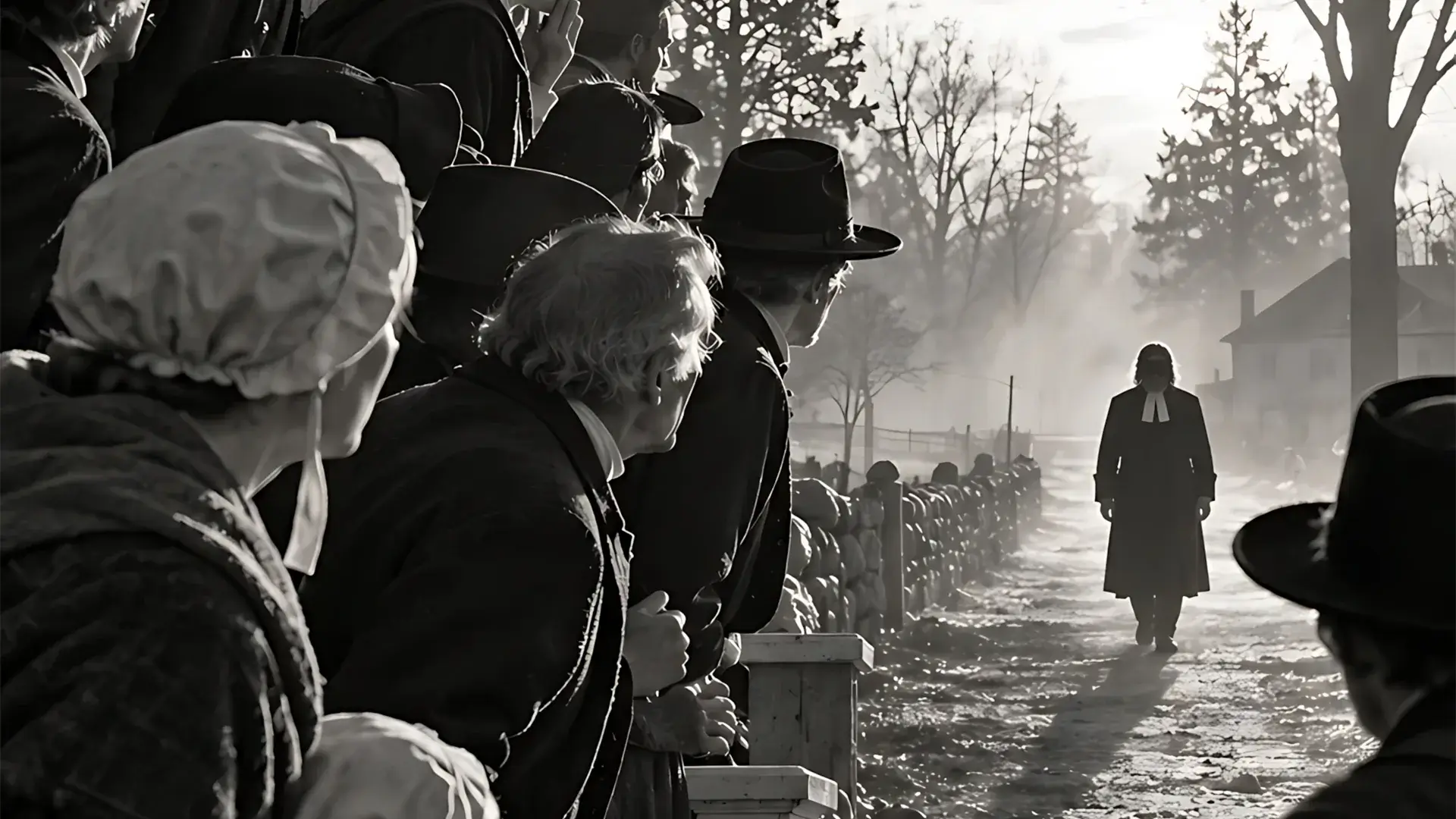
The Minister’s Black Veil opens with a sexton pulling busily at a bell rope outside the Milford meetinghouse. Within a few lines he is staring down the path and says in astonishment: “But what has good Parson Hooper got on his face?”
Before we talk about that veil, ask the question I ask of every story we read: who is telling us this?
It isn’t the sexton. If it were, the story would begin, “I stood in the porch of the meetinghouse, pulling the bell rope.” It isn’t Reverend Hooper either. The voice is outside the story, describing it to us. That what we call a third-person narrator, and with a third-person narrator we have to believe what he tells us or the story makes no sense. I talk a lot about narrators. Why
Because narrators are important. They are either inside or outside a story. For example, you and I are first person narrators: we are inside this story we call life. But third-person narrators are not INSIDE. They are OUTSIDE. God-like. Omniscient. Talking to us.
In classical literature (all literature actually), narrators are one or the other, and critical thinking demands we know the difference. Why?
Because you can always believe the third person narrator; but you can’t always believe the first person narrator. The first person narrator who is inside is like us: human, capable of lying. There are several examples of such narrators on my website and youtube channel (Travel is So Broadening comes to mind about an unreliable first person narrator). Careful readers have to know the difference. That’s why narration is one of Jimmy’s key principles in the study of classical literature.
One more caution. Don’t assume the narrator in this story is Hawthorne. Unless it’s an essay (like Ralph Waldo Emerson’s Self-Reliance which is on my website and youtube channel), my rule is simple: do not assume the author is the narrator unless you can prove it.
So what kind of narrator is this in The Minister’s Black Veil?
One who paints with words. All narrators do that! That’s what makes classical literature “language charged with meaning” as Ezra Pound says. Check it out.
The old people come “stooping” along the street, and stooping is exactly the right word for old people isn’t it? The cause of so much amazement, he says, “may appear sufficiently slight,” which suggests to us how to feel before we’ve seen the veil. Hooper is “good Mr. Hooper,” and the narrator never takes that back, even with the veil on. He tells us Hooper is about thirty, not exactly thirty, because he’s telling us what we need to know and no more. We can wonder…speculate…but as Jimmy always says: stay inside the story for those speculations!
Notice what the narrator does when we want to know more about why. He asks a question: did Hooper seek to hide his face from the dread being whom he was addressing? But he doesn’t answer it. The narrator says “perhaps” the congregation was as fearful a sight to Hooper as the veil was to them. A powerful suggestion! This is the third-person narrator in his own way exposing us to relevant information to make us think! Just as in real life, we’re not exposed to the truth all the time; we have to figure things out. Which is why, by the way, we read classical literature! To learn how others lead their life and how to lead our own.
A reliable narrator isn’t one who necessarily tells us everything. Reliability is a narrator who never lies to us, and who leaves the hardest questions where they belongs: with the readers to figure out!
But here’s the word I promised you in the title of this blog.
Early on, the narrator calls Hooper “still a bachelor.” Later, when the village sends a committee and fails, one woman is unafraid, and the narrator says that “as his plighted wife” it was her privilege to know what the veil concealed.
A bachelor with a wife? Did the third-person narrator make a mistake? Has he been lying to us? If so, we should stop reading and throw the story out.
That would be a mistake. Until you look at the word “plighted,” it would be an awful mistake.
Plighted means pledged, promised solemnly. Engaged. Elizabeth isn’t Hooper’s wife; she’s his fiancée. The narrator never lied, and the contradiction was ours because we didn’t know what the word means.
You see, words change their meaning over time, don’t they? And even if they don’t, what you think a word means may not be what I think it means. So it is with third-person narrators. And first-person narrators. We always have to be on the lookout for these meanings. It’s why Jimmy defines words constantly when I read with you.
And notice what the one word explains: she’s the one person in the village who isn’t afraid of the veil, because she loves the man behind it. Miss that one word and you lose the meaning of the scene. Of the story. Of one of the underlying themes: love.
That’s why we read and pay attention to who is telling us these stories. We look at parts of speech, punctuation, sentence structure, every word. So, when you read The Minister’s Black Veil with Jimmy, that’s exactly what I will do. All the time. Thank you for spending time with me.