March 2, 2026 · Uncategorized
Shakespeare shows us a mind hijacked by prophecy — not because Macbeth is weak, but because once an idea lodges itself deep enough, it becomes fate.
If we want to understand Macbeth, we have to stop asking what he wanted — and start asking what he could no longer stop wanting.
Most readers reduce Macbeth to a familiar moral lesson: unchecked ambition destroys.
That interpretation is convenient. It also misses the real play.
Ambition is a desire for advancement. A person wants something, reaches for it, and — if he succeeds — enjoys it. That’s what ambition looks like when it’s functioning normally.
Macbeth is not functioning normally.
Macbeth does not simply want to be king.
He becomes consumed by the idea of being king forever — and once consumed, he cannot return to balance. He cannot set the idea down. He cannot let it go. He cannot stop.
That is not ambition.
And Shakespeare, long before modern psychology, gives us one of the clearest portraits of obsession ever written.
The Difference Between Ambition and Obsession
Here is the simplest way to see the difference:
Ambition says: I want that.
Obsession says: I cannot tolerate a world in which I don’t have that.
And once obsession begins, the rules change.
Obsession does not negotiate with morality.
Obsession does not respect limits.
Obsession does not ask what the cost will be.
Obsession rationalizes everything.
It takes the mind hostage and then uses the captive mind to invent reasons.
That is why Macbeth is terrifying: not because Macbeth wants power, but because his mind becomes a machine that cannot stop manufacturing permission.
Macbeth’s Obsession Begins in One Moment
If Macbeth were simply ambitious, we would see it early.
But Shakespeare doesn’t write Macbeth that way.
Macbeth doesn’t enter the play dreaming of crowns. He enters as a celebrated soldier — a man rewarded for violence on behalf of the state. His hands are bloody already, but his bloodshed has been called “service.”
That matters.
Because Macbeth is not learning violence. He already knows it. He is trained in it. He has been praised for it.
Then the witches enter the picture.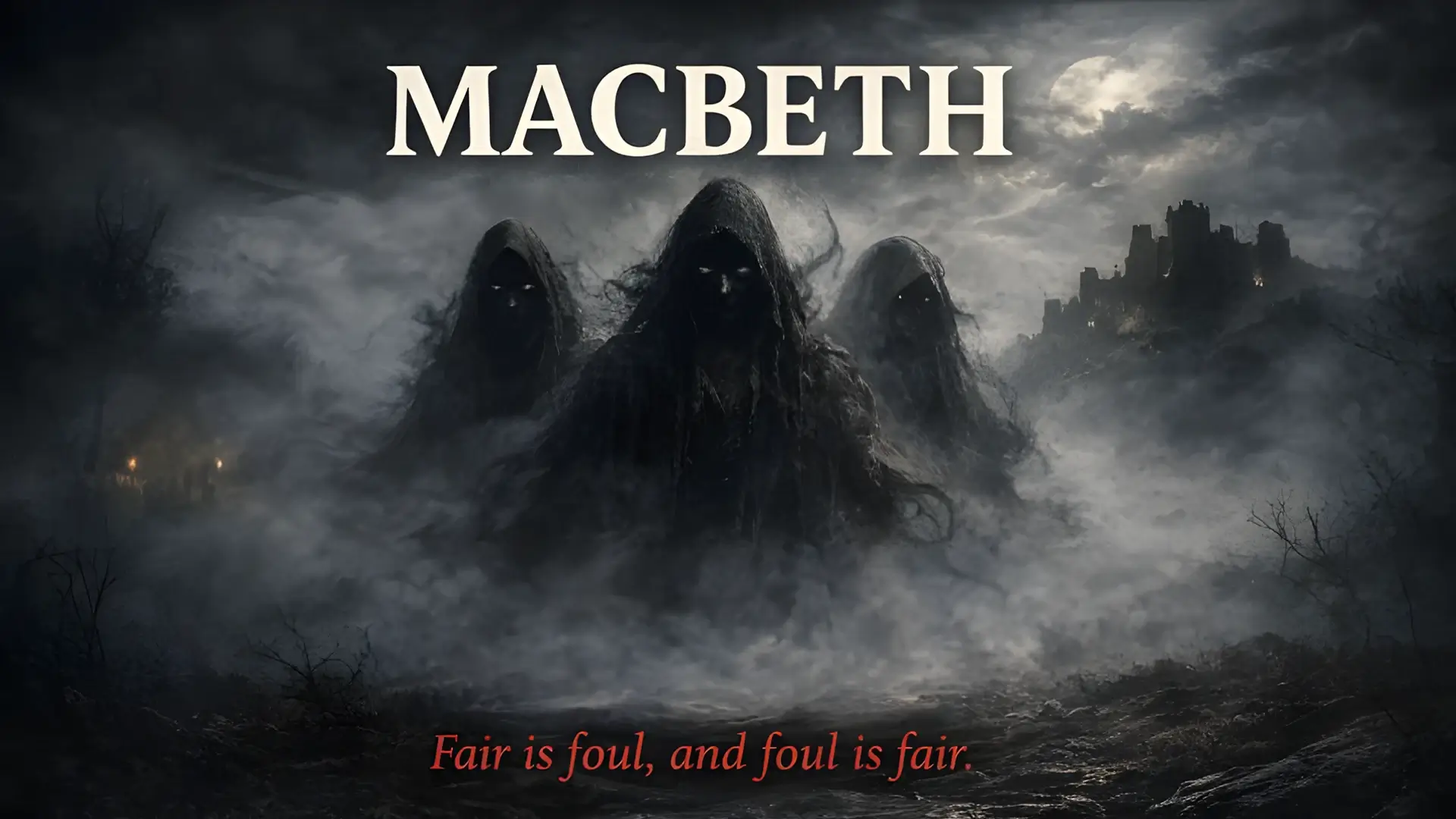
And something happens to Macbeth when he hears what they have to say.
Macbeth’s mind latches on. He becomes inward. Still. Captured.
This is the first signal that prophecy is not merely information. It is ignition.
The witches do not hand Macbeth a plan.
They give him a thought he cannot unthink.
And once you can’t unthink a thought, it stops being a thought.
It becomes a force.
Obsession Is a Form of Imbalance
There is a reason obsession is described as possession:
- “He’s consumed.”
- “He’s taken over.”
- “He can’t let it go.”
Obsession is imbalance. It is the mind leaving its center.
Aristotle had a phrase for this centuries before Shakespeare: the Golden Mean — the idea that virtue lives in balance, between extremes.
Macbeth does not live in balance.
Once the witches plant the prophecy, Macbeth begins to tip.
And as he tips, he stops being moral in the ordinary sense — or even in the sense of “service to the state.”
Not because he stops knowing good from evil.
But because obsession makes good and evil irrelevant.
Only outcomes matter now — outcomes that feed the obsession.
Macbeth’s Inner Life Is the Real Battlefield
One of Shakespeare’s greatest achievements in Macbeth is the way he stages action inside the mind.
Macbeth becomes dangerous because he imagines.
His imagination becomes more powerful than reality.
This is one of the play’s central horrors:
Macbeth’s fear is not what will happen.
It is what his mind can make happen.
Once obsession takes hold, Macbeth begins living in a future that does not exist — yet. It’s a future he is determined to force into existence.
And once a man commits to a future that is not real, the present becomes expendable. People become expendable. Ethics itself becomes expendable.
That is obsession: reality becomes an obstacle.
Why “Ambition” Can’t Explain Macbeth
If Macbeth were simply ambitious:
- killing Duncan would resolve the plot
- coronation would satisfy desire
- the story would end in achievement, even if stained
But that is not what happens.
Macbeth does not enjoy power.
He does not rest in it.
He does not become fulfilled.
Instead, the crown becomes unbearable — because obsession does not stop when it gets what it wants.
It intensifies.
Once obsession is fed, it demands the next feeding.
And the next.
And the next.
Obsession is insatiable.
That’s why Macbeth doesn’t become calmer after the first murder.
He becomes frantic.
The play shows you that ambition is not the issue — ambition does not behave like this.
Obsession does.
Macbeth’s Great Tragedy: He Cannot Return to Himself
The deepest tragedy in Macbeth is not political.
It is personal.
Macbeth loses the ability to return to his former self — to that earlier human balance where a person can hesitate, reconsider, repent.
Once obsession takes over, the mind becomes a one-way street.
Every action becomes a precedent. Every precedent becomes permission.
That is why Macbeth is not a morality play about ambition.
It is a psychological tragedy about obsession.
The Most Important Thing Shakespeare Shows Us
Shakespeare does something brilliant and cruel.
He does not portray Macbeth as a cartoon villain.
He portrays Macbeth as something worse:
A man who can still see what is good…
but no longer has the power to choose it.
That is what obsession does.
It does not remove moral knowledge.
It removes moral freedom.
The Point of Macbeth (So Far)
So before we ever reach the famous scenes — the dagger, the blood, the sleep, the ghosts — Macbeth has already become the thing Shakespeare wants you to examine:
Not a man with ambition, but a man with an idea lodged in his mind so deeply that it becomes fate.
The witches did not force Macbeth.
They did something more dangerous:
They made him obsessed.
And obsession does the rest.
Explore the full Macbeth readings and act analyses here:
Macbeth | Reading with Jimmy
https://readingwithjimmy.com/macbeth/