Chaucer introduces the Prioress the way you’d introduce someone you were genuinely fond of. Before she says a single word of her own tale, the anonymous narrator of the General Prologue spends nearly forty lines just watching her — and everything he sees, he likes.
She is, he tells us, gentle and full of guilelessness — sincere, without guile. By Saint Loy was the worst oath she ever swore, which is its own small joke if you’ve been reading the other tales alongside this one: the Miller and the Wife of Bath swear by body parts and worse. Not this nun. She sings the mass well, intoning it properly through her nose in the fashion of the day. She’s schooled in French — though, the narrator notes with a little smile, it’s the French taught at Stratford-atte-Bow, not the French of Paris. It’s a small detail, but one that shows the difference between a regional dialect and the “proper” version of a language anywhere — close enough to pass, not quite the real thing. Chaucer’s audience would have caught the distinction instantly.
Then come the table manners, described in more loving detail than you’d expect for a minor character: from her lips no morsel ever fell. She wet her fingers lightly in the sauce, because courtesy was her first concern, and worked carefully so that not a drop ever landed on her breast or stained her upper lip. She reached for her food with a calm, composed air. This is a portrait of restraint and delicacy — a woman who has trained herself, in every visible particular, to take up as little space and cause as little disturbance as possible.
And then, there’s this detail:
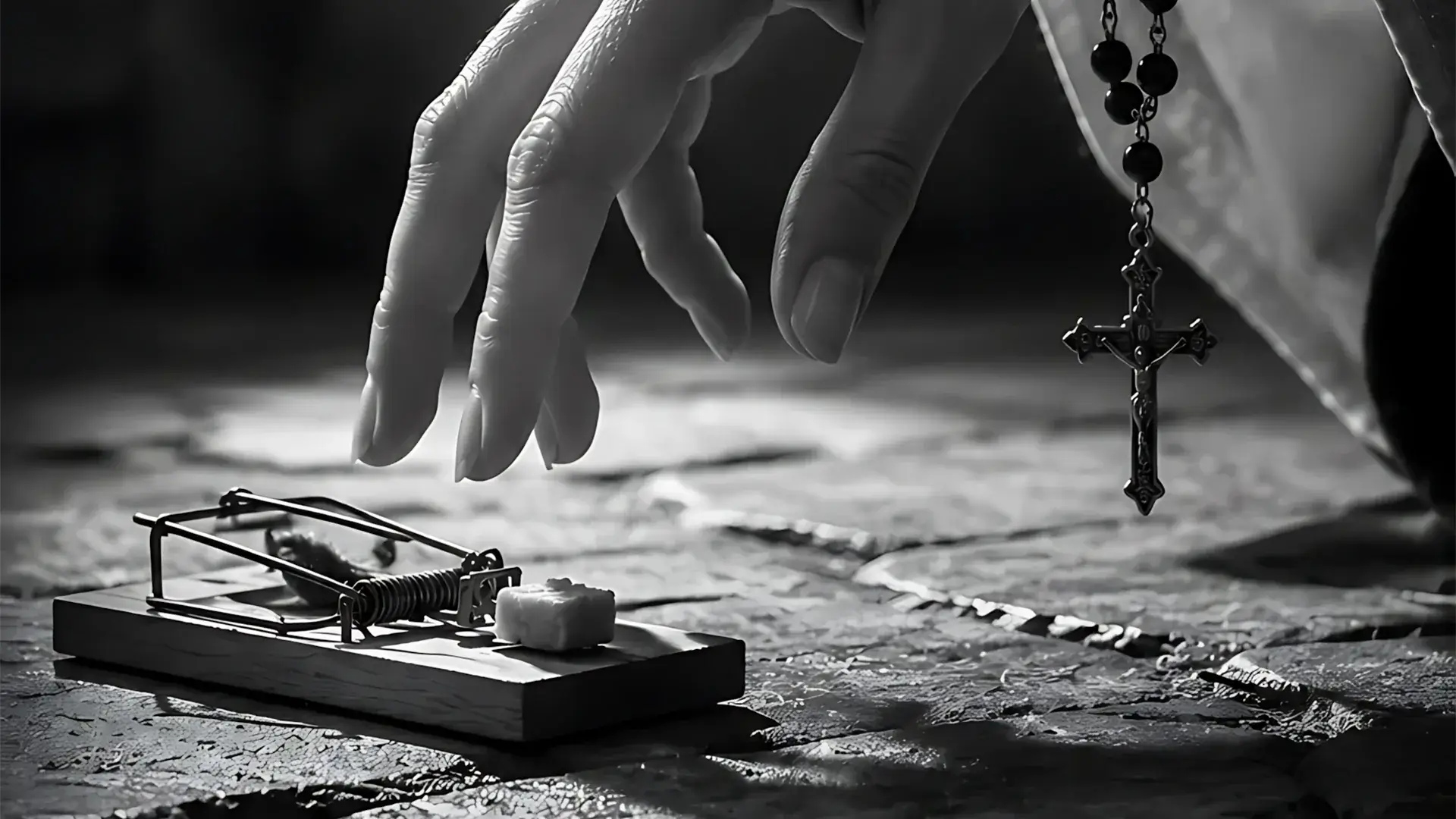
“For her charity and tender feelings / She melted at whatever was piteous. / She would weep if she had but came upon a mouse / Caught in a trap, if it were dead or bleeding.”
She keeps small dogs, too, feeds them roasted meat and fine white bread, and weeps if one is struck or yelps in pain. “All was sympathy and loving heart,” the narrator says of her, and he means it as praise.
The physical description that follows is just as “tender.” Her wimple — the cloth draped over the head and around the chin, the medieval equivalent of what you might picture on a grandmother from an old photograph — is pleated neatly. Her eyes are grey as slate. Her mouth is small, soft, and red. Her brow is wide. She is, the narrator tells us plainly, “not undergrown” — a good-sized, striking woman, not a shrinking figure. She wears her cloak, he says, with dignity and charm.
And around her arm hangs a rosary of small beads and larger green ones, and from it, a brooch of golden sheen, engraved beneath a crown with a single Latin phrase: Amor vincit omnia. Love conquers all.
It’s a genuinely famous line — Virgil’s, originally, and centuries old even in Chaucer’s day. Is it a statement of divine love, the love of Christ that a bride of the Church might wear as a badge of her vocation? Or is there something a little more worldly in it — a taste for courtly romance dressed up in religious jewelry? The narrator never explains. He never does with the Prioress. He shows us the brooch and moves on.
In a few hundred lines this same tenderhearted woman is going to choose, out of every story she could possibly tell a group of traveling strangers, one soaked in violence — real, horrible violence to an innocent child. And she doesn’t weep once. The question you will have to ask yourself and answer is, why?