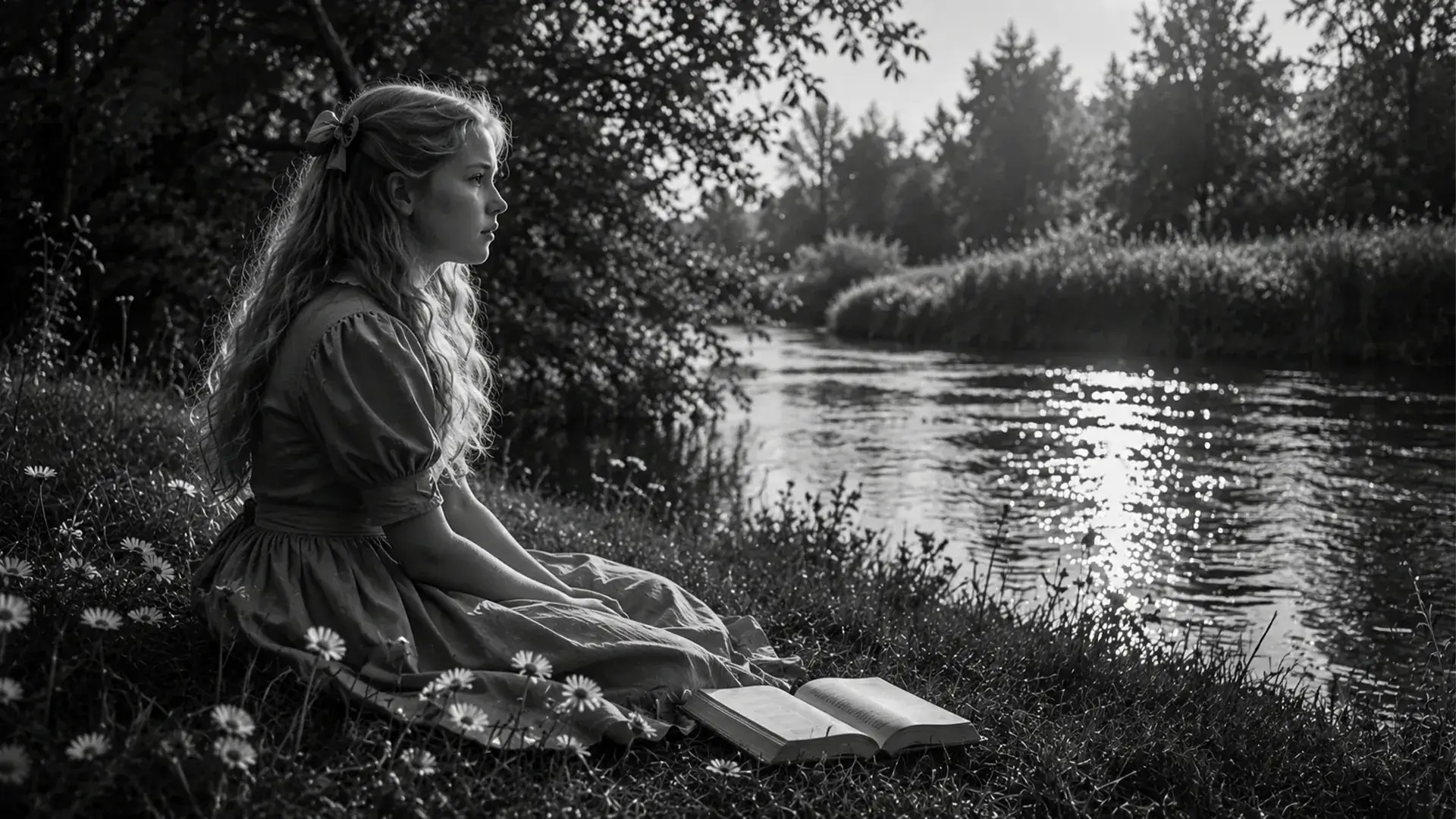
A blog series on reading Alice in Wonderland to develop your critical thinking
From the very first chapter of Alice’s Adventures in Wonderland, there is a garden. Alice finds a tiny door at the end of a long dark hall, kneels down, and looks through it into the loveliest garden she has ever seen — bright flower beds, cool fountains, sunlight. She cannot get through. She is too large. She spends the next several chapters trying to get there.
The garden is her goal. The third-person narrator makes that explicit. Everything Alice does in Wonderland — the mushroom pieces she carries to manage her size, the arguments she endures, the chaos she navigates — is in service of getting through that door.
She gets there. Chapter Eight. She walks through.
It is the Queen’s Croquet Ground.
What She Finds There
The first thing Alice encounters in her longed-for garden is three gardeners painting white roses red. They planted the wrong color by mistake. If the Queen discovers it, they lose their heads. They are covering up the error as fast as they can.
Then comes the procession. Soldiers shaped like playing cards, walking two by two. Courtiers ornamented with diamonds. The royal children with hearts. And finally the King and Queen of Hearts — the Queen who has one solution to every problem, spoken at full volume: Off with their heads! She deploys it approximately once a minute throughout the chapter. It applies to everyone and for any reason. The roses are wrong: off with their heads. Someone looked at her: off with their heads. The Cheshire Cat’s expression displeases the King: off with his head.
Then comes the croquet game. The balls are live hedgehogs. The mallets are live flamingos. The arches are soldiers bent double, and they wander off when they feel like it. Alice tucks the flamingo under her arm, gets its neck straightened out, lines up her shot — and the flamingo turns around and looks at her with a puzzled expression. The hedgehog unrolls itself and crawls away. The arches are gone.
The narrator’s word for it is chaos. Alice’s word, when she finally walks away, is: It’s the most curious croquet ground I ever saw in all my life. That is an understatement so perfectly calibrated it functions as a kind of courage.
The Grass Is Always Greener
You have heard the expression. The grass is always greener on the other side. It means: what you don’t have looks better than what you do. The thing you’re reaching for looks perfect from a distance. Carroll demonstrates this with the precision of a geometer.
Alice looked through the tiny door into a garden of bright flowers and cool fountains. She longed to wander among them. The narrator tells us she longed. That’s not curiosity. That’s yearning. And what she found when she finally got there was a garden where the flowers were being painted the wrong color, where the rules changed every minute, where the person in charge had exactly one response to every situation, and where a croquet game was being played with equipment that had its own opinions about the game.
This is not a cruel trick by Carroll. It is an honest observation. The thing you work toward — the goal that organizes your effort and keeps you moving through difficulty — almost never looks the way you imagined it when you arrive. That is not a reason to stop working toward things. It is a reason to pay attention to what the journey is actually teaching you, rather than saving all your attention for the destination.
She Stands Up Straight
Something important happens in that garden that has nothing to do with the croquet game. When the royal procession arrives, the three gardeners throw themselves flat on their faces. It is apparently the rule. Alice has no idea. She never heard of such a rule. So she just stands there.
The Queen stops and looks at her. Who is this? Alice gives her name politely — and adds, to herself, a thought the narrator shares with us: they’re only a pack of cards, after all. I needn’t be afraid of them. From that moment, the dynamic shifts. The Queen screams off with her head! at one point, and Alice says, simply and loudly: Nonsense. The Queen goes silent. The King touches his wife’s arm and murmurs: Consider, my dear — she is only a child. The King. Timid. In his own garden.
This is not the same Alice who fell down the rabbit hole in a panic and cried a pool of tears. She arrived in Wonderland bored and restless and slightly at sea. She is leaving it — or nearly leaving it — as someone who has learned to stand upright in a room that tells everyone to get on the floor.
Rolling the Rock
The Greek myth of Sisyphus goes like this: Sisyphus offended the gods by helping mankind, and as punishment he was condemned to roll a boulder up a hill for eternity. Every time he nears the top, the boulder rolls back down. He starts again. There is no top. There is only the rolling.
The philosopher Albert Camus wrote an essay about Sisyphus and concluded that the right response to an absurd situation — a situation without final resolution, without guaranteed reward, without a stable set of rules — is not despair. It is engagement. You roll the rock because the rolling is the thing. Not getting to the top. The rolling.
Camus put it this way: it’s not the soundness of the argument that matters, but whether the argument makes you think.
Alice’s Adventures in Wonderland is full of arguments that don’t have sound conclusions. The riddle has no answer. The race has no winner. The trial reaches a verdict before the evidence. The garden is not what was promised. None of it resolves neatly. But Alice keeps thinking. She keeps arguing. She keeps standing up. That is exactly what Camus meant.
The Sister’s Dream
Alice wakes up on the bank. She tells her sister the dream. Her sister listens, and then — in one of the most quietly beautiful passages in the book — sits alone after Alice has run inside for tea, and imagines Alice grown up.
She pictures Alice as a woman, keeping through her riper years the simple and loving heart of her childhood. Gathering children around her. Making their eyes bright with strange tales. Perhaps even with the dream of Wonderland.
That paragraph is the answer to everything the book asked. Who is Alice? She is someone who will remember. Someone who will carry her child’s sense of wonder into an adult life and refuse to lose it entirely. Someone who fell into an ungovernable dream and came back from it with her eyes open.
Henry David Thoreau wrote that most people lead lives of quiet desperation — going through the motions, never asking the hard questions, never looking at the world with fresh eyes. Alice is the argument against that. She asked every hard question Wonderland threw at her. She didn’t always get an answer. She kept asking anyway.
That is what growing up is supposed to look like. Not the loss of wonder. The deepening of it.
— This concludes the Growing Up in Wonderland series.
Reading with Jimmy analyzes canonical texts through close reading of language, character, and structure. Watch the full video analysis at readingwithjimmy.com.