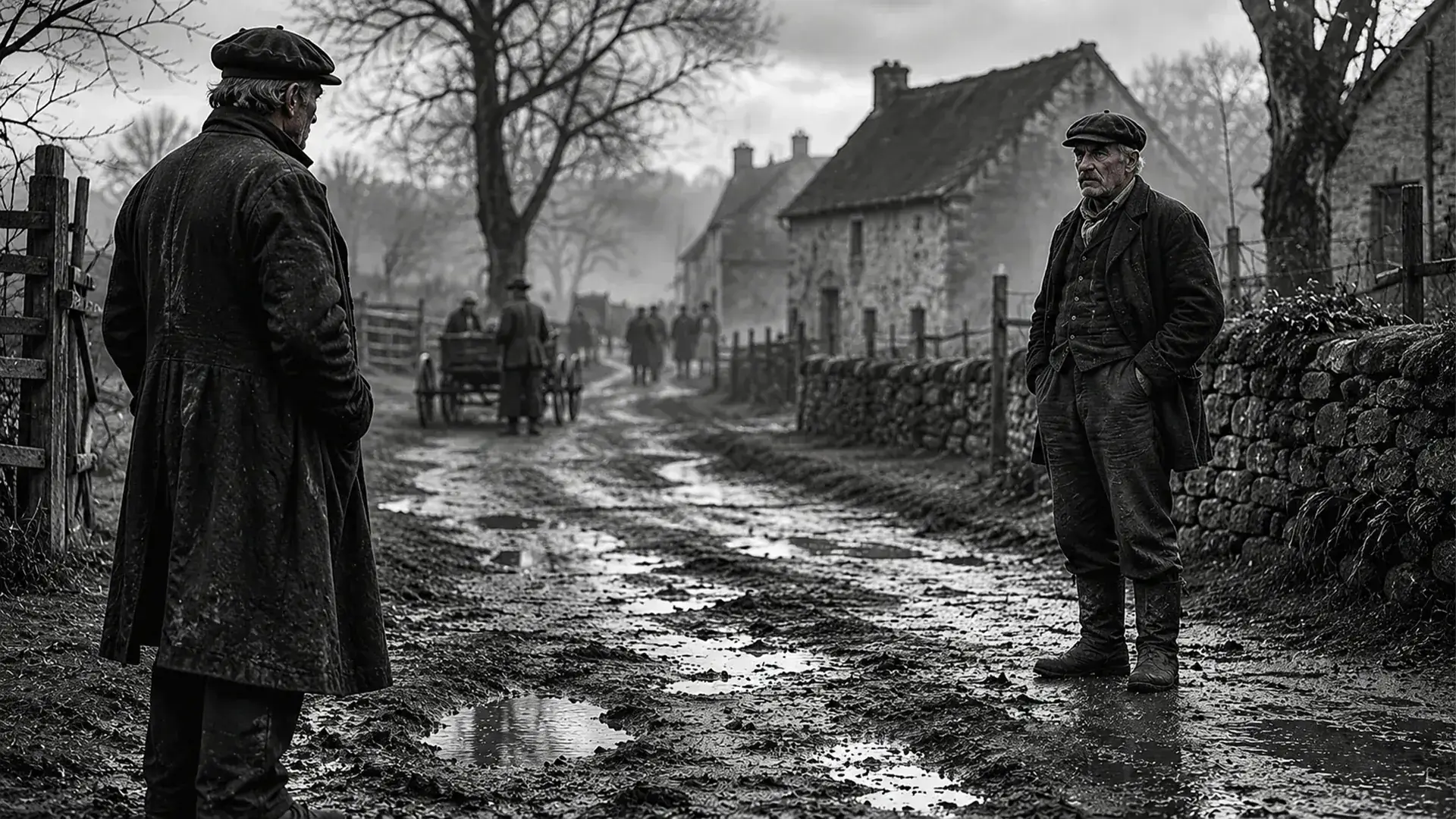
In the last post, we established the foundation: the third person narrator is the only witness in this story who cannot lie. He told us Hauchecorne picked up a piece of string. That is the truth. The rest of the story unfolds from that fixed point.
Now we can look at what is built around it — the plot, the two men at the center of it, and what Aristotle can tell us about why this story works so well.
Aristotle and the Six Elements of Tragedy
Jimmy tells you this in every analysis: Aristotle identified six elements of tragedy in his Poetics — plot, character, diction, thought, spectacle, and song — and ranked plot first and character second. Not because character is unimportant, but because action is what tragedy imitates. A story is not a portrait. It is a sequence of events that happen.
The Piece of String is a tragedy by Aristotle’s definition. Not in the way we use the word today — meaning sad, or unfortunate. A tragedy in the classical sense is a serious imitation of a complete action, structured to produce pity and fear in the audience, and through that, catharsis. You feel sorry for Hauchecorne. You feel something close to dread as his insistence hardens and his neighbors stop listening. And when he dies, you feel the purging of those emotions.
That is tragedy achieved in 2,500 words.
Why This Is a Complex Plot
Aristotle distinguished between simple and complex plots. A simple plot moves from beginning to end in a straight line — fortune changes, but without reversal or recognition. A complex plot includes at least one of these: a reversal of the situation, or a recognition.
The Piece of String has both, and Hauchecorne experiences recognition — in the Aristotelian sense, a moment where a character moves from ignorance to knowledge — twice.
The first recognition comes when Hauchecorne is brought before the mayor and learns it was Malandain who reported him:
“Then the old man remembered, understood, and flushed with anger. ‘So he seen me, did he, the bastard! He seen me pick up this bit of string, Mayor — look!’”
The second comes after the wallet is found and returned by a farm laborer who cannot read. Hauchecorne assumes this clears him. It does not. The townspeople conclude that having an accomplice return the wallet is exactly the kind of clever trick a man like Hauchecorne would arrange. He moves from ignorance of this interpretation to full knowledge of it:
“At last he understood. He was being accused of getting an accomplice to return the wallet.”
That second recognition is devastating. His exoneration became his second accusation. The plot is not a chain of bad luck. It is a logical sequence: every event follows from the one before it, and every event follows from the piece of string.
Beginning, Middle, and End
Aristotle required a plot to have a clear beginning, middle, and end — not as a formula, but as evidence that the action is complete and unified.
In The Piece of String, the structure is clean:
Beginning: The road to Goderville, the market, the piece of string, Malandain watching.
Middle: The accusation, the interrogation, the wallet’s return, the second accusation.
End: Hauchecorne’s obsessive repetition of the truth to everyone he meets, and his death.
Nothing is left dangling. Nothing is random. The plot is, as Aristotle required, of sufficient length to fully represent the action — and not one word longer.
The Two Men at the Center
Aristotle believed characters should be believable — their actions consistent with the kind of people they are. He also believed moral character was determined not by a single act, but by the pattern of acts over time.
Hauchecorne is a rascal. The third person narrator tells us this plainly. He is thrifty to the point of picking up a discarded piece of string from the mud, which is not a crime. He is known throughout the region for Norman cunning and duplicity, which is a pattern. When confronted with something he didn’t do, he hides the string first and then pretends to keep looking on the ground — because he feels ashamed, and because he is the kind of man who instinctively obscures. Even his innocent behavior looks suspicious. His character makes the truth inaccessible.
Malandain is the saddler. He and Hauchecorne quarreled some time before over a halter. Both men are described as “the sort to nurse a grudge.” The story never tells us who came out ahead in that quarrel, but someone did, and the loser has been carrying it since.
Malandain tells the mayor he saw Hauchecorne pick up the wallet. We know this is false because the narrator told us it was string. But here is what the story never resolves: did Malandain know it was string, or did he genuinely believe he saw a wallet? The mayor’s confidence in him — “a man who can be trusted” — carries no weight, as we established in the last post. But the narrator does not explicitly call Malandain a liar either.
Jimmy’s reading: Malandain knew. He had a grudge. He knew Hauchecorne’s reputation. He saw an opportunity. The moment he stood at his door watching and the town crier announced a missing wallet, Malandain had everything he needed. The laughing scene confirms it:
“Malandain, standing at his door, burst out laughing when he saw him go by.”
That is not the laugh of a man surprised by an unexpected outcome. That is satisfaction. Malandain played Hauchecorne like a violin.
When a Strength Becomes a Weakness
Aristotle held that virtue exists on a spectrum between deficiency and excess. Too much courage is recklessness. Too little is cowardice. The virtuous mean sits between them. Applied to character in tragedy, this produces a particular kind of downfall: not the downfall of an evil man, but of a man whose defining quality has tipped past its useful range.
Hauchecorne’s duplicity — his cunning, his double-dealing — was, in a rough Norman sense, a survival skill. It made him effective in bargaining. It gave him a reputation as someone not to be outmaneuvered. In excess, it made him unbelievable even when he told the truth.
His strength became his cage. And the more he insisted on his innocence, the more his insistence read as the behavior of a guilty man performing innocence. Which is, of course, exactly what a double-dealer would do.
The lady doth protest too much, methinks.
Queen Gertrude’s line from Hamlet comes to mind without force here. When someone protests too insistently, the protest itself becomes evidence. Hauchecorne could not win. Every repetition of the truth tightened the snare.
A Word on the Opening
Aristotle ranked diction third in importance — the quality of the language itself. It would be a mistake to move through this analysis without acknowledging what the narrator does in the opening paragraphs of The Piece of String.
Before Hauchecorne appears, before the wallet is mentioned, before any event occurs, the third-person narrator narrates a full page describing the peasants and their wives walking the roads to Goderville on market day. The men’s legs deformed by plowing. Their starched blue smocks shining like balloons. The smell of cow sheds and sweat. The square crowded and confused.
This is not background. This is framing. These are people whose bodies carry the evidence of their labor, who come to the market to do business, who know each other and each other’s reputations. When Hauchecorne bends over in this crowd — a crowd so dense that Malandain supposedly saw him clearly enough to identify what he picked up — the scene is already loaded. Nothing in this story is accidental.
What Comes Next
We now have the narrator, the plot structure, and the two characters. In the third and final post, we will look at what this story is actually saying — about obsession, about truth, and about the Aristotelian golden mean as a framework for understanding why Hauchecorne’s death is not just sad, but instructive.
He died repeating: “A bit of string … a little bit of string … look, Mayor, here it is …”
Questions or thoughts? Write to Jimmy at [email protected]