The Wife of Bath’s Tale — Analysis by Jimmy
Part 4 of 4
If you have read the Wife of Bath’s Prologue with Jimmy — and if you’ve read the analysis in the three posts that precede this one — then you already know something important before the Tale even begins.
The Prologue was the argument. The Tale is the proof.
She has spent twice as many lines as any other pilgrim telling you about her five marriages, her philosophy of power, her rubber band theory of relationships, her battles with scripture, and what she learned from a man who hit her in the ear and ended up giving her everything she wanted. Now she tells a story. And the story, when you look at it carefully, is not a fairy tale. It is a case study.
What Happened
The Wife of Bath’s Tale takes us into King Arthur’s court — a legendary Britain where magical creatures once roamed freely but have since vanished. A young, unnamed knight rapes a maiden. King Arthur sentences him to death.
Queen Guinevere intervenes. She and her ladies offer the knight mercy — on one condition. He has one year to find the answer to a single question:
What is it that women most desire?
The knight travels far and wide. He asks everyone he meets. He hears a long list of answers: wealth, beauty, status, pleasure, remarriage, flattery, freedom. No two women agree. He becomes desperate.
Have you ever been desperate? Jimmy will tell you: desperate people make mistakes. Don’t make any serious decisions when you’re desperate. Think it through. Sleep on it. Because when the knight runs out of time and runs out of answers, he is ready to agree to anything.
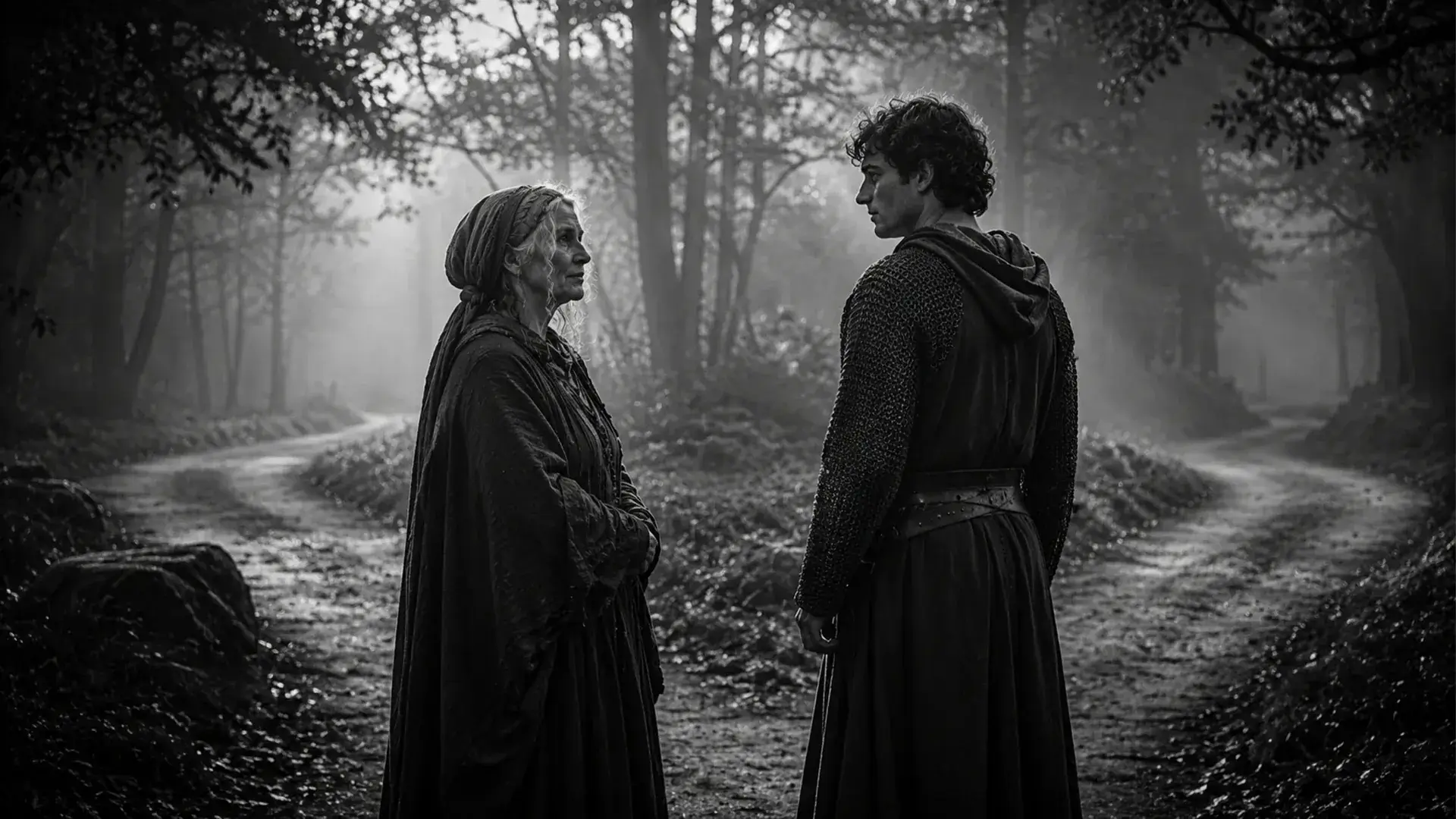
He meets a mysterious old woman — as ugly a witch as fancy could devise — who promises him the right answer if he agrees to do whatever she asks in return. He agrees. She whispers the answer in his ear. He returns to court and stands before the Queen:
“My liege and lady, most of all,” said he,
“Women desire to have the sovereignty
And sit in rule and government above
Their husbands, and to have their way in love.
This is what most you want. Spare me or kill me
As you may like; I stand here by your will.”
It’s the right answer. He is spared.
But now he has to pay the price. The old woman wants him to marry her. He is horrified. He tries to back out. But he gave his word, and a knight’s word is supposed to mean something — even when it’s inconvenient.
They marry. That night, in bed, he sulks. She confronts him. And then she offers him a choice: She can remain old and ugly and faithful — because who, after all, would want to steal an ugly wife? Or she can become young and beautiful — and possibly unfaithful.
The knight — finally, after everything — surrenders. He says: The choice is yours.
That is the right move. She rewards him by becoming both beautiful and faithful. And they live happily ever after.
The Tale Is the Prologue in Disguise
This is not a coincidence. The Wife of Bath chose this story deliberately, and the parallels between her life and this tale are exact.
| Prologue — Her Life | Tale — Her Story |
| Her fifth husband Jenkin dominates her — reads from his book of wicked women, hits her — but finally surrenders sovereignty to her. | The knight violates a woman’s will and body, is forced on a quest, and finally surrenders sovereignty to the old woman. |
| She retaliates, they fight, then negotiate a true reconciliation. | The knight faces death, must surrender to women’s judgment, earns his life by giving the right answer. |
| She gains “the bridle” in the relationship — the power to steer. | The knight says “you choose” — and is rewarded with transformation. |
| The result is peace — not because one side lost, but because both let go. | The result is a magical transformation: marriage without struggle, beauty without betrayal. |
The Tale is a blueprint. It shows what happens when the rubber band stops being pulled — when someone in a relationship recognizes that domination doesn’t work, that force produces resistance, that the only way to real intimacy is through the relinquishment of control.
She’s Not Just Telling a Story — She’s Showing Her Philosophy
And it’s strategic, every bit of it.
She chooses a knight — the symbol of masculine chivalry and power — and makes him the fool who must learn. The ideal of masculine authority in her world. And he rapes a woman in the opening scene. So much for chivalry.
She uses Queen Guinevere, not King Arthur, as the arbiter of justice. The King wants to execute the knight. The women intervene and turn punishment into education. That is not an accident.
She makes the old woman — aged, ugly, underestimated, exactly like herself in some ways — the keeper of truth. The one who knows the answer. The one who sets the terms.
And she ends with the man’s redemption, not his destruction. This is important. She is not narrating a revenge fantasy. She is narrating a story about balance — about what becomes possible when a man stops trying to control and starts listening.
Plot and Aristotle
Let’s bring in our discussion to classical literature: Aristotle.
According to Aristotle, tragedy — which for him simply meant a serious story with weight and consequence — has six elements: plot, character, diction, thought, spectacle, and song. Of these, plot is the most important. It is the representation of human action, the arrangement of events that gives a story its shape and its meaning.
Plots can be simple or complex. Aristotle is clear that complex plots are required for successful stories. A simple plot is one where fortune changes but not because of any reversal or recognition — things just happen. A complex plot is one where the change of fortune emerges of necessity from the events preceding it.
The Wife of Bath’s Tale is a complex plot. Look at how each event generates the next: The knight rapes a maiden → he is sentenced to death → the Queen intervenes → he fails to find the answer → he meets the old woman in desperation → she gives him the answer in exchange for a promise → he keeps his word and marries her → she offers him a choice → he surrenders → she transforms.
Every event follows from the one before it. This is what Aristotle means by unity of action — the sense that events were inevitable, that the story could not have gone any other way once it began.
Reversal
When the knight rapes the maiden, his fortune changes instantly. He goes from knight to condemned man. When the Queen intervenes, it changes again. When the old woman makes her demand, it changes again.
Recognition
The moment the knight says “the choice is yours” is the recognition. He realizes — actually understands, not just says — that the answer to the question applies to himself. Women want sovereignty. The only way to have a real relationship is to grant it.
Tragic Flaw
The knight’s flaw is his assumption that being a knight — that having power and status — licenses him to take what he wants. That flaw drives every complication in the story. His downfall, his quest, his desperate bargain — all of it flows from that one original error.
What’s the Message?
How many relationships have you had in your life? How many have lasted?
When did you pull the rubber band? When did you let yourself be pulled? Did someone pull you because it was easier than letting themselves be pulled?
The Wife of Bath is asking these questions 700 years before you are reading this. And she is not asking them abstractly. She lived them. Five times. She knows what it looks like when the rubber band snaps. She knows what it feels like when it finally stops being pulled.
She is relevant — 700 years later — because she is real. She doesn’t pretend to be ideal. She tells you upfront: I’ve had five husbands, I know what works, I know what doesn’t. She doesn’t hide what she is.
And buried underneath all of that — underneath the bravado and the scripture-wrestling and the frank talk about bodies and appetite — there is something surprisingly tender. She wants what everyone wants. Not just sex. Not just status. She wants to be seen as an equal in love. She wants to be a person, not a possession.
The knight in the tale wants the same thing, in the end — even if he has to be dragged to it. And when he finally stops performing and starts participating — when he stops trying to manage the relationship and lets it be what it is — everything changes.
Albert Camus put it this way: We do not need to reveal ourselves to others, but only to those we love. For then we are no longer revealing ourselves in order to seem, but in order to give — to be. There is much more strength in a person who reveals himself only when it is necessary.
The Wife of Bath revealed herself. All of it, on a pilgrimage, in front of strangers. She seemed like nothing. She was everything.
You’ve been Reading with Jimmy. This concludes the four-part analysis of the Wife of Bath’s Prologue and Tale. Go back and read both texts again now — I promise they will be different the second time.