An Introduction to the Wife of Bath’s Prologue
Analysis by Jimmy
Actually, this isn’t a tale. Not yet.
Among the things we’ve read together in The Canterbury Tales, some narrators offer us a prologue — a kind of introduction before the story itself begins. You may have already read the Miller’s Prologue or the Reeve’s Prologue with Jimmy. They’re interesting, they set things up, and then the tale begins.
But this one is different.
The Wife of Bath’s Prologue is twice as long as the tale she eventually tells. It’s longer than any other prologue in The Canterbury Tales — longer than anyone else’s except the anonymous narrator’s opening prologue that started everything in the first place. And that should give you pause: because the first question you need to ask, before we read a single line of this analysis, is the same question Jimmy always asks when we open a piece of classical literature:
Why is the narrator telling us this?
The Question That Unlocks Everything
Why do people tell you what they tell you?
If that sounds like a strange question, think about it for a moment. When someone is talking to you — telling you something about themselves, their past, their marriages, their grievances — they are not just transmitting information. They are selecting. They are filtering. Every person who opens their mouth chooses what to say and what to leave out, what to emphasize and what to bury, what to admit and what to deny.
“I hit a home run.” That tells you something. The person is proud, excited, maybe a little boastful.
“I struck out.” That tells you something else. Disappointment. Honesty. Maybe humility.
And what if someone asks you how the game went and you just walk away without answering? That tells you something too.
The very act of filtering is itself a revelation. What someone chooses to tell you — and what they choose not to — is a window into who they are.
This is one of the central keys to reading classical literature. In first-person narration, the narrator is inside the story. Like us, they can lie. They can tell the truth. They can bend the truth, leave things out, or say the opposite of what happened. We have to listen carefully, because what they tell us, when they tell us, why they tell us — that is the story beneath the story.
A Woman on a Pilgrimage, Telling Her Life
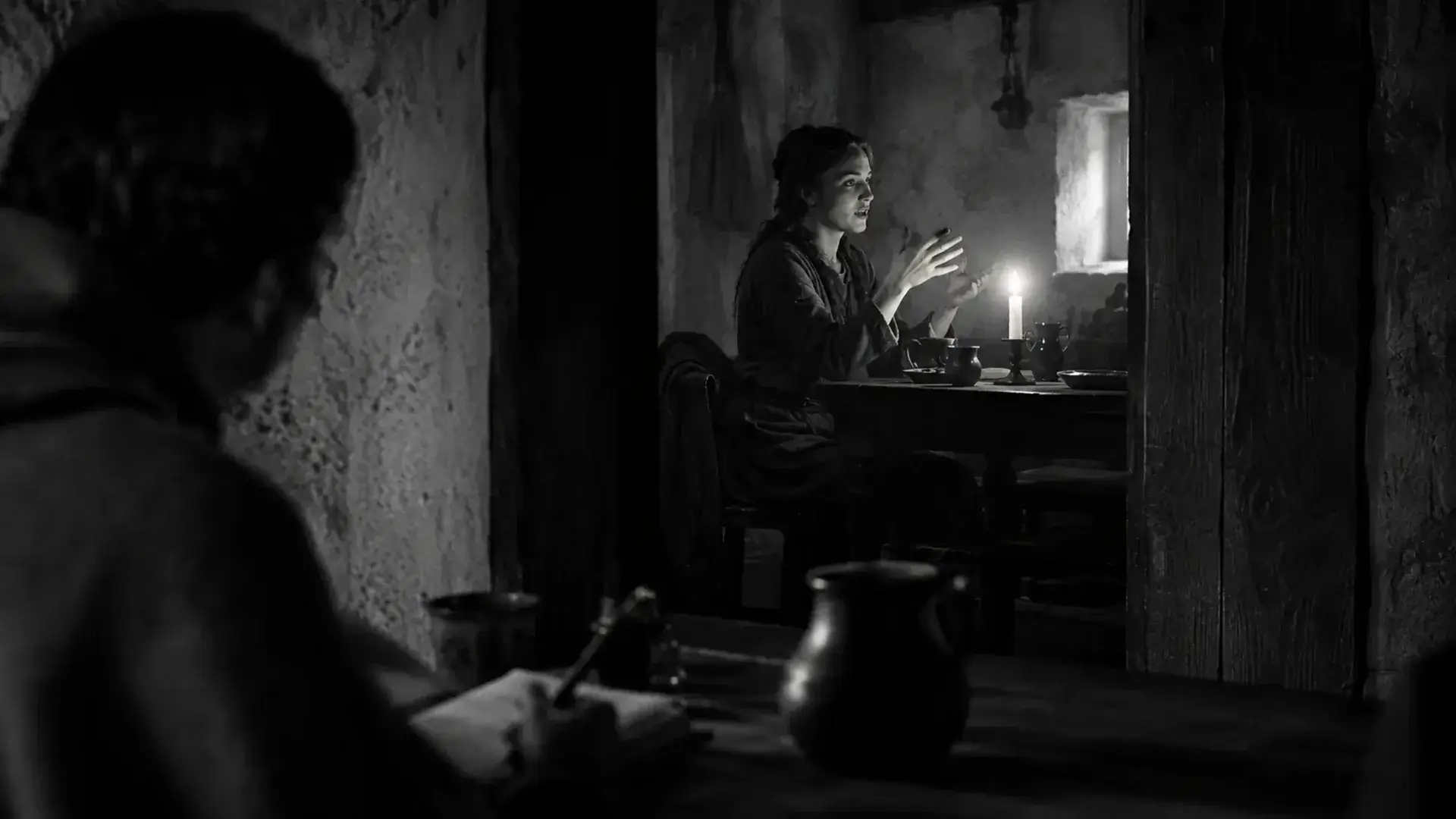
The Wife of Bath — Alison, from near the city of Bath — is one of Chaucer’s pilgrims, traveling with the others to Canterbury. And before she tells her tale, she delivers this extraordinary monologue about her own life: five marriages, beatings, survival, power, scripture, sex, and love. She picks out the facts she wants us to know. She selects. She filters.
But: it comes to us from another fellow traveler! So we are actually hearing her prologue, her tale, through the “voice” of another traveler! That makes this even more complicated narration than first or third person: it’s a story inside a story.
A Story Inside a Story Inside a Story
Before we go further, we need to understand something about how this prologue reaches us — because the narration here is complex. Not complicated in a way that makes it confusing, but complex in the way that life is complex.
Here is how it works:
There is an anonymous narrator — one of the pilgrims, never named — who is telling us the entire Canterbury Tales. He is our reporter. He is the one documenting this pilgrimage and telling us what happens, what people say, how they act.
Inside his story, the Wife of Bath becomes a narrator herself. She starts talking. She tells the other pilgrims about her life, her marriages, her philosophy. We’re now inside a story inside a story.
And inside her story, other characters speak. The Pardoner interrupts her. The Friar and Summoner make their presence felt. The Host weighs in at the end. Each of these is a story inside a story inside a story.
That’s not a flaw in the construction. That’s the point. It is complex — just like life. When a friend tells you what a colleague said about you, when social media reports on an event that someone else claimed to witness — that’s the same layering of narration. That’s why lawyers talk about hearsay. That’s why we sometimes can’t know what’s true.
Why Quotation Marks Matter More Than You Think
The Wife of Bath’s Prologue begins like this, in Morrison’s translation:
“Experience, though all authority
Was lacking in the world, confers on me
The right to speak of marriage, and unfold
Its woes. For, lords, since I was twelve years old
— Thanks to eternal God in heaven alive —
I’ve married at church door no less than five
Husbands, provided that I can have been
So often wed, and all were worthy men.”
Notice the quotation marks at the beginning of this passage. They’re there because the anonymous narrator is telling us she is speaking. Those marks appear at the start of virtually every paragraph throughout the Prologue.
Now do an experiment. Take the quotation marks away.
Experience, though all authority
Was lacking in the world, confers on me…
Who is saying this? Without those marks, we have no idea. The passage becomes unanchored. That simple pair of quotation marks is doing enormous work. It tells us who is speaking, and it reminds us that someone else — the anonymous narrator — is the one reporting it.
The Pardoner’s Interruption
Near the beginning of her Prologue, the Wife of Bath is interrupted by the Pardoner. He practically jumps up and says that hearing her talk about marriage is making him reconsider getting wed. And she doesn’t skip a beat. She tells him, essentially: I haven’t even started yet. Wait until you hear the rest.
“Hold on,” she said, “you’ll drink a keg of this before I’m done.”
This moment shows us how the other pilgrims are reacting to her. It shows us that she is fully in command of the room. And it reminds us that the anonymous narrator is faithfully documenting all of it — the speech, the interruptions, the dynamic between these travelers.
Who Was She, Before She Started Talking?
The anonymous narrator actually introduced this woman earlier, in the General Prologue to the Tales. A few details from that introduction are worth carrying into our reading.
She was somewhat deaf. We find out why when we read her Prologue: her fifth husband hit her so hard in the ear that she lost her hearing.
She was also a master weaver — better than the weavers of Ypres and Ghent, two cities in Flanders famous across Europe for superior textile production. In other words, she wasn’t just competent. She was the best. Better than the best.
At church, she insisted on being the first to make her offering at the altar. If anyone dared walk ahead of her in line, she was furious enough to, as the narrator puts it, dry up all the charity in Bath. She was devout — but her piety was also a public performance of status.
This is a strong, competitive, proud, self-sufficient woman. And she is about to tell you about her five marriages in extraordinary detail, in front of a group of strangers on a pilgrimage to Canterbury.
Why?
That’s What We’re Going to Find Out
This Prologue is, among other things, a study of power. Who has it. Who loses it. Who maintains it. How it moves between people. And the Wife of Bath’s five husbands are, each in their own way, exercises in that question.
She uses her womanhood as a weapon. She uses scripture as a weapon. She uses silence, speech, accusation, and affection as weapons. And in telling all of this to her fellow pilgrims — openly, without apparent shame — she is doing something bold.
But what exactly is she doing? And why?
That is what we are going to explore together. Come back for Part 2 of the analysis, where we go deep into the philosophy behind her opening lines, the rubber band theory of power, and what she does with the Bible that would have made Chaucer’s audience drop their jaws.
You’re Reading with Jimmy. If you haven’t read the Wife of Bath’s Prologue yet, go back and read it with me before continuing. The analysis is richer when you’ve been inside the text.