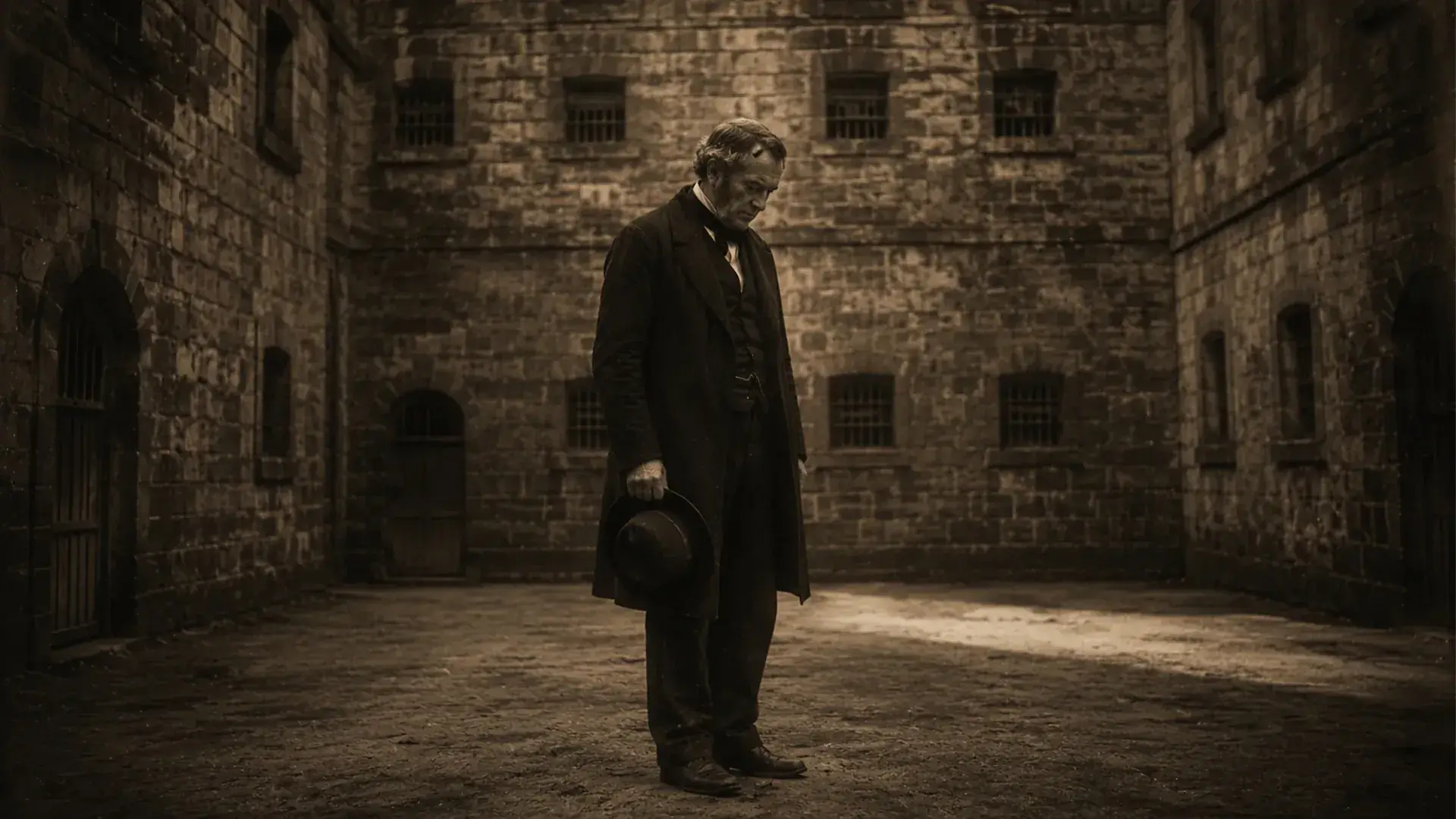
At the very end of Bartleby, the Scrivener, after Bartleby has died of starvation in the Tombs — the New York prison where he was sent as a vagrant — the narrator shares a rumor.
He has heard that Bartleby once worked in the Dead Letter Office in Washington. Letters sent to the dead. Letters sent with urgent purpose — a ring, a bank note, a pardon, good news — that arrived after their recipients may have already died. Letters that went, as the narrator puts it, on “errands of life” to “speed to death.”
The narrator can barely contain what he feels. “Dead letters! does it not sound like dead men?” And then the story ends with two words:
“Ah Bartleby! Ah humanity!”
That is the whole ending. Two exclamations. A name and a species. What does it mean?
The Dead Letter Office — Evidence or Excuse?
Most readings of Bartleby treat the Dead Letter Office as the explanation for everything. Bartleby handled dead letters. Dead letters made him hopeless. Hopelessness made him withdraw. This is why he preferred not to.
Jimmy disagrees — not with the poignancy of the image, which is genuine, but with the idea that it resolves anything. The narrator himself tells us it is a rumor. He does not know if Bartleby worked there. He is speculating. And note where the speculation happens: after Bartleby is already dead, after the narrator can no longer do anything for him, after the relationship is over.
The Dead Letter Office is what the narrator reaches for when it is too late to reach for anything else. It is his attempt to give Bartleby a biography — to make sense of a man that he couldn’t make sense of.
That is not resolution. That is the narrator’s final act of self-consolation. An excuse.
Existentialism, Master-Slave — and Something More
Bartleby has been read as an existential parable — Sisyphus rolling his rock, the absurdity of meaningless labor, a man who simply stops participating in the machinery of modern life. You can find that in the story.
It has been read as a master-slave narrative — an employer who treats his employee as a pure instrument until the instrument refuses to function. You can find that too.
But both frameworks leave something important out. They focus on explaining Bartleby, but they do not explain the narrator’s cry at the end — “Ah Bartleby! Ah humanity!” — or why a prudent, unambitious, eminently safe Wall Street lawyer is still thinking about a dead scrivener years after the fact, still trying to write his story, still unable to let him go.
The narrator did not just witness Bartleby’s decline. He participated in it. He set up the office. He placed Bartleby behind the screen. He moved his offices instead of helping him. He told the new tenants Bartleby was nothing to him. And then he went to the Tombs and watched Bartleby die.
Father Zosima and Responsibility
In Dostoevsky’s The Brothers Karamazov, a monk named Father Zosima articulates a philosophy that sounds impossible at first:
“We are no holier than those what are outside… every one of us is undoubtedly responsible for all men and everything on earth.”
Responsible for everyone. All men and everything on earth. How can that be true?
Think about it this way. The narrator was responsible for one person: Bartleby. Not all of humanity — just this one man who stood in his doorway one summer morning, pallidly neat, pitiably respectable, incurably forlorn. He hired him. He set the terms. He had the power, at every point in the story, to change the outcome.
He accepted Bartleby’s behavior instead of engaging with it. He moved his offices. He walked away.
“Ah Bartleby! Ah humanity!”
That is not just a cry about Bartleby. That is a cry about what it means to be responsible for another person and to fail them — quietly, without violence, without even fully recognizing you have failed until it is too late.
We are all Bartleby. Preferring not to. Suffering in silence. Prisoners of our own design. And we are all the narrator — moving our offices, purchasing delicious self-approval at low cost, telling ourselves we did what we could.
The story ends with an exclamation. But it is not a resolution. It is a recognition — Aristotle’s recognition, arriving at last, after the reversal has already happened, after the fortune has already changed, when nothing can be done but feel it.
That is why Bartleby, the Scrivener has lasted 170 years. And why you should read it again.