Here’s a question worth sitting with after you’ve read Lysistrata: why does it still work? The war it references ended 2,400 years ago. The specific political jokes are lost. Half the cultural references require a footnote. And yet the play is still funny. Why?
The answer has something to do with Abraham Maslow — and with Aristophanes knowing exactly where to plant his flag.
The Hierarchy
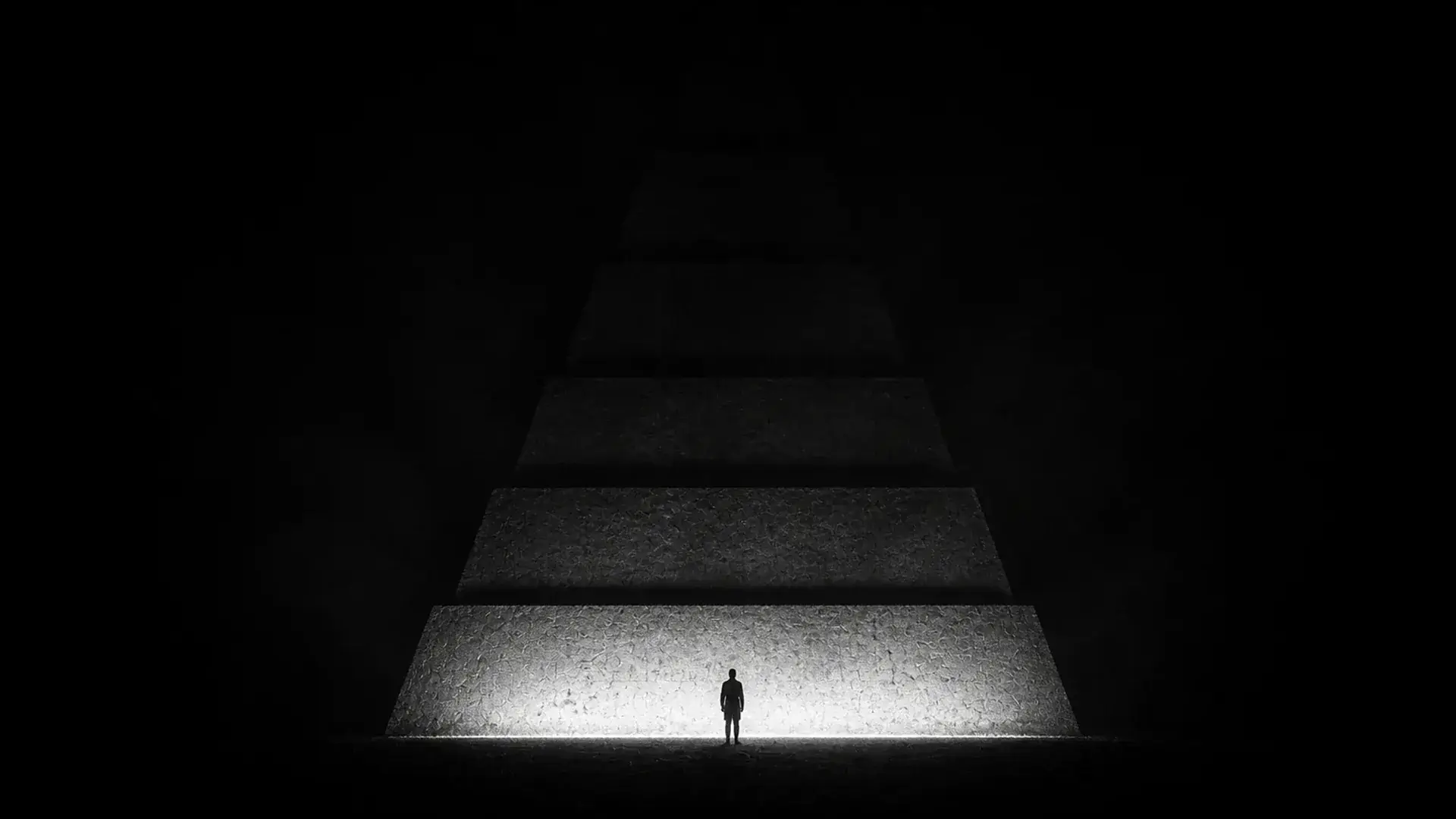
Maslow was a 20th-century American psychologist who proposed that human needs exist in a hierarchy. At the bottom: breathing, food, water, sleep, sex — the physiological basics. Above that: safety. Then belonging. Then esteem. At the top: self-actualization. Maslow’s theory was that you can’t reliably pursue the higher levels until the lower ones are satisfied.
You’ve probably seen the pyramid. It still gets argued about in academic circles. But for understanding Lysistrata, the specifics of the debate don’t matter. What matters is this: Aristophanes set his entire play at the bottom level. Sex. The most fundamental, least negotiable of the physiological drives.
He didn’t write about esteem. He didn’t write about self-actualization. He didn’t write about the political future of Athens. He wrote about the one thing that cuts through all of that. And then he made it funny.
What Comedy Does
Aristotle said comedy represents human beings “worse than they are.” Not evil — just ridiculous. Laughable. The men in Lysistrata are not villains. They’re men who want sex and won’t end a war to get it back. That’s the whole situation, and it’s absurd on its face.
But it’s also recognizable. That’s what makes it comedy rather than just mockery. The audience laughs because they see themselves in it. The Marx Brothers work the same way. You’re not thinking about philosophy when you watch them. You’re just laughing — because what’s happening on screen is an exaggerated version of something real.
Aristophanes understood that when you exaggerate a fundamental human need, you don’t need to build elaborate characters or complicated plots. The need does the work. Lysistrata is, by design, a simple play: one problem, one solution, one conflict. Around 14,500 words. Everything in it moves toward the same point. That’s Aristotle’s unity of action, and Lysistrata executes it cleanly.
Freud and the Joke
Sigmund Freud, in The Interpretation of Dreams, made a connection between the way dreams work and the way jokes work. Both operate by condensing meanings and substituting signs. A pun, for example, lets one word do two jobs at the same time — which is exactly what Aristophanes does throughout Lysistrata. When Kalonike hears Lysistrata’s plan described as “big” and responds that it sounds “beefy” — they’re not talking about the same thing, and everyone in the audience knows it.
That double meaning is the engine of the comedy. It’s working below the level of argument or theme. It hits you before you think about it. Which is, again, the physiological level. The bottom of the pyramid.
Why Some People Don’t Find It Funny
Professor Michael Billig from Loughborough University made the observation that humor is universal — every society has it — but there’s nothing that is universally funny. Humor is particular. It depends on context, on what you know, on what you’re willing to laugh at.
Some people will read Lysistrata and not find it funny. That’s a real response. Cultural distance is real. The specific political jokes are gone. The names mean nothing to us. And staging the play today is genuinely difficult, because modern audiences have lost much of the shared reference pool that made it land for a Greek audience in 411 BCE.
But the central situation still lands. A group of women deciding to withhold sex until men stop a pointless war is still an idea you can picture. The frustration is still recognizable. The stubbornness on both sides is still recognizable. That’s the part that survives.
What You Take Away
Jimmy has read this play more than once, and his answer to what he takes from it is simple: the ability to laugh at yourself. Not at war — war isn’t funny. But at the human situation that produces war. At the men too proud to stop. At the absurdity of what it takes to make them.
François Rabelais — the 16th-century French writer — said it plainly: “It is better to write of laughter than of tears, for laughter is the essence of mankind.” That’s what Aristophanes believed too. Not that the suffering isn’t real. But that laughter is part of how we survive it, and part of what makes us human in the first place.
Take it seriously enough to find it funny. That’s the work.
This concludes Jimmy’s three-part analysis of Lysistrata by Aristophanes. Have questions or reactions? Send them to [email protected] — a lot of this analysis came from reader emails, and yours might too.
Reading with Jimmy — readingwithjimmy.com | [email protected]