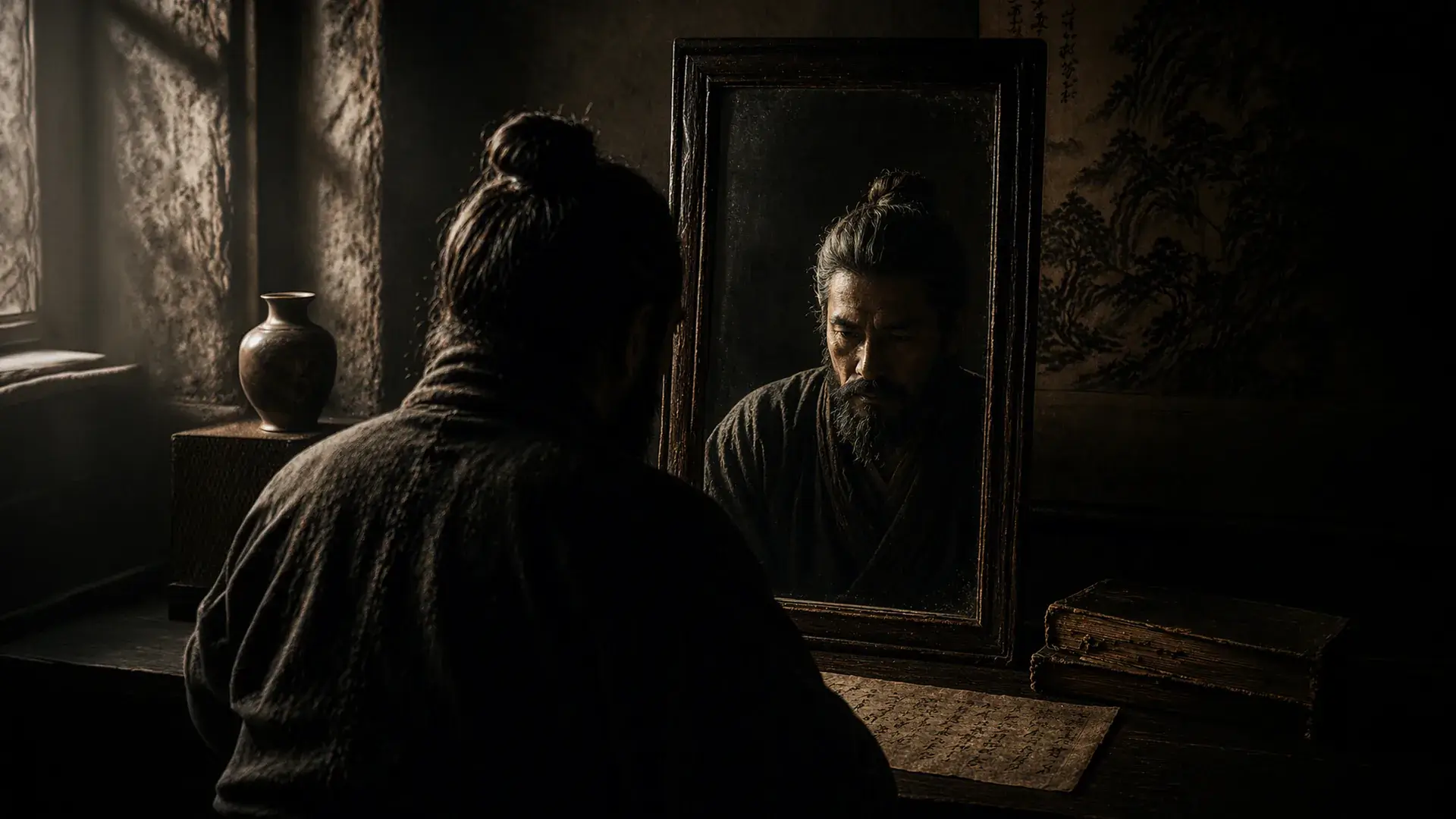
Perception — Sun Tzu Series, Essay 3
This third essay argues that the most quoted line in The Art of War is only half the instruction. Sun Tzu puts self-knowledge first — and the reason is simple: most people lose their conflicts not because they misread their opponent, but because they never honestly assessed themselves.
Everyone knows the line.
If you know the enemy and know yourself, you need not fear the result of a hundred battles.
It gets quoted in boardrooms. In locker rooms. In business books with titles that include the words strategy, winning, and edge. It is probably the most reproduced sentence Sun Tzu ever delivered by his anonymous narrator.
And almost everyone who quotes it emphasizes the wrong half.
They focus on the enemy.
Sun Tzu is focused on you.
The Order Is Not Accidental
Look at the sentence again.
Know the enemy — and — know yourself.
Sun Tzu puts the enemy first in the sentence. But he puts self-knowledge at the center of the entire book.
The general who wins, he tells us, makes many calculations before the battle is fought. The general who loses makes few.
What are those calculations about? The enemy, yes. But also — and more fundamentally — about the general himself. His resources. His weaknesses. His capacity to sustain a campaign. His honest assessment of what he can and cannot do.
Sun Tzu says it plainly: to secure ourselves against defeat lies in our own hands. The opportunity to defeat the enemy is provided by the enemy. But the protection against defeat? That comes from within.
Which means that before you study your opponent, you have to study yourself. And that is the harder assignment by a significant margin.
Socrates Said It First
Know thyself.
Socrates. Athens. Roughly the same century Sun Tzu was being transmitted in China.
Two entirely separate traditions arriving at the same conclusion: that self-knowledge is not a philosophical luxury. It is a practical requirement for anyone who intends to navigate a world full of conflict and consequence.
Introspection is not comfortable. It requires looking at yourself honestly — which means being willing to admit weakness, not just catalogue strength. Most people are considerably better at identifying what they are good at than at naming what they are not good at.
Sun Tzu is not interested in your strengths alone. He is interested in your accurate picture. Because an accurate picture — one that includes weakness — is the thing that produces real strategy. A picture that only shows strength produces overconfidence. And overconfidence, Sun Tzu tells us, is how you lose a battle before it starts.
What Fear Has to Do With It
Sun Tzu connects self-knowledge directly to the elimination of fear.
If you know the enemy and know yourself, you need not fear the result of a hundred battles.
Fear, in Sun Tzu’s framework, is what happens in the absence of knowledge. You fear what you do not understand — about your opponent, yes, but more dangerously, about yourself.
What are you afraid of? The truth about your own weaknesses? The honest accounting of what you do not know?
Here is the hard fact: once you confront your fear — once you name it, examine it, sit with it the way Agassiz’s student sat with the decomposing fish — you begin to lose it. Not all at once. But steadily.
Fear stifles thinking. It narrows options. It pushes you toward reaction rather than strategy. The warrior who has done the introspective work does not become fearless because nothing threatens him. He becomes fearless because he has already reckoned with the worst case and made his calculations.
Marcus Luttrell understood this. In Lone Survivor he wrote that the real battle is won in the mind — by those who understand their areas of weakness, who sit and think about it, plotting and planning to improve.
Not their strengths. Their weaknesses. That is the work Sun Tzu is pointing at.
My Uncle Teddy, Revisited
In Essay 2, I introduced my uncle Teddy.
He came home from World War II and spent decades looking, to those of us who didn’t know, like a passive man. Quiet. Accommodating. He did whatever his wife asked. She went on vacations alone while he stayed home. I was a kid and I thought: what kind of man is that?
Then my mother died. And sitting around her apartment, Teddy started talking. Normandy. Hedgerow fighting. Night after night, going out into the darkness to kill Germans. When he described it, he cried.
I have thought about Teddy many times since that day.
What I understand now that I didn’t understand then is this: my uncle Teddy had done the reckoning. He had looked at what war was, what it cost, what it made him do — and he had come home and chosen a quiet life not out of weakness, but out of understanding. He had seen what conflict at full scale does to a human being. He had no appetite left for any version of it.
That is a man who knew himself.
Not the version of himself the neighborhood saw — the tall, quiet man who deferred to his wife. The version underneath: the one who had been to Normandy, who had done the hedgerow work, who understood at a cellular level what Sun Tzu meant by the cost of prolonged warfare.
His silence was not passivity. It was the strategy of a man who had already calculated everything.
The Teaching Story That Stays With Me
I became a teacher before I became a marketer. And my first day in a classroom nearly finished me.
I had written the best lesson plan of my life. I walked in. Complete chaos. An underachiever class — students who had been told, and had come to believe, that they could not read. They did not care about my lesson plan. They had never seen it. Chaos erupted. Things got thrown.
I realized quickly: they didn’t read my lesson plan. So I never wrote another one.
What I learned — the thing that made me an effective teacher by the second year — was three words: anticipate, react, adapt.
No process is static. The classroom is fluid. The battlefield is fluid. The market is fluid. Water, as Sun Tzu says, has no constant shape. It moves according to the ground it flows over. A soldier — a teacher, a strategist, a person navigating any serious conflict — must do the same.
But here is the thing about anticipate, react, adapt: it only works if you know yourself well enough to be honest about where your plan is failing. The teacher who blames the students for not following the lesson plan will never adapt. The general who blames the terrain for not matching the map will never win.
The adaptation begins with the honest admission: this is not working, and part of why it is not working is me.
That is self-knowledge under pressure. That is what Sun Tzu demands.
The Line No One Quotes
Sun Tzu has another line that deserves as much attention as the famous one:
Do not repeat the tactics which have gained you one victory, but let your methods be regulated by the infinite variety of circumstances.
People think that if something works once, it will work again. I have watched this mistake cost clients years of recovery time. A product launch formula that succeeded in one market, applied unchanged to another — disaster. A communication strategy that worked with one audience, assumed to work with all audiences — failure.
The formula is not the strategy. The formula is what strategy produced the last time, under those specific conditions, against that specific opponent.
Knowing yourself means knowing this: you are not the sum of your previous victories. You are the capacity to read a new situation honestly and respond to what is actually there — not to what you expect to be there, not to what was there last time.
That requires a particular kind of self-awareness. It requires the discipline to question your own proven methods at exactly the moment when they feel most reliable.
That is uncomfortable work. Sun Tzu doesn’t pretend otherwise.
The Real Question
The most famous line in The Art of War is only complete if you take both halves equally seriously.
Knowing the enemy is learnable. You can study an opponent. You can observe tactics and reverse-engineer strategy. You can gather intelligence.
Knowing yourself is harder. Because the self has a strong interest in flattering reports.
Sun Tzu is asking you to be your own most rigorous analyst. To look at your weaknesses with the same clear attention Agassiz’s student eventually gave that fish. To name your fears before conflict makes them visible. To calculate honestly — not optimistically — what you can sustain.
If you can do that, a hundred battles become manageable.
If you cannot, even one may be too many.
The real question is not whether you know your enemy.
It is whether you are willing to know yourself.
You’ve been reading with Jimmy. This completes the three-part series on The Art of War by Sun Tzu. Read the book with me — not just the analysis, but the text itself. And when you do, start where we always start: with the narrator. Thanks for stopping by.