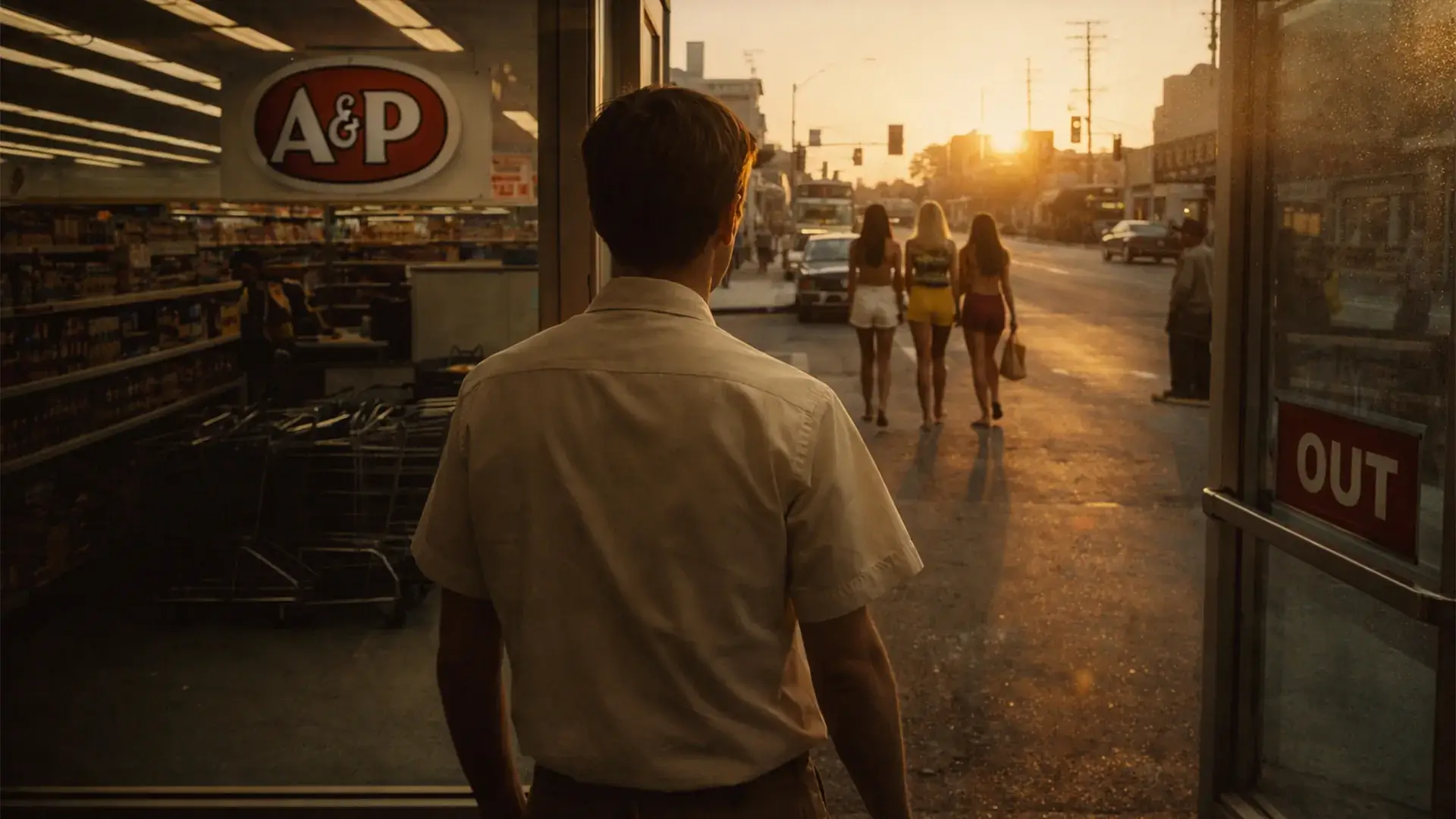
A&P: A Story of a Moment
A close reading of John Updike’s A&P—how Sammy sees, understands, and chooses to act
A&P, first published in The New Yorker in 1961, is often read quickly. It’s short. The setting is familiar. The situation seems simple.
A teenage cashier. A grocery store. Three girls who don’t quite belong in that space.
And because of that, many readers move through it the same way the customers move through the store—efficiently, without stopping.
But this is not a story that rewards speed.
A&P is a first-person narrative.
Everything we see, hear, and understand comes through Sammy—the cashier telling us the story after it has already happened.
That matters. Because what we are reading is not just an event. It is someone recounting an event.
The three short essays that follow take up questions about Sammy – and about each of us:
What kind of narrator am I?
What kind of world am I in?
And what, exactly, am I paying attention to?
In the final Blog #3, we’ll take a deeper look at why Sammy quits—not as a sudden reaction or a gesture for attention, but as the result of a moment he has already seen, understood, and chosen to act on.
By the time Sammy says “I quit,” his decision has already been made. Most readers miss this point: that’s not the moment where the story turned. In fact, Sammy made his decision almost as the story began. Consider this.
Lengel asks him a simple question:
“Sammy, have you rung up their purchase?”
And Sammy responds:
“I thought and said ‘No,’ but it wasn’t about that I was thinking.”
That line where attentive readers recognize “the moment.” He admits to us that he is thinking about something else than his answer to Lengel. What do you think that could have been?
Outwardly, he’s still doing his job. Answering questions. Running the register. But internally, something has already shifted. He is thinking beyond the immediate task and almost playing out an outcome yet to be.
That is not reaction. It is already forming into decision.
The story reinforces this again.
As he completes the transaction, he tells us he is acting:
“all the time thinking.”
That repetition matters. Because it tells us that what follows is not spontaneous.
It is not reactive. It is considered. Strategic.
And that’s why this point is where most interpretations of this classic go wrong.
They assume:
- he is trying to impress the girls
- he is acting out of attraction
- he makes a gesture that fails because it isn’t seen
But the text – his narration — dismantles all of that. He knows the girls will be gone:
“I look around for my girls, but they’re gone, of course.”
“Of course.”
Those words remove any illusion. And don’t forget: he is the first person narrator. And in this case, a truthful one. He is not performing for the girls. He never was. His quitting had nothing to do with anything other than morality around the word decency.
When Lengel defines “decency.” When the girls are positioned as outside the “system,” that’s when Sammy makes his decision. When the store—the middle—reasserts its control.
Sammy sees that. And he recognizes his place within the system. As observer. And as observer, he knows he is changing what he observes. But it’s a dramatic change, a shift in perspective. Sammy is redefining what “decency” means. Or what embarrassment is or could be.
This is where the decision forms. And once it forms, it follows a principle – one of the rules of life actually – when he states clearly:
“Once you begin a gesture, it’s fatal not to go through with it.”
That is not impulse. That is commitment. Wisdom.
When he says “I quit,” he is not creating a moment.
He is completing one. And if you read closely, you will see Sammy is actually observing himself throughout the whole narration. It’s almost as if he is casting himself in a movie. An unsung hero. Making a decision that will actually have a profound effect on his whole life. And probably did, since he is the first person narrator in the story and this has all taken place already.
And his decision comes with a cost. Lengel tells him:
“You’ll feel this for the rest of your life.”
Sammy knows he’s right. At the end, he recognizes it:
“my stomach kind of fell as I felt how hard the world was going to be to me hereafter.”
That’s not regret, is it? It’s self awareness.
What separates this story and makes it a classic is not that it is a story about rebellion or romance or escape. It’s a story about a moment in someone’s life where a gesture puts him outside the system. It’s a story about gestures that we all make, whether to stay inside, or outside a system.
The beauty of this classic is that it is a story about someone who consciously makes the decision to step away from it.
The observer in all of us.
The question the story leaves us with is not whether Sammy was right.
It’s simpler than that.