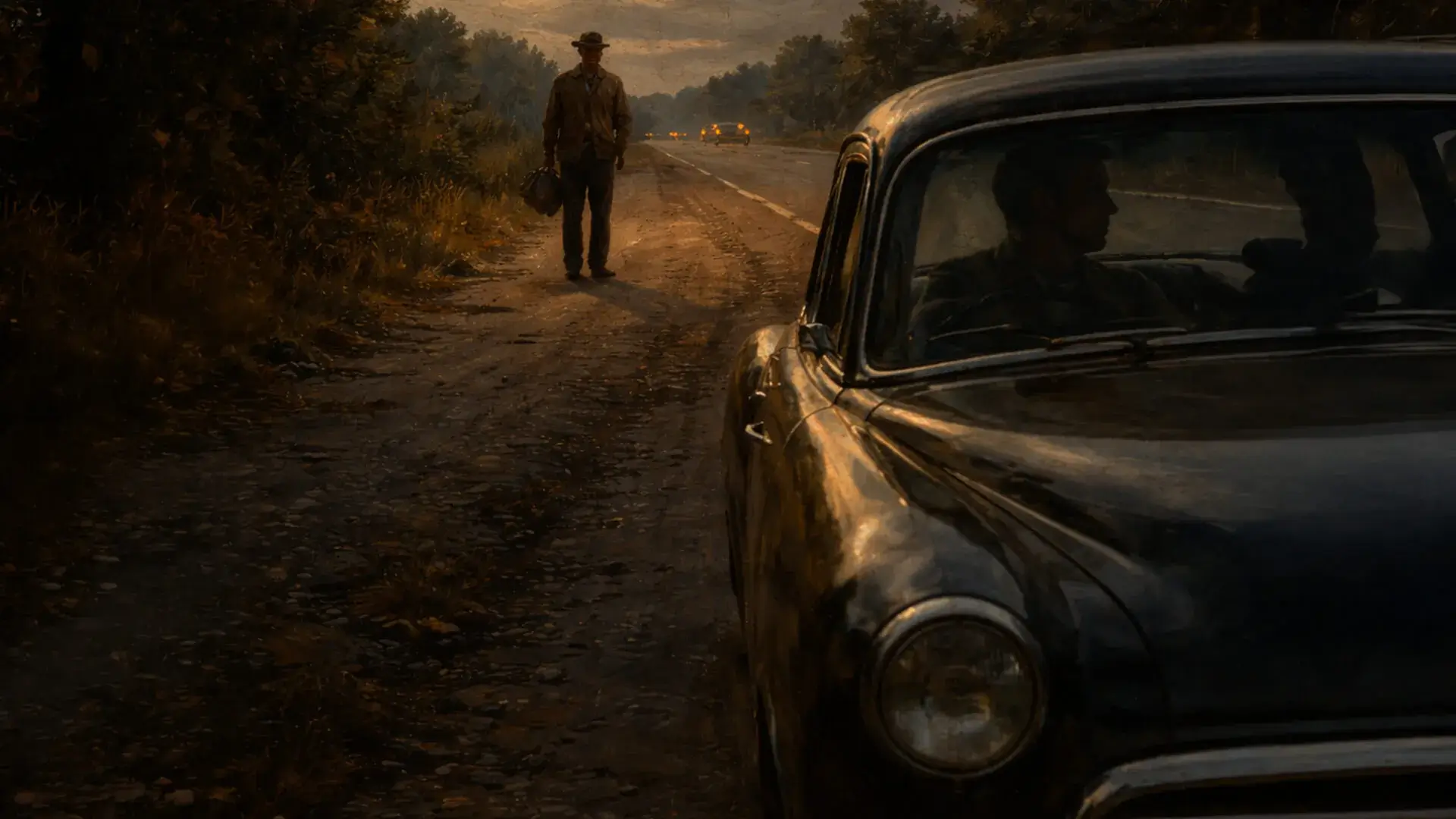
Travel Is So Broadening — Or Is It?
A Reading with Jimmy Series Introduction
Most readers approach Travel Is So Broadening as light satire — a humorous portrait of a boastful traveler who never quite makes it where he claims to be going. The jokes seem obvious. The exaggeration is easy to spot. The narrator is ridiculous.
But Sinclair Lewis is not simply making fun of a man.
He is doing something more exact — and more uncomfortable.
He gives us a first-person narrator and then lets him talk. He does not interrupt him. He does not correct him. He does not condemn him. He simply allows Mr. Schmaltz to reveal himself through his own words — through his generalizations, his pride, his prejudices, his small cruelties, and his complete confidence that he has been “broadened” by experience.
The story is not about Yellowstone.
It is not about automobiles.
It is not even primarily about travel.
It is about what happens when a man speaks at length without ever listening — to others or to himself.
Across this short series of essays, we will examine three things:
- how first-person narration exposes character
- how language reveals moral blind spots
- why travel does not automatically produce growth
Because the most revealing journey in this story is not the one across state lines.
It is the one inside the narrator’s mind.
And it is narrower than he imagines.
In Travel Is So Broadening, Sinclair Lewis uses first-person narration to show that travel does not broaden character — it merely amplifies whatever character already exists.
Generalizations, Cruelty, and the Illusion of Moral Superiority in Travel Is So Broadening
In this second essay, we turn from voice to ethics. What does Mr. Schmaltz’s language reveal about how he sees other people? Here we examine how casual generalizations, small cruelties, and confident judgments create the illusion of superiority — and why Lewis never has to accuse his narrator directly. The critique is embedded in the way the story unfolds.
If Blog #1 established that Mr. Schmaltz reveals himself by talking, this essay asks the harder question:
What exactly does Schmaltz reveal?
The answer is not simply that he exaggerates.
It is that he generalizes.
And those generalizations are not harmless.
The Habit of Categorizing
Schmaltz rarely encounters an individual. He encounters types.
Farmers are “sweet,” but culturally behind.
Small-town restaurant owners are incompetent.
The hobo is lazy.
The other driver is a “rube.”
The Jewish shoe salesman becomes a caricature.
The woman at the farmhouse is ungrateful.
Each encounter is filtered through a label.
Now, we all generalize. We must. Without generalization, the world would overwhelm us. We recognize patterns. We infer. We categorize.
But there is a difference between a necessary generalization and a lazy one.
Schmaltz does not generalize to understand.
He generalizes to dismiss.
Language is a Moral Clue
Pay attention to his word choices.
He does not describe people neutrally. He describes them in ways that reduce them:
- “Hick.”
- “Rube.”
- “Shabby looking cuss.”
- Slurs he repeats casually.
- Tone that drips with sarcasm.
He laughs at inconvenience.
He delights in another man’s misfortune.
He calls cruelty clever.
And then he congratulates himself.
Notice the pattern: he always positions himself as rational, polite, dignified — even when his actions contradict those claims.
He describes damaging the other man’s tire and later laughing about the inconvenience it will cause.
He refuses a ride to a hobo, lectures him about responsibility, and calls it helpful advice.
He recounts these stories with pride.
He does not see contradiction.
That blindness is the story’s true subject.
The Broken Valve Stem
The tire incident is the clearest example.
He bumps another man’s car.
He damages the valve stem.
He knows it will fail later.
He says nothing.
Then he laughs.
That moment is small in action — but large in revelation.
Cruelty does not always look like violence.
Sometimes it looks like indifference.
Sometimes it looks like pleasure taken in inconvenience.
Sometimes it looks like telling a story and waiting for applause.
Schmaltz calls himself justified.
But the narrative quietly exposes something else: he does not take responsibility.
And more importantly, he does not examine himself.
The Illusion of Superiority
Throughout the monologue, Schmaltz operates under one assumption:
He is smarter.
He is more cultured.
He is more efficient.
He is more correct.
Even when he is plainly petty, he reframes himself as dignified.
He tells the hobo to “buckle down.”
He mocks the restaurant owners.
He lectures his wife.
He boasts about outsmarting the shoe salesman.
Every interaction reinforces his belief that he stands above others.
But here is the irony:
The more he asserts superiority, the smaller he appears.
Lewis never says this outright. He doesn’t need to.
First-person narration does the work.
The Danger of Unexamined Speech
There is a quiet warning embedded in this story.
When a person speaks continuously without reflection, speech becomes insulation. Just listen carefully to how people talk, what they say, how they say it.
It protects the speaker from self-awareness.
Schmaltz never pauses long enough to question himself.
He never wonders whether he misjudged someone.
He never considers that the woman at the farmhouse might be exhausted.
He never imagines the hobo’s circumstances.
He never entertains the possibility that the other driver’s frustration was reasonable.
Instead, he explains.
And explains.
And explains.
Language becomes armor.
And the armor prevents growth.
What Travel Did — And Did Not — Teach Him
Schmaltz insists that travel broadens.
But what has broadened?
Has his sympathy expanded?
Has his curiosity deepened?
Has his humility increased?
Or has travel simply provided him with more material for storytelling — more examples to reinforce what he already believed?
This is the heart of the matter.
Travel cannot broaden a mind that refuses to listen.
Experience cannot enlarge a character that refuses to examine itself.
And speech cannot redeem a man who never questions his own certainty.
In the final blog, we will turn to the title itself — and ask whether Travel Is So Broadening is satire, warning, or mirror. Because the most uncomfortable question in this story is not whether Schmaltz is a blowhard. It is whether we recognize parts of him in ourselves.