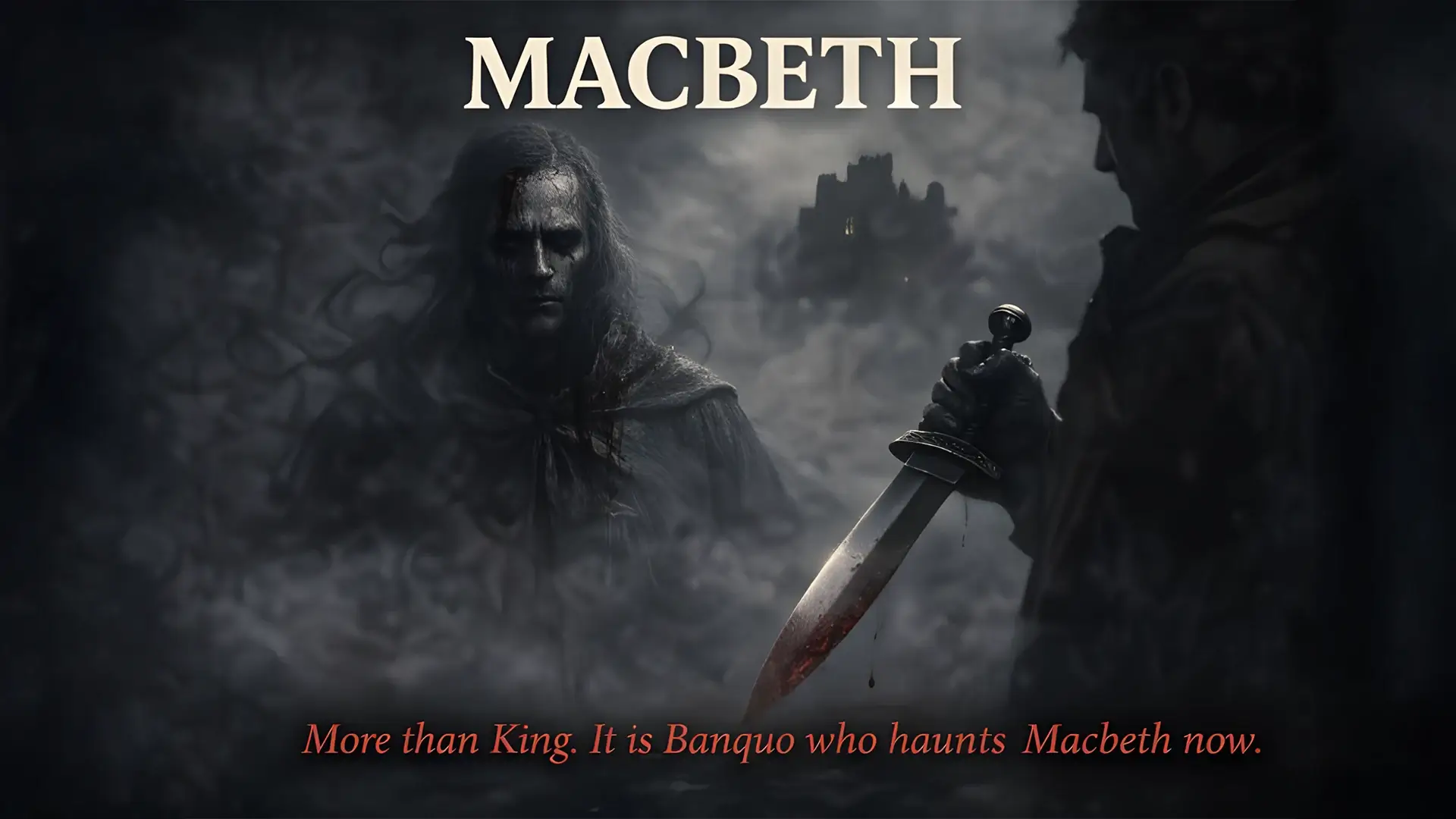
Because obsession doesn’t end when it gets what it wants. It intensifies, shifts targets, and begins eliminating anything that threatens permanence — especially the future.
In Macbeth, the crown isn’t the finish line. It’s the beginning of the real catastrophe.
Most readings of Macbeth treat Duncan’s murder as the center of the play.
That’s understandable. It’s shocking. It’s violent. It’s irreversible.
But it isn’t the real turning point.
If Macbeth were a play about ambition, Duncan’s death would end the story. The crown would be won. The desire satisfied. The plot resolved.
But Shakespeare doesn’t end the play there.
Because the play is not about ambition.
It’s about obsession — with power.
Macbeth is about what happens when obsession discovers that power is insatiable.
Duncan Is an Obstacle — Banquo Is the Threat
Duncan stands in Macbeth’s way.
Banquo stands in Macbeth’s future.
That difference matters.
Duncan is a problem that can be removed.
Banquo is a problem that must be removed.
Because obsession isn’t ever about one thing.
It’s about one thing after another thing — to infinity.
Once Macbeth kills Duncan, the crown is his.
But obsession doesn’t stop there.
Obsession is about permanent power.
Banquo represents something Macbeth cannot control: a future — children — in which Macbeth’s power dissolves into someone else’s lineage.
That is intolerable to an obsessed mind.
Obsession Is About Elimination, Not Achievement
Here is the pivot that most readers miss.
After Duncan’s murder, Macbeth does not relax. He does not enjoy kingship. He does not savor triumph.
He becomes more agitated.
Why?
Because obsession is never satisfied by success.
It is only satisfied by certainty — and the truth is, nothing is ever certain.
Once obsessed, the pursuit of power becomes eternal.
Banquo’s heirs make certainty impossible.
So Macbeth’s thinking shifts — subtly but decisively — from getting to eliminating.
Once that shift happens, the play — and Macbeth himself — becomes far more dangerous.
Because now Macbeth is no longer reacting.
He is preempting.
Banquo Is Dangerous Because He Knows — and Because He Waits
Banquo is one of Shakespeare’s most quietly threatening characters.
He hears the same prophecy.
He receives his own.
And yet he does not act.
He waits.
He watches.
He does not allow the prophecy to hijack his mind.
That restraint is unbearable to Macbeth.
Because Banquo becomes living proof that the witches did not force anything.
Which means Macbeth forced himself.
That is why Banquo must be eliminated.
Not because Banquo is plotting.
But because Banquo is not obsessed.
The Murder of Banquo Proves the Diagnosis
This is the moment where ambition definitively fails as an explanation.
Banquo’s death gains Macbeth nothing tangible.
It does not give him more power.
It does not make him safer.
It does not stabilize the kingdom.
It is a pure act of obsession.
Macbeth is not expanding his position.
He is trying to create the future.
And that is the clearest sign that the play has moved beyond ambition into pathology.
Fleance Escapes — Obsession Escalates
Shakespeare is merciless.
Banquo dies.
But Fleance escapes.
This is not a plot inconvenience.
It is a psychological catastrophe.
Obsession cannot tolerate partial success.
If certainty cannot be achieved, obsession intensifies.
That’s why Macbeth does not — cannot — stop killing.
That’s why the body count rises.
And why moral language disappears altogether.
Once obsession realizes it cannot control the future, it tries to erase everything it cannot predict.
That is why Macbeth becomes more violent, not less.
Why Macbeth Fights at the End
By the time we reach the final act, Macbeth knows the witches have deceived him. He knows the prophecies were equivocal. He knows the future he tried to control has collapsed.
This is not courage.
This is obsession refusing to surrender.
Macbeth no longer believes in victory.
But obsession cannot stop. It has nowhere else to go.
So Macbeth becomes a man who continues moving even after the reason for movement is gone.
As a result, he loses his head — and since obsession lives in the head, this is called irony.
That is Shakespeare’s final, brutal insight.
The True Tragedy of Macbeth
Macbeth’s tragedy is not that he wanted too much.
It’s that once obsession took hold, he could no longer want anything else.
Not peace.
Not rest.
Not repentance.
Not life.
Only continuation.
Only force.
Only resistance against a reality that would not obey him.
The Point of Macbeth
Macbeth is not a warning about ambition.
It is a warning about what happens when an idea captures the mind and refuses to let go.
When moral categories collapse.
When prophecy replaces judgment.
When the future becomes more real than the present.
Shakespeare shows us that obsession does not destroy a person all at once.
It erodes choice slowly — like unwinding a rope, strand by strand.
And when choice is gone, violence becomes automatic, without thought.
That is why Macbeth endures.
Because it is not a story about kings.
It is a story about what happens when the mind loses its center — and power becomes the only thing left holding it together.
Explore the full Macbeth readings and act analyses here:
Macbeth | Reading with Jimmy
https://readingwithjimmy.com/macbeth/