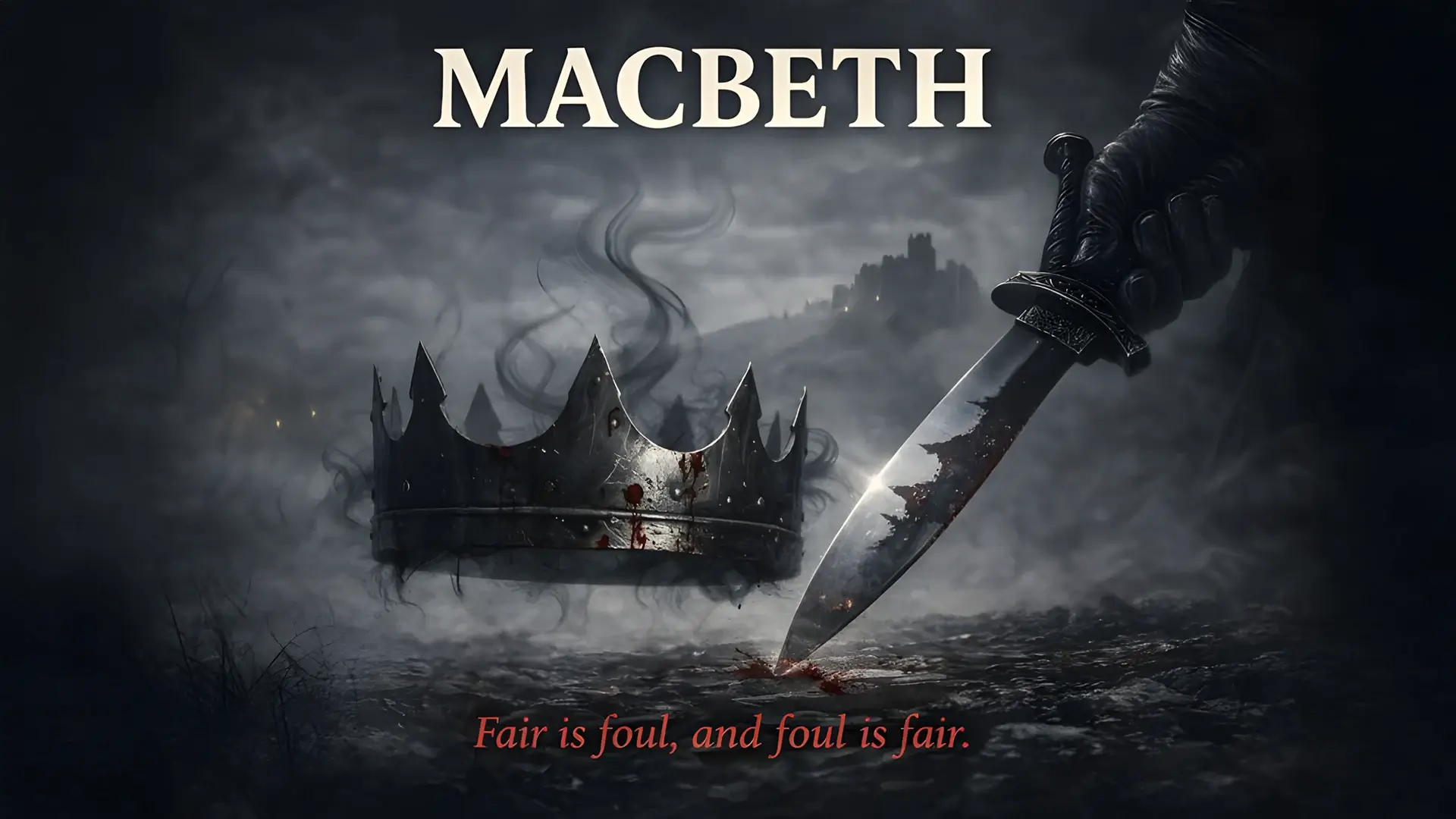
When moral categories collapse, everything becomes arguable… and then everything becomes permissible.
Macbeth is what happens when obsession enters a world where language stops stabilizing truth — and “permission” replaces conscience.
Shakespeare does something unusual in Macbeth.
He doesn’t begin with Macbeth.
He begins with a voice.
A voice that doesn’t belong to any court, any family, any kingdom, any normal human life. It comes out of weather, smoke, and fog. It comes out of nowhere — and yet seems to know everything.
Witches.
And before we even understand what is happening, they speak a sentence that quietly poisons the entire play:
“Fair is foul, and foul is fair.”
Most readers treat that line as atmospheric. Gothic. “Spooky.”
That is a mistake.
This line isn’t there for mood. It’s there to tell you what kind of world this is about to become.
This Is Not a Story of Evil — It’s a Story of Inversion
“Fair is foul” is poetry.
And it’s an ethical formula.
It says:
- categories are no longer stable
- labels no longer hold
- the moral compass no longer points north
Once “fair” can be “foul” — and “foul” can be “fair” — the whole system collapses on itself, like a star that has run out of energy.
And when moral categories collapse, something terrifying happens:
Everything becomes arguable.
Everything becomes justifiable.
Everything becomes permitted.
That is how obsession needs to see the world: permitted.
Because obsession doesn’t recognize rules.
It only sees outcomes.
Why Shakespeare Starts With Witches
People argue endlessly about whether the witches are real, supernatural, symbolic, demonic, hallucinated — and I’m not dismissing those points of view.
But Shakespeare has a deeper, simpler point:
The witches operate like an anonymous narrator.
They are outside normal moral life. They aren’t “characters” in the typical sense. They don’t have a home, a conscience, or a stake in human consequences. They don’t love anybody. They don’t protect anybody. They don’t pay for anything.
That matters because it mirrors what the play is about to do to Macbeth:
detach him from ordinary morality.
The witches are the first sign that this play will not treat good and evil as secure categories — as balanced.
The witches are going to dissolve good and evil.
The Prophecy Works Because It Contains Truth
The prophecy does not arrive as pure fantasy.
It arrives as a blend.
It mixes the supernatural with the factual — and that combination is what makes it dangerous and real.
When Macbeth hears himself named Thane of Cawdor and then the news confirms it, the witches become credible.
Not because witches are credible.
But because truth has been injected into their poison.
Once a prophecy contains one verifiable truth, the mind begins to treat the entire vision as inevitable. Or at least necessary.
Inevitability is the fuel of obsession.
That’s why this isn’t simply “temptation.”
It is intellectual destabilization.
Macbeth’s Mind Begins to Split
One of the most telling moments in Macbeth isn’t a murder scene.
It’s a sentence.
When Macbeth receives the prophecy, he can’t file it away cleanly as good or bad. His mind begins to wobble — and he says something that captures that wobble perfectly:
“This cannot be ill; cannot be good.”
Read that again.
Macbeth is describing the collapse of moral categories in his own head.
This isn’t “evil rising.”
This is moral confusion becoming permanent. You are witnessing morality disappearing from a person’s mind.
Macbeth cannot place the prophecy inside moral reality.
So he does something worse:
he begins to remove moral reality itself.
Once he can’t decide what is fair and what is foul, the mind becomes malleable.
And obsession begins to shape the world the way it wants it — not the way it is.
The Fog Is Not Weather — It’s Ethics
That opening line about fog and filthy air isn’t just scenery.
It’s a moral environment.
Macbeth moves into a world where:
- appearances become unreliable
- motives become unreadable
- conscience becomes negotiable
In other words: he enters a world where language stops stabilizing reality.
And without stable language — without stable categories — you can talk yourself into anything.
That’s why Macbeth not only begins to sound like someone arguing with himself.
He actually does argue with himself — continually.
His mind becomes a courtroom.
And obsession becomes the judge.
“Nothing Is, But What Is Not”
This is one of the play’s most frightening moments — not because it’s supernatural, but because it’s psychological.
Macbeth begins to inhabit a reality that does not yet exist. He begins to live inside what might be, not what is.
And he says a line that nearly defines obsession:
“Nothing is, but what is not.”
This is not poetic despair.
This is the mind losing its grip on the present.
This is the mind turning the future into the only reality that matters.
Once that happens, the present becomes expendable.
Which means people become expendable.
Which means morality becomes expendable.
That’s why “fair is foul” is not atmosphere.
It’s prep work.
“Fair Is Foul” Is a License
Now we come to the center of it.
Once moral categories invert, Macbeth can do what obsession wants to do: commit to an outcome without having to own the evil.
If fair is foul and foul is fair, then:
- murder can be framed as destiny
- treachery can be framed as necessity
- conscience can be framed as weakness
- hesitation can be framed as foolishness
Remember: the witches don’t force Macbeth to kill Duncan.
They do something more subtle — and more wicked:
They create a world in which Macbeth can treat murder as a conclusion rather than a crime.
That’s why the inversion matters.
Macbeth’s Obsession Needs a Moral Fog
Obsession cannot thrive in clarity.
It thrives in ambiguity.
Relativity.
Permission.
To do what it needs to do, obsession requires:
- unstable categories
- unstable language
- unstable judgments
Because when everything is unstable, the obsessed mind can always find an argument for what it wants.
That is why Macbeth is not about ambition. Ambition has clear-cut goals.
Macbeth adjusts his goals based on the obsession of the moment.
This play is about what happens when a mind begins living inside a prophecy — and moral boundaries stop holding.
The Point of Macbeth (So Far)
Shakespeare gives you the key in the first minute of the play:
Fair is foul. Foul is fair.
That is the engine that makes the tragedy possible.
Not because it is magical.
But because it is moral.
When you dissolve moral categories, you don’t create freedom.
You create permission.
And once permission exists, obsession can become law.
Explore the full Macbeth readings and act analyses here:
Macbeth | Reading with Jimmy
https://readingwithjimmy.com/macbeth/