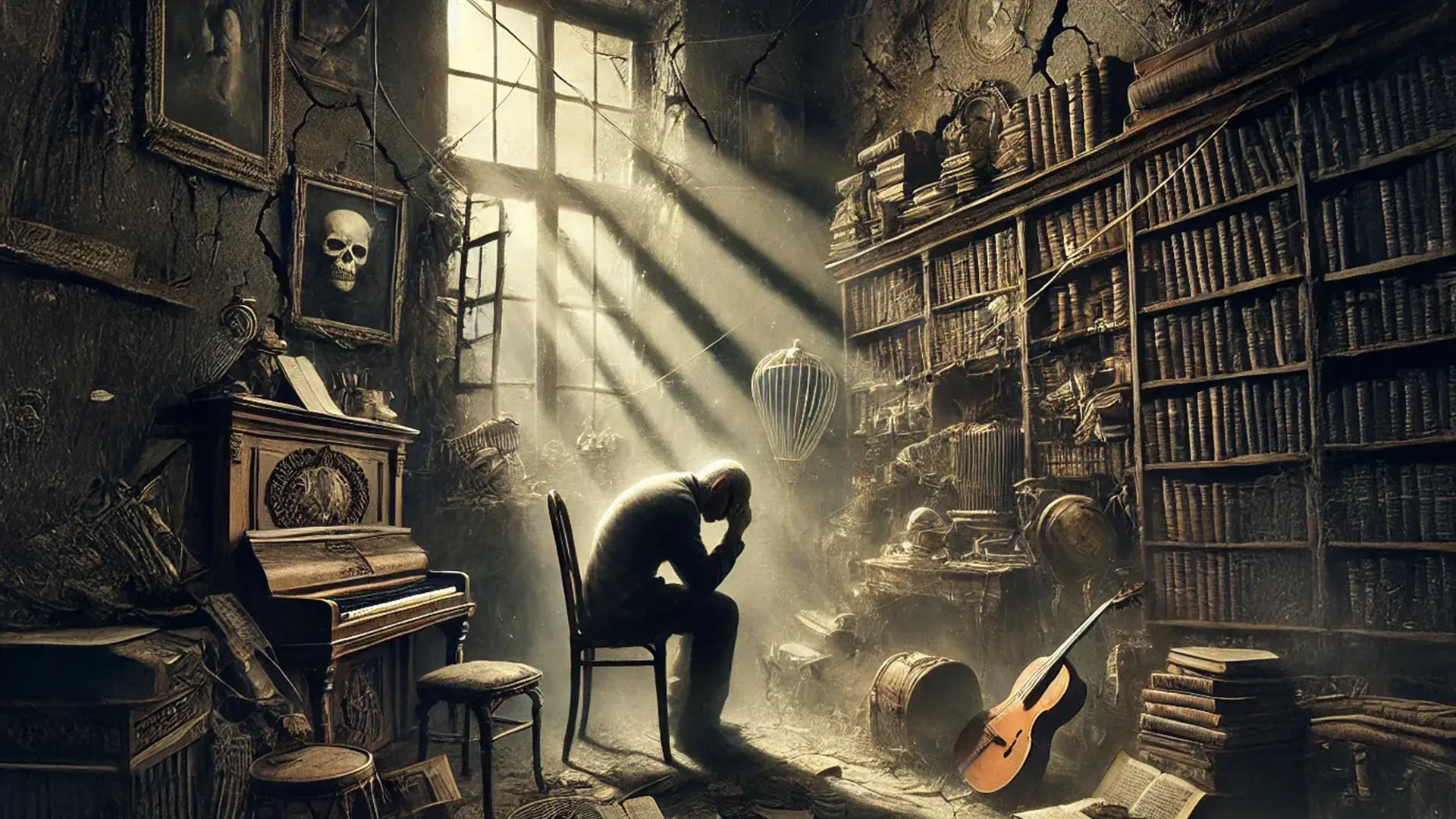
Silence in The Fall of the House of Usher is usually treated as atmosphere. The house is quiet. The corridors are hushed. The characters speak softly. The stillness feels oppressive, funereal, Gothic.
But silence in this story is not merely a mood. It is an instrument.
Poe uses silence strategically—to conceal motive, to defer responsibility, and, most importantly, to allow certain characters to benefit while appearing passive.
The question Poe keeps pressing is not why no one spoke, but who gained by not speaking.
Silence Is Never Neutral
Throughout the story, crucial moments pass without objection.
- The narrator does not question why he is summoned after years of distance.
- He does not ask why Madeline disappears from view.
- He does not challenge the logic of the sealed vault.
- He does not act on the sounds he hears.
Each silence preserves order. Each silence prevents confrontation. Each silence allows events to proceed smoothly—until they cannot.
Silence, here, is not absence. It is alignment.
The Narrator’s Convenience
The narrator frames his presence as reluctant and dutiful. He insists he had “no room for hesitation.” But Poe gives us enough detail to doubt that framing.
He knew little of Usher as an adult. The family line was ancient, wealthy, and failing. Madeline’s death removes the last visible continuation of that line.
Poe never states motive outright. He does not need to. Silence does the work.
The narrator’s calm cooperation allows him to remain:
- a guest, not a suspect
- a helper, not a decision-maker
- a witness, not an accomplice
Silence preserves his innocence—on the surface.
Roderick’s Silence as Control
Roderick’s silence is different. It is not passive; it is deliberate.
He hears Madeline. He recognizes the sounds. He understands their meaning. And he waits.
Why?
Because silence allows him to delay reckoning. As long as he does not speak, he does not have to act. As long as he does not act, the consequences remain suspended.
Roderick’s silence benefits him psychologically. It allows him to endure what he cannot face.
The Shared Advantage of Not Naming
What Poe constructs is not a villain and a victim, but a shared economy of silence.
- Roderick avoids guilt by delaying acknowledgment.
- The narrator avoids responsibility by accepting explanations.
Neither must act as long as nothing is spoken plainly.
Silence keeps the system intact.
When Silence Breaks
The story’s climax is not Madeline’s return. It is Roderick’s confession.
“We have put her living in the tomb!”
This sentence arrives too late. It names what silence has already made irreversible.
Speech without timing is confession without redemption.
The moment silence breaks, benefit collapses. The house follows.
Why the Narrator Leaves So Quickly
Once silence is no longer possible, the narrator departs immediately. There is nothing left for him to gain by staying. The structure that protected him—politeness, patience, deference—has disintegrated.
His exit is swift because his investment has ended.
Poe does not describe grief. He describes flight.
Silence as Moral Strategy
Poe’s most unsettling suggestion is not that silence hides evil, but that it can enable ordinary self-interest.
No character needs to act maliciously. They only need to refrain from acting decisively.
Silence allows them to remain decent in their own eyes.
Why This Reading Matters
Many interpretations of Usher focus on madness, decay, or symbolism. All are present. But none explain why no one intervenes when intervention is still possible.
Motive answers that question.
Silence benefits those who prefer not to know too much, not to ask too much, and not to risk too much.
Poe forces us to ask whether silence is truly innocent—or simply profitable.
The Final Question Poe Leaves Us With
By the time the house falls, silence has done its work. No one is saved. No one is absolved. No explanation is sufficient.
Poe leaves us with a question that cannot be answered by psychology, symbolism, or atmosphere alone:
When silence protects you, what does it cost someone else?
That question is why The Fall of the House of Usher still matters. It is not a story about what went wrong.
It is a story about what was allowed.