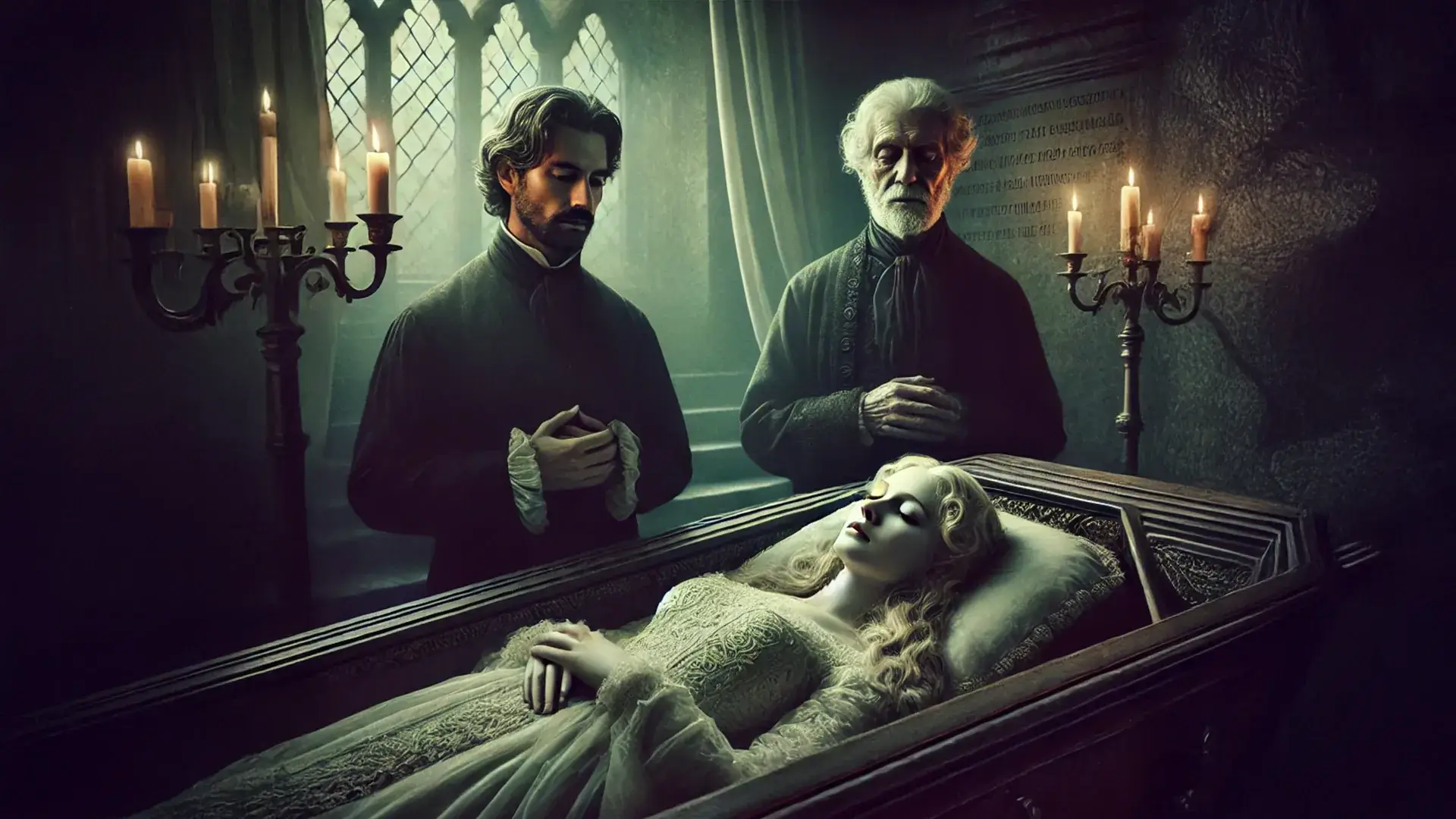
One of the quiet achievements of The Fall of the House of Usher is how long it refuses to become the story readers expect. Modern summaries rush toward the premature burial, the living corpse, the collapsing house. Poe does not. He delays. And that delay is not ornamental. It is ethical.
The story’s true horror unfolds not in a moment of shock, but in the long middle—where nothing decisive happens, and everything that matters still could.
Poe’s Most Important Choice Is Temporal
Poe structures Usher around postponement. After Madeline’s “death,” the narrative does not accelerate. It slows. The burial is described as temporary. The entombment is described as precautionary. Time stretches. Two weeks are mentioned. Days pass. Nights are sleepless.
This matters because delay preserves possibility.
As long as time remains open, action remains possible. Poe ensures we feel that openness. The vault is beneath the narrator’s bedroom. Sounds travel upward. The house listens before it collapses.
Horror is postponed so that responsibility can mature.
Delay as Moral Space
In many Gothic stories, terror arrives suddenly. Fate descends. Characters are overwhelmed. Poe refuses that structure here.
Instead, Usher creates what might be called moral space—a span of time in which characters know enough to act but choose not to. The delay is not ignorance. It is hesitation. It is rationalization. It is endurance disguised as patience.
This is why illness explanations feel insufficient. Illness may explain the initial confusion, but delay explains the crime.
Parentheses as Temporal Brakes
Poe repeatedly interrupts forward motion with parentheses. These insertions do more than clarify; they slow the reader down. They model hesitation.
(so he told me)
(as I have previously hinted)
(for I felt that I should sleep no more during the night)
Each parenthetical pauses the narrative. Each creates distance between event and acknowledgment. Poe turns grammar into moral rhythm.
Delay is not just what the characters do. It is how the story breathes.
The Sounds That Take Too Long to Matter
When Roderick finally confesses that he has heard Madeline moving in her coffin, the revelation lands with force precisely because of how long it has been withheld.
He has heard her:
- for minutes
- for hours
- for days
The repetition is devastating. Delay has accumulated weight. By the time speech arrives, action is no longer possible.
This is the ethical trap Poe builds: speech without timing is indistinguishable from silence.
The Narrator’s Patience Is the Problem
The narrator prides himself on endurance. He stays. He observes. He reads aloud. He tries to soothe. All of this feels humane—until we notice that it substitutes for intervention.
Delay allows the narrator to tell himself a story: nothing has been proven yet. Poe exposes how often moral failure hides inside reasonable waiting.
The narrator leaves only when waiting has become pointless.
Why the House Falls When It Does
The house does not collapse when Madeline is entombed. It does not collapse when she struggles. It does not collapse when she climbs the stairs.
It collapses only after delay has exhausted every alternative.
By the time action finally occurs, it is no longer action. It is consequence.
The fall is not supernatural punishment. It is temporal accounting.
What Poe Is Teaching the Reader
Poe forces us to sit in delay because that is where real moral life happens. Not in crisis, but in postponement. Not in shock, but in justification.
Most readers rush past this middle section to reach the horror. Poe insists we live there.
That insistence is the story.
Why This Still Matters
Modern readings often flatten Usher into atmosphere or illness. Both approaches skip the long middle where choices still matter. But Poe’s story is constructed precisely to make that middle unavoidable.
Delay is not neutral. It is a decision with a shape and a cost.
The Fall of the House of Usher endures because it asks a question that remains uncomfortable:
How long can you wait before waiting becomes a choice?