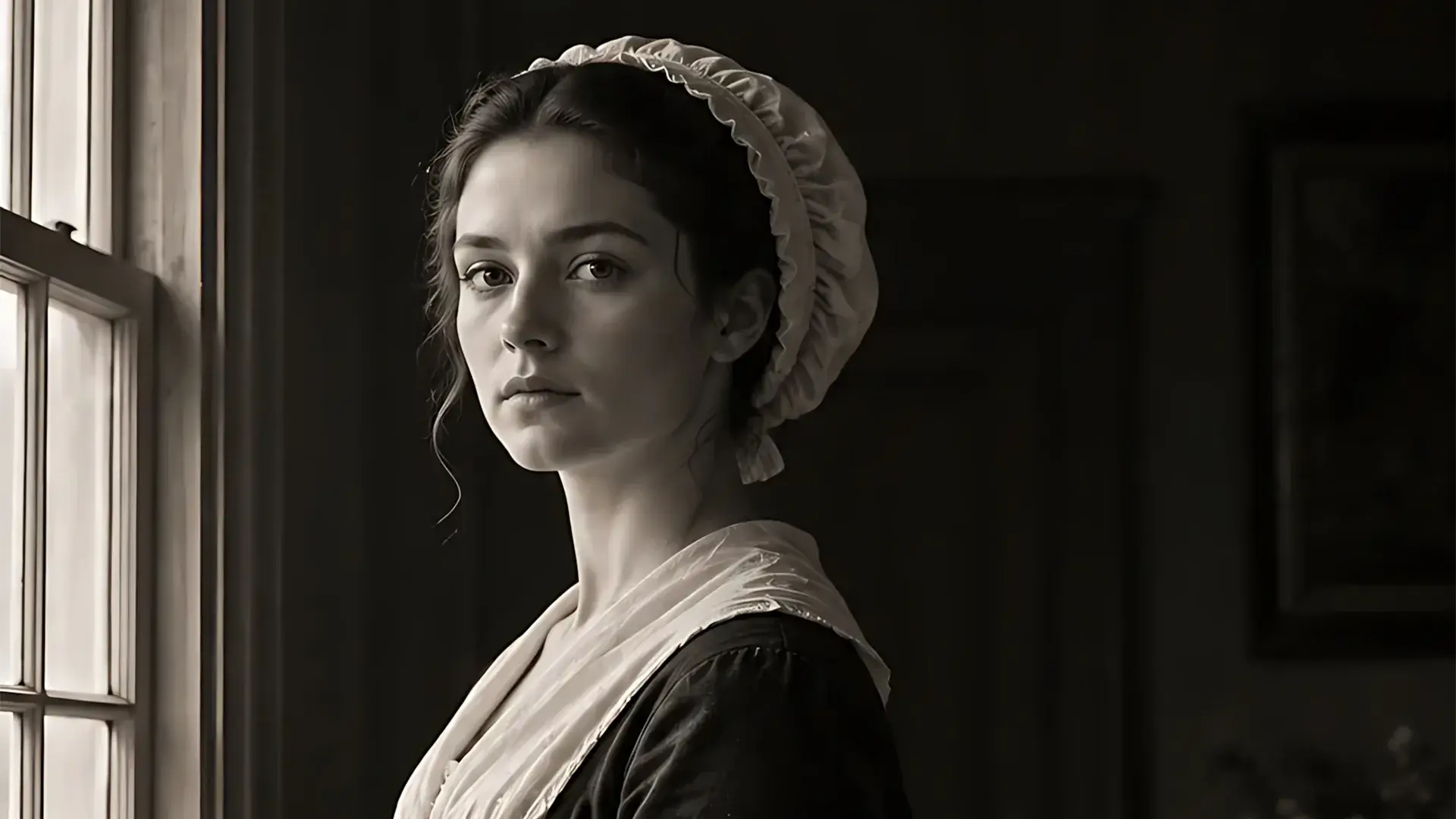
There’s one person in the village who isn’t afraid of the black veil, and she’s the one with actually the most to lose in The Minister’s Black Veil.
Elizabeth is Hooper’s fiancée, his plighted wife. While everyone else shrinks from the black crape, she looks at it and says, with a smile, that there is nothing terrible in it, “except that it hides a face that I am always glad to look on.”
That’s a tell. That’s love talking isn’t it? Then she asks for the simplest thing. “Come, good sir,” she says, and begs him to let the sunshine out from behind the cloud: lay aside the veil, then tell her why he put it on. She’s the only person with the courage to ask that question. The rest of the village sends a committee. Speculates. Imagines.
Hooper’s answer isn’t what she wanted.
“There is an hour to come,” he says, “when all of us shall cast aside our veils.” What the heck doesn’t that mean
She tells him his words are a mystery, so take away the veil. And for the first time he calls her by name: “Elizabeth, I will, so far as my vow may suffer me.” Then comes the vow: the veil is a type and a symbol. No mortal eye will see it withdrawn. It must separate him from the world, and even she can never come behind it.
So the veil is connected to some vow he took. Do you know what a vow is? ? A vow is a solemn and sac red promise or pledge to do something or to behave in a specific way. Usually, vows are serious things.
She tries everything. She begs him to lift it for the sake of his holy office. She argues. She cries. And then, in an instant, one feeling replaces another. She stares at the veil, and its terrors fall around her like a sudden twilight. She stands trembling before him, and he asks, mournfully, whether she feels it now, at last. She covers her eyes and turns to leave.
What is “it?” Before we discuss that, note what follows is the most human moment in the story. Hooper catches her arm. “O! you know not how lonely I am, and how frightened to be alone behind my black veil. Do not leave me in this miserable obscurity forever.”
Think about that. The man who frightened a whole village is begging not to be alone. She asks for one thing: lift the veil once and look at me in the face. “Never!” he says. “It cannot be!” She says,“Then farewell.”
And Hooper smiles, even through his grief, at the thought that only a material emblem has separated him from his happiness.
Do you think this is silly?
Do you think that people don’t act this way, and certainly not over a piece of cloth?
Have you looked at the divorce rate? All sorts of things come between people, and not just black veils. Pride. Secrets. Silence. Something that was never said. It’s very easy to let a material thing stand between two people who love each other. And don’t forget: these two aren’t married yet.
Elizabeth never marries him. But she never leaves him either. She’s there at the end, caring for him at his deathbed, faithful the way Penelope was faithful to Odysseus.
That’s a love that is sustained somehow. Nietzsche the philosopher wrote, in Thus Spoke Zarathustra that to be loved by overflowing hearts, “you must understand how to be a sponge.”
It isn’t easy to be a sponge. It means taking in what someone gives you without demanding they be something else. Elizabeth tried. In the end, even she couldn’t get behind the veil.
Which raises the question this story keeps asking: is there something between you and the people you love? What the heck was that veil really hiding? Or, was it hiding anything at all but what was in the minds of people who looked at it!! Hint: ask yourself who puts the meaning on the veil: Hooper, or the people looking at it? Maybe both?
Read The Minister’s Black Veil with Jimmy, and think about this.